

Fred Carlton is the owner and operator of Los Angeles–based design team Nerdmatics – specialising in advanced music performance systems, and audio and Midi software development – has chosen DirectOut for complex playback rigs for high-end touring.
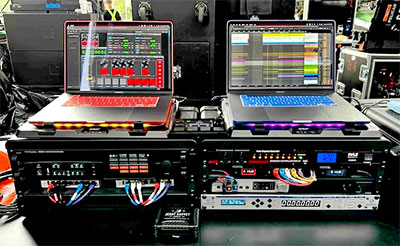
Also a partner at ASAP Sound, a collective providing turnkey solutions for entertainment applications worldwide, Carlton’s playback systems previously required multiple devices from different manufacturers, resulting in complex and fragmented workflows. With DirectOut Smart Audio Platforms, he is replacing this multi-vendor approach with a unified, integrated platform that consolidates multiple mission-critical functionalities within a single, failsafe device.
 Starting out as a musician, Carlton’s career evolved into the technical side of music production. After building guitars for Fender, a chance encounter led him on tour as a guitar technician with 30 Seconds to Mars, an experience that would shape his entire professional path.
‘For 30 Seconds to Mars, the demand on technology was huge; it pushed me to become better quickly,’ he says. ‘Their playback system had to be completely adaptable, it wasn’t just hit play on a click track and forget, we were jumping and looping, so I became proficient very quickly.’
When the tour came to an end, Carlton founded Nerdmatics, launching the company that would later support artists across a wide range of genres. By 2014, he was working with Linkin Park, and soon his client list expanded to include Maluma, Becky G, Drake and Kendrick Lamar, among many others. Despite the diversity of artists and productions, one element has remained constant across his systems: DirectOut. The platform provides the stability and flexibility required to build playback rigs that can respond dynamically to live performance, rather than locking artists into predetermined structures.
‘Most big pop shows now are completely locked in; every show is exactly the same, even the interaction with the audience. When you’re dealing with automation for moving stages, or pyrotechnics, it’s dangerous to have the artist in control, but for music and lighting, it doesn’t have to be that way,’ he continues. ‘The desire for spontaneous live music, a shared singular experience that can’t be anticipated, is really exciting and it’s entirely possible to combine that with playback if you have the right set-up.’
Finding the right set-up has been an ongoing process of refinement. A major turning point came in 2018, when Carlton was tasked with designing a system for a stadium show for Riot Games. Searching for a solution that could meet the scale and reliability demands of the project, he discovered DirectOut’s Prodigy.MC.
‘When I built these systems in the past, I would probably be combining six or seven companies, I was basically a system integrator,’ he says. ‘It wasn’t easy because if there was an issue and I had to call support, and each brand would blame the next. Then DirectOut arrived and it was the first all in one system. I now have a built-in switcher, multiple styles of format and network protocol – Dante, Madi, Ravenna, Soundgrid – and they’re all compatible.’
A key advantage for Carlton is the modular architecture of the Prodigy Series – what began with a single Prodigy.MC configured with a Dante card and analogie backup quickly grew into a long-term collaboration. Today, DirectOut forms the backbone of many Nerdmatics systems, including a recent installation for Illenium at the Sphere: a 128 channel redundant audio system built around two Dual Network Dante.Dante SRC.IO cards.
Thanks to the dedicated globcon user interface, global system control can be managed by a single operator and even accessed remotely when needed, enabling ongoing support regardless of physical location.
By keeping audio routing and channel management within DirectOut devices, while handling musical elements through a flexible Midi based workflow, Carlton maintains a system that feels musical rather than mechanical. This approach preserves spontaneity for the artist, while still providing the reliability and structure required by the wider production team.
‘I like to use Ableton in rehearsals, we use Midi locators to keep things fluid,’ he says. ‘I can hit play and everyone’s machines will follow, but if something changes, I can just send new locator files to everyone. It’s much more efficient than bouncing files after a long day, it’s not just audio tracks and waveforms. DirectOut delivers sample rate conversion and fail over redundancy, while Midi control allows artists to move freely through their set, enabling them to react to the live audience and cater their set to their wants and needs.’
Through platforms like Patreon, Carlton actively shares his system designs, helping others understand how a DirectOut powered approach can support creativity rather than constrain it. For him, a robust playback system does not need to be rigid or overly technical; it can be expressive, adaptive and responsive.
‘The modular part of my DirectOut systems is super important because people change their minds last minute. By using Prodigy Series solutions, I can build a system that is maxed out, so I can be asked for anything and it’s not a problem,’ he says. ‘Prodigy has done the hard work with its DSP so you can run with every single slot filled and everything happening at once, or you can run a simplified version and it’s happy. That flexibility makes a world of difference.’