

Now the largest evangelical church in Romania, Biserica Penticostală nr. 1 selected Outline to address the unusual geometry of newly completed 3,600-seat sanctuary in Vicovu de Sus.
The space is hexagonal in plan, with its widest section (40m across) sitting immediately in front of the stage. With wall and ceiling treatment, complemented by bass traps installed under every balcony soffit, having already produced a controlled acoustic environment, the installation was designed and delivered by QuattroSound.
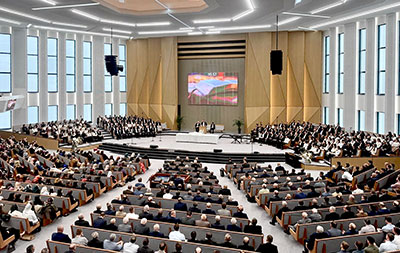 Against this backdrop, the loudspeaker system had to satisfy a tight set of aesthetic and operational constraints – no subwoofers at all, neither flown nor floor-standing; a minimal visual footprint to match the venue’s all-white interior; an extended low end down to 60Hz, ideally 50Hz, to support the bass instrument in the orchestra; and ease of operation in a town of around 15,000 inhabitants where qualified audio engineers are a scarce commodity.
A further challenge came from the stage itself. A 200-voice choir and an 80-piece orchestra are positioned on stage, facing each other across a wide gap, with a very high count of open condenser microphones and no in-ear monitoring. They need to hear every instrument and voice clearly, and they must follow the pulpit and the entire service from their fixed positions.
The central area of the stage also hosts smaller groups with guitars, accordions and similar instruments, so the 300 people seated in the choir and orchestra zone must hear what the audience hears. In this scenario, Superfly’s SART (Side Acoustic Rejection Technology) plays a key role – containing rear emission, the system keeps the stage area free of unwanted low-frequency energy.
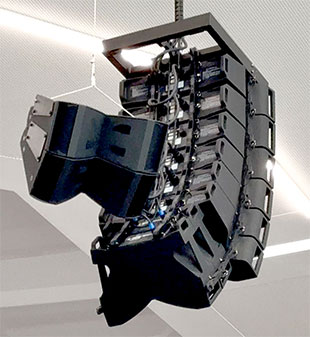 System design was supported by acoustic simulations carried out in Outline OpenArray 2. The final configuration is an full-range LR configuration without subwoofers. Each side comprises six Superfly modules and two Mantas 28 down fills, the latter delivering 120° of horizontal coverage; four ultra-compact Vegas 24 cover the first rows as front fills. Behind the main clusters, two Scala 90 enclosures per side are flown at approximately 7.5m to serve choir and orchestra. Amplification is provided by four TTM12K4 and three TTM8K4 units.
At 240mm in height for a 2x10-inch enclosure, the compact format of the Superfly cabinet was an additional factor in preserving the carefully designed aesthetics of the hall.
‘As soon as Pierfrancesco d’Aloisio, sales engineer at Outline, shared the Superfly technical specifications, I realised this was one of the very few line arrays – perhaps the only one – capable of meeting every requirement of this hexagonal hall,’ says QuattroSound owner, Lucian Galea. ‘The client’s directive on visual footprint was unequivocal. Other manufacturers we consulted insisted that at least three suspended clusters were technically mandatory, with more complex and visually invasive layouts. The simulations we ran in OpenArray 2 told a different story: an LR configuration would deliver coverage to every seat.
‘The brief on stage was demanding in its own way. With the choir and orchestra working entirely on open microphones and no in-ear monitoring, the system had to behave with discipline behind the line arrays. Superfly did exactly that, and the musicians were taken aback by the clarity and naturalness of the Scala 90 too, even at a flying height of around 7.5m.
‘The second challenge was to cover the stalls and the first balcony while leaving the second tier as a future expansion. The result took the client by surprise – speech intelligibility was remarkable even in the second tier, with minimal SPL falloff. For them sound was the aspect they were most concerned about, and it ended up being the most rewarding part of the entire project. Some of them had recently toured the largest American evangelical churches, and told me they had never heard “a sound like this” anywhere. They asked me to extend their thanks to Outline. This experience changed the way I think about line arrays and opens new directions for my future projects.’