

Britten-Norman has passed a milestone in its collaboration with World Mobile Stratospheric, with the BN2T-4S Islander aircraft now prepared for the next phase of 5G system integration. The aircraft is now ready for installation of the airborne 5G antenna system.
The installation of the advanced phased-array antenna system represents a complex integration challenge, supported by more than 100 individual engineering drawings produced by Britten-Norman’s Design Office. This work underpins the aircraft’s role as a platform for next-generation airborne connectivity and highlights the company’s in-house capability across structural analysis, systems integration and certification.
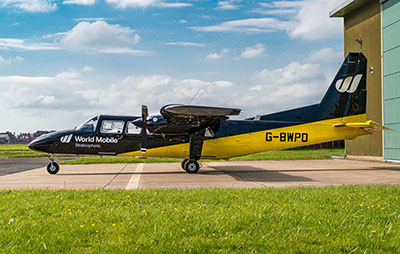 With preparation complete, installation is now underway at Britten-Norman’s Maintenance, Repair and Overhaul (MRO) facility in the UK, with test flights scheduled to commence in the summer. The programme continues to progress in line with initial expectations.
Once fully equipped, the aircraft will be used to validate how airborne, aircraft-based 5G systems can deliver real-time mobile connectivity. The programme is intended to demonstrate applications ranging from connecting remote and underserved communities to rapidly restoring communications in disaster-affected regions. Flight assessment will be conducted by Britten-Norman’s flight operations team in collaboration with World Mobile Stratospheric and in cooperation with BT at its Adastral Park R&D facility near Ipswich.
‘Reaching the installation phase is a significant milestone for the programme,’ says Mark Shipp at Britten-Norman. ‘The scale of the design effort reflects the complexity of integrating advanced communications systems onto the Islander platform and demonstrates the depth of engineering capability within Britten-Norman. We now look forward to progressing into flight assessment and validating the aircraft’s role in enabling airborne connectivity.’
‘We are very happy to have reached this important milestone in our joint work with Britten-Norman to deliver connectivity from the sky – both for disaster resilience using the Islander platform and, ultimately, for wider communications coverage from our future stratospheric aircraft,’ adds Richard Deakin, CEO of World Mobile Stratospheric. ‘Working with the highly capable and professional team at Britten-Norman has proven to be a real pleasure. Now we look forward to the next stage in this complex and important programme.’
The BN2T-4S’s endurance, payload capability and modular design make it well suited to advanced mission system integration, supporting programmes such as airborne connectivity and reinforcing the Islander’s role as a highly adaptable platform for specialist operations world.
More: https://britten-norman.com/britten-norman-products/islander