

The world renowned Metropolitan Museum of Art in New York City has upgraded its Grace Rainey Rogers Auditorium, simultaneously overcoming its long-standing acoustic challenges and providing a portable system for performances across the museum’s gallery spaces.
Opened in 1954 to showcase instruments from the Met’s collection without amplification, the 700-capacity auditorium has remained largely unchanged in appearance. The original Korina woodwork endures, as does the Steinway piano gifted by the company upon the venue’s opening.
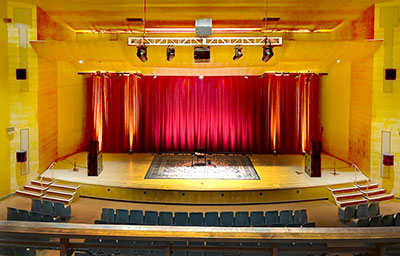 Writing in The Met’s own Bulletin upon its opening, Robert B Newman said: ‘The virtues of the Rogers Auditorium are inescapable and many. Its intimacy is warming. Its seats are built on the wise assumption that nature has not done the upholsterer’s work for him. Its sight lines are perfect and its acoustics so good that no amplifiers are needed, and a person talking in conversational tones on the stage can be heard with ease in the balcony’.
Yet, as the auditorium’s programming evolved, so too have its audio requirements. The legacy sound system – comprising early-generation column loudspeakers positioned on the left and right sides of the room – delivered severely uneven coverage, with significant gaps across both the floor and balcony. It was barely adequate for lectures and simply unsuitable for contemporary musical performances.
Sebastian Hurtado joined The Met as Senior Technical Manager AVMS Production, in 2024 and, as a seasoned audio engineer who has worked across multiple countries and throughout the US, the sound in the auditorium became an immediate focus. ‘I think I identified the need for an upgrade within three days of arriving,’ he recalls.
Once a business case had been authorised and budgetary approval came, Hurtado’s brief was clear: replace the legacy system with a one capable of handling everything from intimate lectures to full live bands while preserving the visual and architectural integrity of the space.
After consulting with several top-tier manufacturers, Hurtado and his team selected Martin Audio, citing both the product fit and the quality of communication with the company throughout the process. ‘We sent an initial concept, and they mapped it out and made recommendations,’ he says. ‘It made us feel confident it was being done correctly.’
The resulting installed system is anchored by three Torus Series T1230 and a T1215 constant curvature array element, configured as a centre cluster and rigged from a truss at the front of the stage. ‘We didn’t want to change the essence of the space, and with no positions possible to hang an LR line array, we realised a centre cluster was the way to go,’ Hurtado says. ‘It covers the lower and upper centre of the house incredibly well. Even without subwoofers, the low end from the Torus 12s is substantial for video playback and presentations.’
Four FlexPoint FP12 point-source loudspeakers are positioned to fill coverage gaps, while four time-delayed FP6 loudspeakers address the notoriously difficult under-balcony zone. ‘The FP6s have provided one of the biggest improvements,’ Hurtado notes. ‘They sound fantastic and are delayed so well that it almost seems like they’re not doing anything, which is perfect.’
For larger performances, a groundstacked system comprising three-per-side Torus T820 tops and two-per-side SXC115 cardioid subwoofers, is designed to handle any production required in the space. Ten LE100 stage monitors round out the rig: ‘We’ve had guest engineers ask what they were because they want some; they sound great with minimal processing,’ Hurtado reports.
‘The response has been noticeable by everyone,’ he continues. ‘The even coverage is the most significant improvement; there’s not a dead spot in the entire room. And we have the full frequency range represented with incredible clarity and fullness. Whether it’s a lecture that keeps the audience engaged, or a full band with brass and strings, everything is represented properly.’
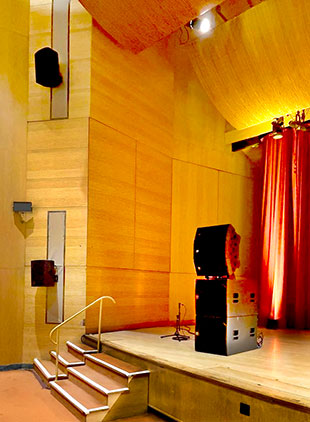 A key aspect of the system is its modularity and the ability to deploy elements of the system in other areas. The groundstacked system doubles as a portable rig for events and performances throughout the museum, allowing The Met to bring consistent, high-quality audio to spaces as acoustically challenging as the all-glass, hard-surfaced Engelhard Court.
‘The challenge in many of our rooms, especially with speaking, is intelligibility. But with the Martin Audio system, we’re able to overcome it,’ Hurtado says. ‘Its flexibility means we can deploy optimum systems for each event – that may be three tops and two subs per side, or a more distributed system.’
The subs have proved particularly successful: ‘They work remarkably well,’ Hurtado says. ‘You can stand right behind them and not feel a thing. In a big echo chamber like this museum, having subs fire in only one direction really helps.’
The system was purchased through dealer ADI, who also handled amplifier programming and final tuning. Physical installation – including routing cables through the building’s complex, century-old infrastructure – was carried out by Hurtado and his in-house team. A helpful discovery during the process: the mounting locations for the FP12s sat behind fabric-covered plywood panels concealing former pipe organ openings, which served as convenient cable pathways.
‘We worked through a number of design options with Sebastian as we considered all possible use case scenarios and the best way for the museum to get the most bang for their buck,’ says Martin Audio USA Regional Sales Manager, Martha Callaghan. ‘It’s incredibly gratifying to see this work come to fruition. It’s a gorgeous venue, with important work to do, and the combo of Torus and FlexPoint makes sure that work is coherent and delivered with pristine articulation and clarity. I am looking forward to our ongoing collaboration with The Met and the team.’
Perhaps most tellingly, the upgrade has changed the way the institution programmes its spaces. ‘It has prompted programmers to start doing more events in the auditorium,’ Hurtado concludes. ‘Before, they preferred the galleries because the auditorium infrastructure wasn’t great. Now, our spec is much more rider-friendly, and we don’t have to rent outside gear.’
More: https://martin-audio.com