

The University of Oxford has unveiled its Stephen A Schwarzman Centre for the Humanities, home to seven faculties, institutes and research centres including the Faculty of Music’s three music studios – one featuring a Harrison 32Classic 32-channel analogue mixing console serving various music venues and rehearsal spaces over the building’s Dante network.
‘Studio Three is a traditional recording studio,’ Schwarzman Centre Studio Manager, Daniel Hulme, elaborates. ‘As well as more experimental and electronic compositional work, we teach students the traditional ways of making music in the recording studio, with small- to medium-sized ensembles performing in a room together.’
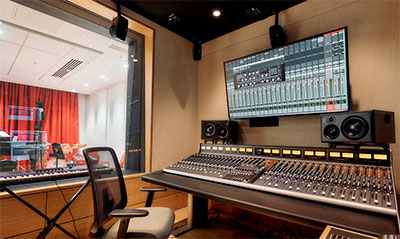 The studio has an associated performance space, the Ensemble Room, plus four smaller practice spaces which all tie via the network into the Harrison, which features 64 bi-directional channels of Dante and premium A/D and D/A converters.
‘The Harrison gives us connectivity between all those spaces in that immediate area, so you can really capture a good-sized ensemble with separation,’ Hulme says.
Investigating his console options, Hulme recognised that the Harrison’s operation would be easy for the students to grasp. ‘They’re not technicians, they’re not engineering students – they’re musicians. It’s not an engineering course; it’s a creative practice course. So, the workflow of the Harrison was perfect, in that it’s a relatively simple, open architecture. Some other products are more geared towards tech-heavy engineering, and have multiple layers; there’s lots of stuff that could be overwhelming for a music student. There are no hidden layers to the Harrison. It’s all there to see. The 32Classic has the right balance of function, form, and sound. That really appealed to me.’
The 32Classic’s Dante workflow also lends itself to the students’ needs, enabling them to tap into the network of the arts and humanities building. ‘The functionality with the Dante integration means that there’s a really simple workflow that we can create for the students. It’s one-to-one from the live room into the console and one-to-one from the console into the DAW. It’s an easy thing to teach and for students to understand. They get good results quickly, and we can move through the curriculum quickly.’
Beyond the immediate music studio and live room ecosystem, the Dante network also serves the 500-seat Sohmen Concert Hall and 120-capacity Black Box Performance Lab, in addition to the Ensemble Room, allowing live performances to be recorded. ‘The concert hall is pin-drop quiet and has a beautiful, variable acoustic, and there’s a multitude of concealed microphone ties and various other connectivity to connect back to the studios,’ Hulme says.
‘We are excited to be part of the audio infrastructure at the University of Oxford’s new multi-studio facility,’ says Audinate CMO, Joshua Rush. ‘Dante was built to make audio routing as flexible as creativity itself, and this project is a perfect example of what’s possible when a whole building shares one network. By connecting studios, rehearsal spaces, and performance venues to a common Dante backbone, the Faculty of Music can capture performances wherever they happen quickly, reliably, and at the highest quality.’
The Schwarzman Centre is open to the public, and in April the university will begin presenting concerts and other performance events here. The music studios will also be available for third-party hire. ‘When we commercialise, the Harrison will appeal to visiting artists and professionals,’ Hulme says. ‘I learned very early on that a little bit of analogue saturation goes a long way. It’s a tiny, additive thing, but it really does make a big difference. The Harrison has it in spades – it’s a great sounding board.’
The Dolby Atmos 9.1.4 Studio One and Studio Two – an immersive compositional space that can be configured to handle multiple immersive formats including NHK’s 22.2, Dolby Atmos, Sony 360 Reality Audio and Ambisonics – have been equipped with Dante interfaces. All three studios were acoustically designed by Level Acoustics. Since the 32Classic can monitor a 12-channel-wide surround source from the Dante interface, Hulme has been contemplating a workflow that could allow students to record with an immersive format in mind and even monitor a project through Studio One’s Dolby Atmos speaker system. ‘That’s an area of research that I’m focused on very much,’ he says.
Starting out in the music business as a teenager, Hulme cut his teeth working at Suite 16, a prolific all-analogue recording studio co-owned by New Order’s Peter Hook in the north of England, before moving on to a successful freelance career and eventually running studios in London and Liverpool. ‘That’s where I learned about collaboration and communication, and capturing great artistry, all those necessary tools to become a good producer and engineer,’ he says. ‘Those tools have really stood me in good stead for much of my career.’
Because of these early experiences, Hulme already knew what he wanted as planning began for the Schwarzman Centre’s new music studios – and Studio Three in particular.
‘I wanted an analogue console,’ he says. ‘There’s a view to the future of music production here and what that might mean. We are very invested in exploring immersive technologies and workflows creatively; but let’s not forget about the past and where we’ve come from. If you’ve got good foldback and you can combine things together in an easy and immediate way, and it sounds fantastic without you having to do too much, your in a good place creatively. That makes things more fluid, and the whole production process happen quicker. I think a good analogue console uniquely brings that to the table.’