

Czech-based production company CS live has equipped its newest OB van with an integrated Riedel infrastructure, combining MediorNet media networking, the hi human interface control system and Artist intercom with Bolero wireless communications. Delivered in collaboration with system integrator Smart Informatics, the installation provides a highly flexible and future-ready production infrastructure.
Designed primarily for high-profile sports productions, the new OB vehicle supports coverage of national football and hockey leagues, international football competitions, and large-scale MMA events. The system architecture centres on the close integration of MediorNet’s distributed signal network with the hi control platform, enabling operators to manage infrastructure and production workflows through a unified operational interface.
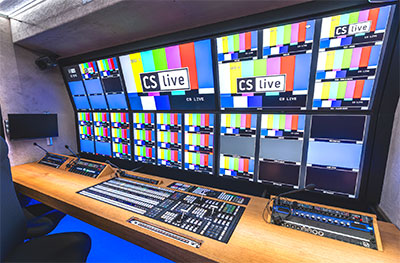 ‘Deploying hi in this OB van is a major step forward for our production workflows,’ says CS live CEO, Pavel Braun. ‘It allows us to manage routing, production switchers, audio consoles and other systems from a single interface – and even operate the system from a tablet when needed. That central control gives us the flexibility and speed we need for demanding sports productions.’
The OB van’s signal backbone is based on 12 MediorNet MicroN UHD nodes, with seven dedicated to signal routing and five configured as multiviewers. The distributed architecture allows signals to be transported, processed and monitored directly within the network while maintaining the flexibility required for modern OB production environments. CS live also uses two MicroN Standard nodes as external stageboxes to link signals from stadiums, studios, or other OB vans, enabling SDI, Madi and Ethernet transport over a single fibre connection. MediorNet also provides the production company with a practical migration path as production technologies evolve. While CS live’s current workflows rely on baseband infrastructure, the system keeps the OB ready for a gradual transition toward IP-based production in the future.
On top of this infrastructure sits Riedel’s hi human interface control system, which serves as the operational control layer for the truck. This enables operators to control multiple production systems from a single interface, providing centralised access to routing, device control and facility functions. In the van, hi integrates and controls broadcast equipment from multiple manufacturers, including third-party audio consoles, production switchers, replay servers, monitoring systems, facility GPI triggers and on-air lights. The deployment includes five hiPush18 panels, one hiPush32 Shading panel, one hiPush36 panel and three hiContact panels, along with tablet-based control for additional operational flexibility.
‘This project marks the first deployment of Riedel’s hi human interface control system in the Czech Republic,’ says Smart Informatics MD, Tomas Vesely. ‘We have been partnering with Riedel for many years, and that close cooperation was key in bringing hi into this OB environment. Together with CS live and Riedel, we were able to successfully introduce the system and deliver a highly integrated vendor-agnostic control platform for the truck.’
Communications inside the OB van are powered by Riedel’s Artist intercom platform, built around an Artist-1024 ecosystem with 17 RSP-1216HL SmartPanels, three RSP-1232HL SmartPanels and two DSP-2312 Desktop SmartPanels. Wireless communication is provided by Riedel’s Bolero wireless intercom, using four antennas and 12 beltpacks to ensure reliable coverage across production positions.
‘MediorNet provides the distributed media backbone, Artist delivers reliable communications, and hi adds the operational control layer on top,’ Riedel Communications Regional Sales Manager, says Ismet Bozkurt. ‘Together, these systems enable customers to manage complex multi-vendor production environments through intuitive interfaces while maintaining the flexibility of a decentralised signal network. At the same time, MediorNet enables them to support their current baseband workflows while providing a clear path toward IP-based production in the future.’
More: www.riedel.net