

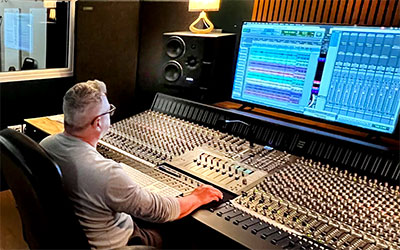
Sound designer and mixer Richard Brooker and Leos Strings’ director Rachel Shakespeare have upgraded their West Midlands Brookspeare Music studio with a Solid State Logic Origin 32-channel analogue mixing console and UF8 eight-channel DAW controller. The studio specialises in remote string recording sessions for TV, film and games.
Brooker, a 35-year-plus veteran of the business, was previously using a DAW control surface at the studio: ‘I feel like everything is in front of me with the Origin,’ he reports. ‘It works so well as a traditional analogue console, but it also fits perfectly into a modern DAW-controlled studio, especially with the UF8 controller.’
 The lion’s share of the studio’s work involves composers worldwide. Some listen in and view the sessions remotely, while others send the score and a demo. But where typically in commercial recording there is a three-hour minimum for a session, Brookespeare Music has an alternative.
‘We book the musicians for a day and then we sell slots, so composers just pay for an hour of the studio and the musicians’ time,’ Brooker explains. ‘We get a full day of work, the musicians all get paid properly, and the composers don’t have to shell out for time they don’t need.’
Brooker has recorded a diverse assortment of instruments and voices at Brookspeare Music. ‘We’ve done vocals and dialogue recordings. I’ve had a drum kit in there. I’ve had bands in there. We’ve had brass, woodwinds and a harp. So it’s not only strings.’
Whatever he is recording, sources go through the Origin’s PureDrive mic preamps. ‘I can either have a transparent, beautiful, crystal-clear, uncoloured sound, or I can dial in some drive,’ he says. ‘Everything then goes directly out into Pro Tools through my converters. Then I have the option of either bringing it back into the console’s stereo groups, putting it through the bus compressor and printing it that way, or I can just lay the whole thing out as individual tracks.’
With the release of the SSL’s Origin Evo, Brooker is considering swapping out some of his modules for the Evo version, which incorporates SSL’s E Series dynamics section. If he wants to go outside the console to add colour, he has an SSL Fusion ‘that I use quite a lot’, and is about to invest in SSL’s The Bus+ compressor.
Top of Brooker’s wish list when considering moving to an analogue console from a DAW controller was summing: ‘Everything coming together is never going to sound the way it does through analogue, and particularly through an SSL. There’s an SSL sound, and that is something that is worth every penny. So I wanted to have SSL circuitry, and I wanted to have a real SSL bus compressor.’
Another advantage to having a large-format console in the control room is in perception of the studio. ‘I think it has upped our game,’ he says. ‘People look at our website, see the Origin and think, “that’s a proper studio”, and when anyone walks into the studio, there’s a little bit of an intake of breath. I think people don’t expect smaller studios to have a console of that size and quality anymore.
‘I feel inspired to work when I sit behind it,’ he adds. ‘Plus, it goes without saying – but I am going to say it – there’s the sound. I love the way SSL consoles sound, and what they bring to a mix, especially the bus compressor.’
More: www.solidstatelogic.com