

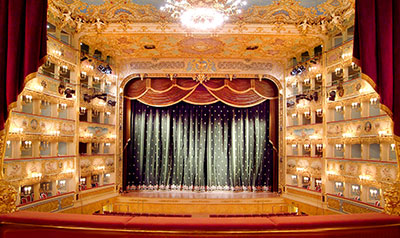
Mong the world’s most prestigious opera houses, the Teatro La Fenice has suffered two disastrous fires, each time being rebuilt to its former glory. Recently its Yamaha PM1D digital console has been replaced by a Rivage PM5 bring its recording facilities – and those of its older sister, Teatro Malibran – up to date.
Founded in 1792 and located in Venice’s San Marco district, with the smaller Teatro Malibran, founded in 1678, seeing a Rivage PM5 replace an analogue console. Although the Yamaha PM1D was still working, the Rivage PM5 system is a major step forward in terms of technology and flexibility.
‘We are committed to the highest possible recording quality, through careful microphone placement, in-depth musical and technical study of the opera, our expertise, live listening to our productions and critical playback evaluation of the results,’ says Teatro La Fenice audiovisual department head, Michele Benetello.
 ‘At Teatro La Fenice, the need was for better microphone preamplifiers and to achieve a more detailed signal, to integrate the Dante protocol for recording and distribution, as well as to adopt a more modern and flexible workflow which includes plug-ins, reverbs, EQs and so on. At Teatro Malibran, it was about making the transition to a digital system and aligning the workflow across both studios.’
The Yamaha Italia technical team visited both venues, determining the best options, suggesting Rivage PM5 as the best combination of facilities, size of mixing surface and ease of use to satisfy both venues’ technical needs and being a significant step up from the previous systems. ‘Over time, we have built strong trust in the reliability of Yamaha products and the quality of the company’s technical support is always timely and knowledgeable, so the presence of the technical team made it possible to approach the project with complete confidence,’ Benetello says. ‘Yamaha products allowed us to manage this transition smoothly, creating an infrastructure which allows us to interface different environments using the Dante protocol and to control the surfaces remotely for system checks.
The installed system includes two CSR5 control surface and DSPRX processors, with four HY256TL TwinLane interface cards, along with two HY144DSRC interface cards, two MY8ADDA96 96kHz cards, two MY8AE96 96Hz cards, two AIC128D1 Dante accelerator cards and seven RY16MLSILK interface cards. Additioanlly, there are two RPIO622 I/O racks.
‘The installation brought a clear step forward - the audio results are superior to the past, the technologies have been updated and our workflow has been simplified and modernised, making operations smoother and faster.’
More: www.yamaha.com