

The recent celebration of Caribbean culture offered by Guadeloupe’s Cultural Weekend was served by a DiGiCo Quantum 225 console at front of house and an SD12 at monitors, both supplied by Sono Scène.
A well-established hire company, Sono Scène is owned by Maurice Cely, who mixed front of house for the weekend and has supported every festival since its first outing in 2013. Engineer Mikael ‘Benj’ Benjamin, a French sound engineer based in Guadeloupe, was monitor engineer and has also been involved with the event since its start.
‘The DiGiCo system was deployed with two D2-Racks acting as stage boxes, one dedicated to FOH and one to monitors,’ he says. ‘Given my years of experience of the event, my knowledge of traditional drums, local bands and artists, plus my familiarity with DiGiCo consoles, Maurice felt I was the right person for the job. Sono Scène has used DiGiCo consoles on this event for several years, and my prior DiGiCo training was an important factor in this collaboration.’
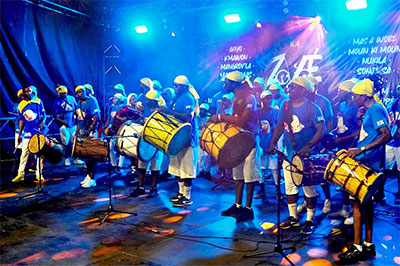 The event included Mouvement Mas K Klé, a musical collective based around Tanbou Mas drums and their associated family of instruments that hold a powerful significance in Guadeloupe culture. For the engineers, the Quantum 225 dynamic EQ of the was particularly useful for targeting the resonances of these drums, maintaining the sonic clarity of the mix.
‘The Quantum 225 handled the drums extremely well thanks to its flexibility, processing capability, and sound quality,’ Benjamin continues. ‘The Tambour basse generates strong low-frequency energy, while the Tambour contre basse creates low-mid frequency build-up and the Tambour chant occupies the higher frequency range. The Quantum dynamic EQ allowed us to target these frequency ranges very precisely, engaging only when defined thresholds were exceeded. This approach preserved the natural energy and character of the instruments while keeping the mix clean, controlled and musical, delivering precise sound shaping with excellent clarity and minimal background noise.’
‘On the SD12, features like Mute Groups via Macros and Copy To were essential for handling multiple performers and constant stage changes,’ he adds. ‘I also created a custom EQ preset bank, allowing fast recall of drum EQ settings and ensuring consistency across performances. A well-organised desk layout and consistent channel structure made it possible to manage very different musical dynamics smoothly.’
These features also came into their own for including last-minute guests. The weekend is an inclusive event that always involves the whole community, so making sure everyone can be seen and heard was key to the success of the 2026 event.
‘We chose not to use Snapshots,’ Benjamin elaborates. ‘Instead, we relied on a clear desk layout, a consistent channel structure, and real-time control, which made transitions faster and more predictable. In a cultural show context where additional musicians, especially percussion, can appear without being present during soundcheck, this workflow proved essential. The Copy To function was invaluable again, allowing us to quickly duplicate processing and routing to spare inputs when unexpected instruments were added, ensuring continuity without interrupting the flow of the show.
‘For the undecided, don’t be afraid to use, explore, and truly understand DiGiCo Products,’ he concludes. ‘The eco-system is extremely versatile, and the Quantum series offers outstanding flexibility for both FOH and monitor applications. DiGiCo consoles are clearly designed for real-world live production. Their routing, processing, and control capabilities allow engineers to adapt quickly to complex situations. Taking the time to learn and experiment with these tools directly improves workflow efficiency and overall show quality.’
More: www.digico.org