

Since joining Arxiduc Audio as Chief Engineer earlier this year, Tokihiko Tokuda has been responsible for the sound design and operation of the concert touring work that sits alongside the company’s sports, gaming and corporate events operations. Having first used Sennheiser products more than 20 years ago, he now finds them frequently requested and recently added the Digital 6000 Series to the Arxiduc Audio arsenal.
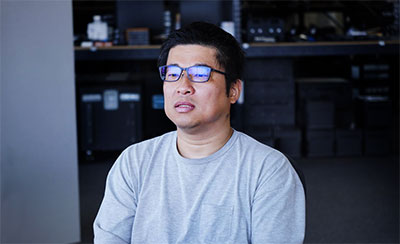 ‘I think it was a 3050 Series IEMs,’ he says of his first encounter. ‘I remember how amazing they sounded – it was the beginning of IEMs, and everything was groundbreaking.’
‘I strongly felt Tokihiko’s passion for Sennheiser when we demoed the 6000 Series to him,’ says Bestec Audio Sales Manager, Daiki Mori. ‘We look forward to seeing this trusted product being used on even more of his projects.’
Tokuda says that a major appeal of the 6000 Series to the Yokohama-based company is its stable connectivity: ‘The live shows I work on can sometimes attract audiences of more than 10,000, and the larger the venue, the more difficult it is to manage the RF. We are often impacted by signals from mobile devices and LED screens. Even in such challenging environments, the 6000 Series maintains a stable connection, so we have no concern whatsoever. Being able to scan with the receiver is also an advantage. There are surprisingly few manufacturers that allow direct scanning with the receiver, but it’s convenient because it eliminates the need for additional equipment.’
Tokuda cites the ‘proximity of the vocals’ as a major reason for choosing the 6000 Series: ‘I think the reason why the 6000 Series is used so often in the NFL Super Bowl halftime show is because vocal proximity is so important,’ he explains. ‘In the many live performances I work on, I often need to deliver the artist’s vocals more powerfully and clearly than in their recordings, so this sound quality is an essential element.
‘I think Sennheiser is extremely good at bringing vocals to the front of the mix. Increasing the volume to make vocals more audible is a common practice, but there is a difference between increasing the volume and bringing the sound to the forefront. Even if the volume is kept constant in the mix, due to the structure of the human brain if the sound “comes to the front”, we hear the sounds that are closer to us first. With Sennheiser, the sound naturally comes to the front, so there is no need to forcefully turn up the volume – achieving this presence is a breeze.’
Tokihiko works on a wide range of events, from rock concerts to Idol concerts and live hip-hop shows. Regardless of genre or size of venue, he frequently calls on the MMD 935-1 microphone capsule.
‘I’ve been using the wired e 935 for many years, so I chose a similar model, the MMD 935-1, as my main microphone capsule,’ he says. ‘Particularly when there are multiple musicians, I use the MMD 935-1 because it varies little both in terms of compatibility and overall balance. Depending on the characteristics of the artist, I sometimes use an MM 445 or MM 435.’
Tokuda says that the introduction of the 6000 Series to the Arxiduc inventory will broaden the range of applications the company can work on: ‘I’d like to try the SK 6212, a compact bodypack transmitter, with horn sections. During the 5200 series era, I always used the SK 5212 II P. When I attach microphones to the trumpets in the horn section, other manufacturers’ microphones are too large, and the artists have often complained that the size makes it difficult to play with them. Also, with trombones, the microphone body is secured in place with tape, but some musicians have pointed out that if it’s too heavy, it can affect posture during performance and the performance itself. That is why I’m thinking a compact, lightweight model would be ideal.’
He also has high expectations Sennheiser’s Spectera, the world’s first wideband bidirectional digital wireless ecosystem launched in 2024. ‘I think we can expect a great deal from the stability of the signal and ease of planning, and I’m keeping an eye on reports of projects it’s being used on so I can hear what other engineers think of it.’