

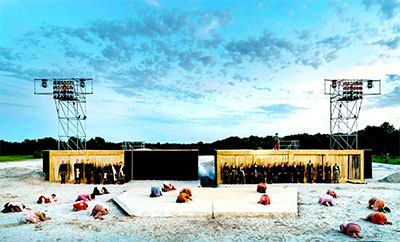
The Groningen open-air venue on the outskirts of Meerstad presents event organisers with an unwelcoming cocktail of wind and rain, and also ever-invasive sand. ‘No matter what you do, the sand just gets everywhere,’ says Kasper van der Spoel, responsible for the theatre’s RF equipment at the Zummerbühne Groningen (Groningen Summer Theatre) musical theatre premiere that was recently staged at the venue. Happily, the choice of Sennheiser’s Spectera wireless audio system proved up to the task.
‘When I heard that the new Sennheiser Spectera system was going to be used for Zummerbühne 2025, I was naturally delighted,’ says van der Spoel, taking on the production’s RF for the third time. ‘I was, of course, familiar with the name Spectera – rumours about WMAS technology had been flying around in the audio industry for some time – but it soon became clear that not everything that my colleagues were saying at the time had any real substance.’
 As full-service technical provider for Zummerbühne, AddLive took delivery of the Spectera systems. ‘I took the units home and put them through their paces for a whole week,’ van der Spoel says. ‘I also had the opportunity to work at Opera op de Parade in ’s-Hertogenbosch, where technical producer Marty Brugmans and equipment provider Unlimited Sound & Vision had three Spectera Base Stations and 90 SEK bodypacks in use – probably the most extensive practical application of the system so far.’
As monitor speakers were also being used, Zummerbühne primarily used the 49 SEK bodypacks as microphone transmitters. The bidirectional functionality with mic and IEM channels was used for the orchestra conductor and three instrumentalists (trombone, saxophone, bass clarinet) who needed to move around the stage.
The performers wore their bodypacks in pouches underneath their costumes, but ‘in spite of that, one of the beltpacks was bound to end up in the sand every now and then’, van der Spoel reports. ‘It was a particular problem for Matija Franješ, who portrayed Cerberus, the hound of Hades, a role in which he spent a lot of time rolling around in the sand, as it was with some of the dance and acrobatic performances. But these extremely difficult conditions didn’t impair the functionality of the SEK bodypacks in any way.’
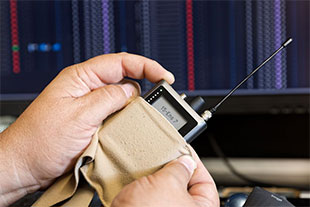
Even the Base Stations that were kept in a container were not spared the ubiquitous sand: ‘Although there was less sand around, it still managed to get into every nook and cranny of our production containers, which meant that I had to regularly clean the ventilation grids of the Spectera Base Stations,’ van der Spoel says. ‘When the performance season was over, I carefully opened both units to remove any sand that had got inside.’
 Van der Spoel also made extensive use of the ability to remotely configure the parameters of the SEK bodypacks using Spectera WebUI: ‘I determined the pre-amplification of the headworn microphones in close consultation with my FOH colleagues,’ he says. ‘All beltpacks were set to the same level, regardless of the individual user’s voice volume. For the mobile musicians, I defined a control range of -40dB to +3dB for their in-ear monitors. I also found it very helpful that the software lets you know if a plug is coming loose from its socket. At first, I had to get used to the fact that the potentiometer on the SEK beltpack doesn’t have a hardware-defined start or end point in its control range and can be infinitely rotated. But I actually haven’t had any problems with this at all.’
He mounted four DAD antennas at different heights and positions on each of the two lighting towers and connected to the Spectera Base Stations by Cat5e cables up to 50m long. ‘Signal transmission over Cat cables worked perfectly,’ he says. ‘I wired the antennas in such a way that each antenna on the left and right of the performance area was assigned to each of the 8MHz blocks of a Base Station.’
Spectera occupied four blocks with centre frequencies of 522, 554, 602 and 690MHz. ‘With all the possibilities that Spectera offers in the UHF band, I can work really well in the Netherlands,’ van der Spoel says. ‘Once you’ve done the frequency scan, you should always be able to arrange the 8MHz blocks sensibly in the spectrum, especially because there is no need to strictly observe the existing TV channels when you’re setting up the system. I’m particularly impressed by the fact that the audio channels in Spectera are very close together without causing any interference due to artefacts.’
He also noticed that the wireless equipment could be put into operation much more quickly than in previous years, when using wireless equipment from a different company. ‘Once the basic parameters have been defined, Spectera performs the other settings automatically and synchronises the SEK bodypacks that are assigned to the Base Station. That’s much more convenient.
‘I was able to save around a third of the time that I otherwise would have needed for setting up the equipment. A very useful feature is that the time-consuming job of marking each beltpack is eliminated, as the assigned user’s name is continuously shown on the e-ink display, even when the battery packs are removed.’
Invited to make a comparison with analogue IEM wireless systems, van der Spoel comments: ‘There’s a world of difference between conventional analogue wireless technology and the Sennheiser Spectera system. There’s no longer any noise, the sound is completely transparent and open – I can even notice it at my RF console when I’m monitoring the sound with my dynamic Sennheiser HD 25 headphones. I’m really happy with the sound, and so are the musicians. When our sound designer Jannes Noorman heard the sound transmitted by Spectera for the first time at the sand depot, he was immediately impressed. I’ve been working with Jannes for many years now, but I’ve seldom seen him with such a satisfied smile on his face as he had when he first listened to this system.’
To transmit the audio signals, van der Spoel selected the Live audio link mode for both mic and IEM channels. This uses Sennheiser’s proprietary SeDAC codec, which has a latency of only 1.6ms. ‘I have 49 SEK bodypacks in operation, and the same audio quality is available to all users,’ he says. ‘The fact that our audio signal flow is organised entirely digitally also has a positive effect on the overall sound – from the initial A/D conversion to the digital inputs of the power amplifiers, there are no longer any analogue intermediate steps. Everything operates with a 24-bit word width and a sampling rate of 96kHz.’
At the Groningen premiere, van der Spoel was supported by Sennheiser RF specialist Vincent Tilgenkamp and Business Development Manager Ivo Dousi. On Tilgenkamp’s advice, two A 1031-U passive omnidirectional antennas were added to the wireless set-up as the mobile musicians sometimes performed inside metal containers, which weakened the RF signal reception. The solution was to mount a Sennheiser A 1031-U on the outside of the container and place its counterpart inside, linking the two by a short coax cable. ‘Only an expert can come up with the idea of installing a passive pass-through like this,’ van der Spoel admits appreciatively.
 For Groningen, Jannes Noorman operated the FOH console for many of the shows and was also responsible for sound design alongside his colleague, Peter Zwart.
‘I didn’t have the opportunity before Groningen to gain any practical experience with the Spectera system and I was completely surprised during the first rehearsal at the venue – but in an extremely positive sense. The sound is simply impressive. Our leading actor, Marcel Hensema, looked at me during this rehearsal and asked, completely gobsmacked: “What the hell is that?”. Immediately afterwards, he wanted to find out more about the new system, as he might want to use it for his solo projects in the future.’
‘This first impression was definitely confirmed during the subsequent rehearsals and performances,’ he adds. ‘I needed to make far fewer adjustments to the individual microphone channels on the console EQ than I would have to do with some other wireless systems. And I’m happy to repeat: Spectera sounds fantastic, especially in combination with the internal floating-point signal processing in our mixing console and the optimum set-up of our PA system.
‘Although the system has only recently been launched, everything went absolutely smoothly, and I’m sure that future software updates will provide even more exciting features and improvements in details, he adds. ‘The audio quality of the Sennheiser Spectera system is flawless and far surpasses all other products that we have used for the Zummerbühne in recent years. The sound of Spectera has made a lasting impression on all of us here.’
More: www.sennheiser.com