

One memorable day in April 2019 flames engulfed in flames the Notre-Dame de Paris, destroying its spire and roof, and causing significant damage to the cathedral’s altar, pipe organs, C13 rose windows and many religious relics. Five years on, after what is described as ‘one of the most ambitious and extensive house of worship reconstruction projects in modern history’, it has reopened.
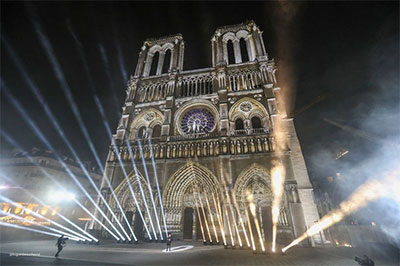 Appointed lead integrator for the resoration, Novelty Paris handled the majority of the integration work, with support from its sister company De Préférence for fine-tuning and acoustic optimisation, and the wider Groupe Novelty companies to provide a sophisticated and fully integrated audiovisual infrastructure.
The project incorporated sound system installation, RF systems, live audio recording and video delivery, as well as remote video production capabilities for KTO, the French language Catholic television channel to broadcast the reopening and subsequent religious services.
Among the project leads for the installation work was David Créteur from Novelty Paris. To ensure a futureproof integration work, Novelty Paris requested from the onset an increased capacity for optic fibre to be used for the cabling infrastructure. A full-fibre infrastructure was deployed throughout the cathedral, enabling seamless management for technicians and external service providers, alongside a dual spine-leaf network topology that supports both audio and visual workflows and uses industry-standard protocols, including Milan-AVB (audio video bridging), Dante Network Device Interface (NDI) for synchronised, low-latency transmission.
The venue demanded custom and non-invasive mounting solutions in order to preserve the remains of the original space. Positioning of all the A/V equipment was arguably the most challenging part of this highly ambitious integration, due to the restrictions imposed by the architecture.
Loudspeaker placement was optimised using precise altimetry, angling and rotation, with discrete locksmithing to support 128 colour-matched L-Acoustics speakers including Kiva arrays in the main area and above the choir stalls, alongside a combination of two-way passive 5-inch Syva and 3.5-inch Soka column loudspeakers, coupled with two-way passive 5XT and X4i boxes.
Most of the sound distribution is handle by six 19-inch equipment racks situated in the grandstands, with an additional rack located in a chapel on the ground floor dedicated to the technical room. LA2Xi and LA716i amplifier/controllers were chosen for their channel density and native Milan-AVB compatibility.
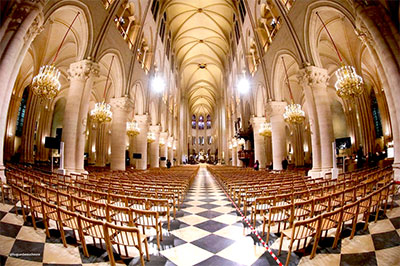 DiGiCo mic preamps have also been installed in the grandstand racks to relay audio ambiences and organs, as well as inside the two credenzas at the choir for all stage mics (20 Schoeps CCM4s and a Sennheiser MEB-114 SW at the altar), for the spoken voices and the Maîtrise de Notre Dame, as well as for additional live equipment.
With this installation, Novelty Paris has not only addressed the acoustic requirements of a world-renowned religious venue but also cemented the groundwork for a next-generation digitally connected place of worship. ‘This integration was as much about discretion and precision as it was about performance,’ Créteur says. ‘Working within a site as iconic and architecturally complex as Notre-Dame required custom engineering and solutions that respected its heritage while delivering high-quality, advanced technology.’
Updating the wireless
The resurrected Notre-Dame is also home to the world’s first installation of Sennheiser’s Spectera, the first wideband bidirectional digital wireless system for live audio production. The Novelty integration team appreciated the qualitative and speed of the new Spectera, offering simplified management of microphones, IEM/IFB signals and control data on a single RF canal, allowing to optimise space and reduce installation time.
When Créteur looked at the RF wireless provision for the cathedral, he realised a new solution that would satisfy the demands that came with the reconstruction was needed. RF coverage had to be ensured throughout the entire length of the cathedral, from the entrance of Notre-Dame to the chapel of the Crown of Thorns reliquary located at the rear, and across its width, where obstacles like wooden partitions and massive stone pillars had to be overcome.
Notre-Dame’s old system relied on an analogue two-channel Sennheiser 3000 series receiver and a pair of active directional antennas placed at the centre of the liturgical podium. Créteur felt it was time to move on from analogue…
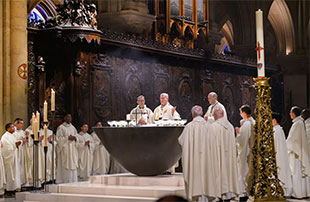 The new specification included sound reinforcement for mobile celebrations, where the priests or the archbishop would move about while still being heard clearly without any dropouts. In addition, the use of new spaces such as the side chapels had to be factored in. ‘Instead of working only along the axis, we now had to cover almost the entire cathedral, which is just over a 100m long from the entrance to the back and almost 50m wide at the transept,’ he points out.
He also neeeded a system that was discreet and easy to operate, knowing that Notre-Dame has to combine spiritual life with welcoming the public. ‘Notre-Dame is a place of sharing open to all visitors, whether they wish to attend a service or just want to walk under its vaults,’ says Laurent Prades, Technical Manager of Notre-Dame de Paris. ‘This is what makes this cathedral so unique: It welcomes the whole world, worshippers and visitors alike, with services being held during visits, and visits continuing during services.’
In practice, Notre-Dame remains a place of prayer and contemplation for the thousands of worshippers who can attend five services every day of the week. But it is also a place open to the public 12 hours a day, seven days a week, 365 days a year.
‘With the digital wireless technologies we were familiar with, we could have done it, but we would have had to multiply the number of antennas to a total of at least eight to be placed throughout the building, and then connect them with long lengths of cable. To compensate for the rigidity and line losses associated with copper coaxial cable, we would have had to use costly fibre extension solutions, which would potentially have led to problems with combining antenna pairs and zoning. Ultimately, the installation would have been quite complex, requiring the use of numerous devices, with the added difficulty of having to activate and deactivate zones manually.’
Créteur briefly considered switching to a DECT-based solution. Then, during a chance encounter with a Sennheiser presentation, he discovered the possibilities offered by Sennheiser’s WMAS implementation, the new Spectera system: ‘The further we got into the presentation, the more Spectera seemed to solve the problems one by one, and to perfectly meet the specific requirements of our project by considerably simplifying the system and its installation.
‘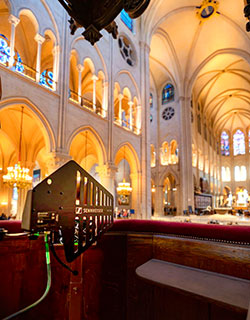 First of all, unlike traditional wireless systems, Spectera does not need diversity, so with comparable or even superior coverage, we can go from eight antennas to four, which halves the cabling. Second, the antennas combine perfectly without the need for a technician to intervene, eliminating the operational difficulties associated with zoning. And finally, the antennas are connected via Ethernet cables, a standard that is easier to integrate and more affordable than coaxial cable.’
On paper, the further the study progressed, the more the system seemed suited to Notre-Dame de Paris, but the stability of Spectera’s RF transmission still had to be verified on site. A full-scale test was therefore organised in early 2024 in a cathedral still under construction: ‘We were all dressed in white overalls,’ Créteur recalls.
Together with Sennheiser’s Hadrien Soulimant (Business Development Manager Professional Audio) and Charly Fourcade (Technical Application Engineer Pro Audio), Créteur set up a test configuration in the middle of the scaffolding. In parallel, a test span was created to check the visual appearance and audio quality of the sound system. With test results satisfactory, the project moved forward.
Notre-Dame’s technical rack is strikingly simple and compact, with the Spectera Base Station occupying a single rack unit while allowing the use of up to 32 microphones and 16 stereo IEMs. With a traditional system, the necessary components would have required much more space and higher electricity consumption. Spectera directly integrates with a DiGiCo console via Dante, using a 4ERA4 matrix, which allows simple and smooth transport and distribution of audio channels to the console. Initially planned to be located on the gallery at a height of around 10m, the four antennas were ultimately brought down, providing very stable coverage throughout the cathedral.
With the installation completed, Créteur was quick to begin planning for the future: ‘There may be occasions when priests need to speak in front of the church. In this case, a fifth antenna would be needed. We already tested such a scenario live, and simply took Antenna 4 outside during operation. It worked without having to restart the system.
‘Spectera gives us the freedom to accommodate a larger number of bodypacks, either permanently or on a rental basis for one-off events in the cathedral,’ he continues. ‘We could also reroute additional channels to the outside to facilitate the work of our regular partners KTO or Radio-France, who often come to Notre-Dame. In addition, thanks to its bidirectionality, Spectera offers new possibilities for sound engineers. When they need to move around to make level adjustments from their tablet, they can now press a PFL button and hear it directly through their headphones plugged into an SEK bidirectional bodypack. Even though these uses were not originally requested, we’ve realised that these features can be really useful, and why not take advantage of them since they are already included?’
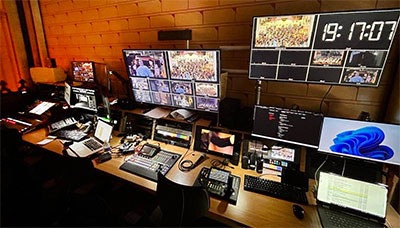
The broadcasting integration comprises eight Panasonic AW-UE150 cameras, coupled with three extra cameras for content feedback and onsite streaming. A Panasonic 4K AV-UHS500 live switcher with a Blackmagic Design ATEM 4 M/E Constellation 4K switcher for remote live production were chosen to feed the live stream to KTO’s HQ in the outskirts of Paris. Ten NEC screens on the cathedral pillars allowed guests to follow the ceremony.
Reopening the Cathedral
Upon completion of the renovation, Groupe Novelty was also tasked with delivering the entire A/V equipment for the grand reopening, attended by the world’s dignitaries and broadcast worldwide.
Having supplied equipment for several previous video mapping events at the cathedral over the years, along with a series of permanent audio installations over four decades, Groupe Novelty handled the full audiovisual set-up through its subsidiaries Alabama Média, De Préférence, Dushow TV, Magnum, Magnum Power, Novelty and On Stage. The set-up included projection mapping on the cathedral’s façade, power distribution, lighting, broadcast and staging for this project of monumental importance. For this historic moment, Groupe Novelty also deployed a vast 1,400m² marquee in the square facing the Cathedral.
After three weeks of installation for the re-inauguration, two days of operation and 24 articulated lorries of A/V equipment, the reopening ceremony began with the ringing of the cathedral’s bells for the first time since 2019. Laurent Ulrich, archbishop of Paris, then struck one of the closed doors three times with his crosier, which had been made from a roof beam that had survived the fire, with the façade lighting up in gold each time he did so. The cathedral choir responded by singing and when the doors were opened upon the third strike, French president Emmanuel Macron entered the nave of the cathedral, where guests were already sat.
 ‘We were approached by Publicis Live to go through the options at our disposal and their feasibility,’ recalls Gérald Bouché, Operational Sales Director at Novelty and Groupe Novelty’s project lead for this reopening project. ‘The first request was to highlight the cathedral; we studied the plans and started elaborating on various ideas. The Paris 2024 Olympics were also in the picture, so by the time we could get fully focused on the project, we were already in October.
‘We knew that event of this scale would require an extremely varied number of expertise, and that collaboration would be paramount to the effective management and overall success of this project. With hundreds of millions of eyes globally turning to Paris for the re-inauguration, we knew Groupe Novelty was perfectly equipped to deliver a show that would make world history.’
Handled by sister company Dushow TV, the lighting played a major role in enhancing the grandeur of this historic ceremony. More than 200 lighting fixtures from Martin, Elation and Robe, with eight Viper 2.6 fog machines and eight AF-1 effects fans, were installed inside the marquee and another 200 Astera, Martin, Robe and ARRI units were positioned inside the cathedral. Lighting in each area was controlled using an MA Lighting grandMA3.
For the many spectators gathered outside the cathedral, the team set up trailer-mounted screens and sound along the River Seine. Power distribution was also an important challenge, and in order to minimise cabling on site, Magnum and Magnum Power decided to host seven power generators on a barge on the river Seine which runs next to the cathedral, providing uninterrupted electricity for all equipment during the reopening show.
‘We are especially proud to have had the opportunity to contribute to the rebirth of Notre-Dame de Paris,’ says Jacques de La Guillonnière, founding president of Groupe Novelty. ‘This project, with its immense scope, ranks among the most prestigious we have had the privilege to deliver. It stands as a remarkable demonstration of the complementarity between our companies and the synergy within the group, drawing on individual areas of expertise to successfully carry out a project of such complexity.’
More: www.groupe-novelty.com