

Originally a showcase for Spanish noise bands, Primavera Sound has become one of Europe’s defining festivals. Sold out for a second consecutive year, the 2026 bill moved between shoegaze to hyperpop to techno, often within the same hour. ‘We define success as much more than simply achieving sufficient SPL,’ says Primavera Sound Audio, Video & Broadcast Manager, Pedri González.
First staged in 2001 at the Poble Espanyol, the festival moved in 2005 to the Parc del Fòrum, the seafront site on the edge of Barcelona with The Cure, Gorillaz, Skrillex and My Bloody Valentine headlining.
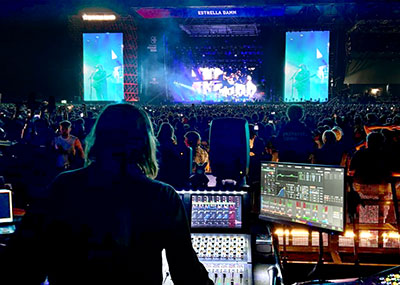 At the centre of the site stand two main stages, Estrella Damm and Revolut, built side-by-side and divided by a single large screen. They share one audience area and alternate sets from mid-afternoon until the early hours. When a headliner plays, 70,000 to 75,000 people stand in front of them. Sea on one side, a residential city on the other, and six further stages around the perimeter.
‘The audience experience is determined by the mix and the artistic content, and not by where somebody is standing in the venue,’ González says. ‘Directivity and off-site noise control were system performance parameters for us, every bit as fundamental as headroom.’
The Parc del Fòrum makes that hard to deliver – the terrain is irregular and site constraints allow a single delay position, 88m from the stage behind FOH. A 10m-high wall closes the field around 220m out, ready to bounce PA reflections into the audience. A VIP grandstand sits to one side, another festival stage lies roughly 230m to the rear right, and the city begins just beyond the perimeter fence. Being on the water, the site also experiences temperature and humidity swings between afternoon and night, and the wind comes in off the sea.
Twincam Pro International (formerly Twincam Audio) has been an official audio provider to Primavera Sound since 2004, and supplies L-Acoustics systems to the two main stages, the Plenitude stage and the Cupra Pulse stage. Fellow L-Acoustics partners Ara So and TST also supported this year’s festival, with Ara So serving the Cupra stage and TST covering the Schwarzkopf and Port stages. The company brought K1 and K2 to the Parc del Fòrum in 2014.
‘The choice of L-Acoustics is by no means accidental,’ says Twincam Pro International System Engineer, Josep María Riera. ‘It is the direct result of the festival’s commitment to delivering world-class technology that matches the standards of the international artists who have performed here over the years.’
Riera is an electronics engineer who has worked in live production for more than 30 years, specialising in electroacoustics. ‘What matters to me is keeping control of the system,’ he says. ‘L-Acoustics gives me that control and the tools to manage each project. Acoustic pollution is a real problem now, designs get more complex every year, and you need good ones to condition them properly.’
Design for each year’s event begins around six months ahead of delivery with Riera reviewing the site AutoCAD drawings, reopening the previous year’s design in L-Acoustics Soundvision, and settling the terms with the people responsible for noise control around the Fòrum.
With only one delay position available, the main arrays carry far more of the field than usual. The long-throw section at the top of each K1 array covers 116m, and the main system reaches 125m in total, with the delay towers overlapping the lower boxes of the main arrays across roughly 8m. Between them they take coverage to 182m, stopping short of the rear wall so that it is never excited. Front to back, SPL drifts by less than 3dB between the barricade and a listener at 160m, and by less than 6dB for the furthest listener at 180m.
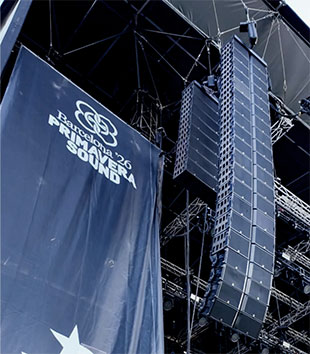
Each of the main stages flies left and right main arrays of 16 K1 over four K2, with eight K1-SB flown directly behind every array. Low frequency on the ground comes from 99 KS28 subwoofers, laid out as 33 stacks of three in a single line running close to 70m across the front of both stages. On the Estrella Damm stage, an out fill of eight K1 over eight K2 reaches the lateral VIP grandstand at up to 120m, while the Revolut stage carries a deliberately smaller out fill of eight K2. Front-fill is handled by 37 Kara II spread across 17 points along the barricade, seven pairs for each stage, a decoupled cluster of three between the two, and a cluster of three at each outer edge of the stage structure. Behind front of house, the two delay towers fly 16 K2 each.
In total the system runs to 304 enclosures driven by 113 LA12X amplified controllers in 38 LA-Rak II touring racks, with six P1 processors on a redundant Milan AVB network backed by an analogue fallback loop. A Luminex GigaCore core and a pair of L-Acoustics LS10 switches inside every LA-Rak II carry the Milan streams to the racks, and the whole system is monitored and controlled through LA Network Manager.
 Each KS28 stack runs two boxes forward and one back on the KS28 C cardioid preset, a two to one ratio that gives the best rear cancellation for the pressure delivered to the front. The ground reinforces the pattern, and the mirror image it creates adds to the cardioid performance of the line.
No electronic arc delay is applied along that line, because the number of active stacks changes through the day. A set on one stage may need stacks one to 16, while a headliner calls for all 33. At close to 70m of physical length, the line delivers its coverage without one.
In the air, the eight K1-SB behind each main array run parallel to the top eight K1. ‘The flown K1-SB significantly improved the low frequency contour at long distances and increased rear rejection,’ Riera says. ‘Combining flown and ground resources in this way gives us exceptional directional control over the low end.’
The difference between the two out fills is the clearest expression of the brief. Sixteen enclosures face the sea, where the VIP grandstand needs covering. Eight face the city, where every decibel that leaves the site is a decibel in somebody’s living room, and where a neighbouring festival stage sits 230m behind the audience. The same logic sets the coverage zones for every other part of the design, and the final day on site is given over to environmental noise measurement inside and outside the festival perimeter.
‘This year we achieved a clear improvement in the management of acoustic impact towards the city and between stages,’ says González. ‘Better system optimisation, directivity control and more precise level management have reduced spill towards the surrounding urban areas while holding the experience we want inside the venue.’
Two stages sharing a singlr field means the system has to behave as one. Both FOH positions feed a unified master control, which lets the team change how much of the system is live from set to set, depending on how many people are in front of it. ‘Thanks to our master system control, changeovers between acts are not an operational issue,’ says Riera.
Conditions move as much as the programme does. Autoclimate in LA Network Manager takes temperature and humidity from the sensors on the P1 processors and adjusts the air compensation filters across the system in real time, zone by zone, as the afternoon turns into night. ‘With such big shifts in temperature and humidity between day and night, Autoclimate is crucial,’ says Riera. ‘Wind, though, remains a relentless enemy.’
L-Acoustics worked alongside Twincam through pre-production and across the festival. Andy Carrington acted as technical liaison with the headliners’ front-of-house and systems engineers, Eva Argandoña handled commercial support, and Tom Laveuf and Rafael Pereira provided technical field support.
‘Over the past two years the support from the L-Acoustics team has been vital and decisive,’ says Riera. ‘Andy’s communication with the headliners’ engineers streamlined the entire operation. I truly believe this close collaboration between the manufacturer and the festival is indispensable moving forward.’
Riera measures his own work by what nobody says: ‘I usually say our job is the success of indifference,’ he explains. ‘When nobody comments on the sound, everything went perfectly.’ This year the comments came anyway. ‘The systems engineers and front-of-house operators of headliners like The Cure told us it sounds fantastic, it is absolutely perfect, I do not need to touch a single thing on the system.’
‘The midrange is incredible,’ says González. ‘The clarity and the punch are what convince us, particularly through the midrange, which is the part the wind takes away from us. It is an international standard, it is easy to tune, it is dependable, and the artists are genuinely happy with it.’
More: www.l-acoustics.com