

By rethinking its audio infrastructure, the Evangelical Chinese Church (ECC) in Washington State has installed a scalable, volunteer-friendly platform that ensures consistent sound, operational simplicity and supports long-term ministry success.
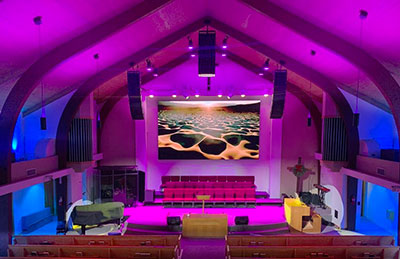 Working with Morgan Sound and Nexo, volunteer Technical Leader Nathan Goh headed the sweeping modernisation of the church sanctuary: ‘We came up with this vision of us having a distraction-free worship,’ Goh recalls. ‘Our mission was to create a space where we don’t have any distractions. ‘We’re not trying to buy a solution for tomorrow, but for 20 years down the line.’
The English congregation leans toward contemporary worship, with drums, bass, guitars and modern production, while the Mandarin congregation draws more on choir, organ, grand piano and traditional hymns. ‘We have basically two services in the space,’ Goh explains. ‘We’ll have the English service and then we’ll have a very short transition time.’
The need for a new approach became obvious over time – ECC’s production environment had grown organically, with equipment and solutions added whenever a problem surfaced. Eventually, that approach reached its limit. ‘For a long time, our church has been kind of under this band-aid solution where we’ve been trying to fix things as we go,’ Goh says.
The consequences were particularly noticeable in the sanctuary: ‘It’d be very loud in the front, very quiet in the back, and then very quiet in the balcony,’ Goh says. ‘It would be really hard to get the same experience for everyone in every seat.’
‘The frequency response would be completely different depending on where you were standing,’ Lawrence Tan adds. ‘The problem wasn’t that the church lacked equipment. It was that the system had evolved without the opportunity to step back, examine the room as a whole and design around what ECC actually needed.’
‘One of the challenges was that they wanted the speakers flown as high as possible for sightline reasons,’ offers Morgan Sound A/V Designer, Fraser Brearley.
The original design called for six Nexo Geo-M10 elements per side. But once the final hanging positions were established, the geometry demanded another solution. ‘Having to fly it that high and still hit the front row required a seventh box,’ Brearley says. ‘So I added a box and changed angles.’
The final design incorporated seven Nexo Geo-M10 loudspeakers per side along with a flown cardioid subwoofer array, optimised using Nexo’s NS-1 modelling software. Rather than relying on additional front fills or delay systems, Morgan Sound focused on the main arrays themselves.
ECC as well as the sound system, the church expanded its wireless infrastructure, standardised routing and adopted Dante networking. The church also opted for greater console capacity than it presently needs. ‘Ours is a 64-channel console and we don’t actually use all 64 channels all at once,’ Tan says. ‘But we did that so that we don’t have to re-patch anything.’
The church was anticipating what it might need five years from now or when the next generation of technical volunteers takes over. ECC had already demonstrated that mindset before the renovation. ‘They built their own Waves server and had that integrated with their console,’ Brearley says. ‘They were doing super high-level stuff.’
With volunteers a key part of the technical team, a system can be technically excellent but fail if only one or two people know how to operate it. ‘One of the things that Nathan and I were really hoping for is that even after Nathan and I move away or we’re not involved anymore with the A/V team, that people would still be able to use that stuff,’ Tan says. So simplicity became part of the engineering brief. ‘Just press one button, everything turns on and everything just works.’
Morgan Sound implemented power sequencing, predefined workflows, fixed routing, amplifier presets, analogue failover paths and scene-based operation. The complexity is still there but lives underneath the surface rather than in the hands of every volunteer. ‘We thrive off using presets and show files and scenes,’ Tan explains. ‘Most of the people, they just know how to turn things on and use them.’
For Brearley, the church’s technical volunteers were unusually capable. ‘These guys are system-tech-level volunteers,’ he says. ‘Once we got it configured together and they understood how it works, I don’t even have to worry about it.’
The real test came when the system was commissioned. Instead of simply listening from the mix position, the team walked the room and found that it sounded the same. ‘We were just walking back and forth down the aisle,’ Tan recalls. ‘Honestly, it was mind-blowing.’
‘We finally could hear the bass for the first time,’ Goh adds.
That flexibility is particularly important in a room that can move from choir and piano to a contemporary worship band - and then bring multiple languages and congregations together.
More than a year after the installation, ECC has made almost no changes to the PA. ‘The only change they asked was a little bit more headroom to the subs,’ Brearley says. ‘It’s been over a year since they’ve asked for any audio changes on the PA.’
More: http://nexo-sa.com