

The Thunerseespiele on Lake Thun in Switzerland has staged open-air musicals since 2003. Each year, a new production brings its own idiosyncratic challenges to be handled by TiMax SoundHub, a fixture since audiopool founder Tom Strebel built the first sound system.
Set against the backdrop of the Eiger, Mönch and Jungfrau, 2025’s The Hunchback of Notre Dame played on a set full of scaffolding, with loudspeakers in plain view. For Grease in 2026, the classic look meant they had to disappear.
Strebel refined the system with TiMax co-founder Robin Whittaker and has spent the past five seasons rebuilding it with Youssef Iskander, now audiopool MD. The two were co-sound designers on Grease. ‘I want to give big credit to Tom,’ says Iskander. ‘He laid a foundation for a system that is versatile.’
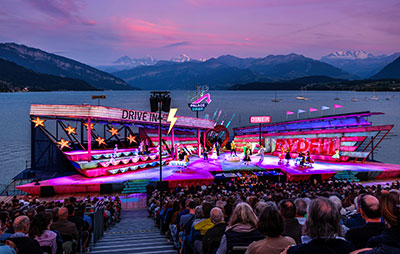 The site, with its majestic views, asks a great deal of that system. A 3,000-seat grandstand faces the stage and the mountains beyond. Nothing can be flown, and with homes nearby, noise limits are strict. ‘We cannot be loud at all, but we still have to cover 3,000 people,’ Iskander says.
The design used numerous discreet sources managed by a 64-channel TiMax SoundHub, so every seat in the house hears the show as though it were the sweet spot. The heart of the system, which Strebel calls the main PA, used eight stacks concealed under a net at the front of the stage.
Surrounds, delays and set loudspeakers complete a system of more than 40 outputs. ‘Nothing is loud, but it’s powerful, and you need to coordinate it all together,’ Iskander says.
Cleverly placed in the scenery, small cube speakers provided TiMax anchor points for the performers’ voices, helping the speakers disappear sonically as well as visually. ‘Audience members no longer hear the speakers,’ Iskander says. ‘They feel that every sound, even in the back row, comes directly from the actors on stage. Some even ask why the PA isn’t turned on, even though they can hear and understand every detail of the show.’
Supporting this, vocal localisation, with enhanced accuracy from TiMax TrackerD4, worked as lighting does in traditional performance. With shows beginning before sunset, much of the first act plays in daylight. During the ‘Summer Nights’ number, solo lines passed between 25 performers across the wide stage. ‘You look at the audience’s heads turning to where the sound comes from,’ Iskander says.
Tracking makes it simple for the sound to follow the action. Until 2025, the team tracked only the principals and grouped the ensemble by area. Since Iskander and Whittaker made the tracking set-up more precise, every performer has worn a tag, around 30 on Grease. In the open air, sensors sit high and low, front and back, to catch performers wherever they turn. ‘The tracking saved me a lot of time,’ Iskander says .
For the drive-in scene, TiMax turned the audience’s relationship with the stage on its head. The car sat downstage facing the grandstand, so the audience became the screen, with car sounds all around and the film’s soundtrack playing from behind. ‘At one point we brought everything back onto the stage, and then the focus was there,’ says Iskander. ‘It was one of the most important uses of TiMax this year.’
More: https://timaxspatial.com