

Michigan State University’s College of Music has transformed Eichler Hall into one of the most ambitious immersive audio environments in American higher education, installing a Genelec Smart IP loudspeaker system for Ambisonic composition, performance, education and multidisciplinary research.
Located within the College of Music, the hall is a rehearsal and performance space used by the university’s large ensembles, including orchestra, band and choir. With the addition of the new system, it can now also function as a sophisticated spatial audio environment capable of creating a 360° listening sphere and positioning and moving sounds throughout three-dimensional space.
Currently, the installed system comprises 143 Genelec 4430AW Smart IP Installation Loudspeakers (in white) and two Genelec 7382A Smart Active Subwoofers, with a network infrastructure already in place to accommodate additional loudspeakers. The project was made possible through the support of Ed and Wanda Eichler, who also funded the creation of Eichler Hall.
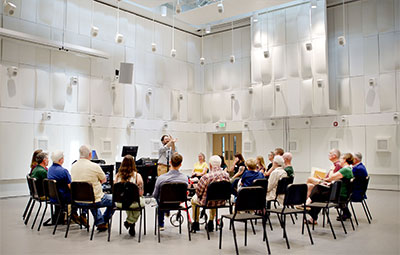 Leading the project for Michigan State was Anthony T Marasco, Assistant Professor of Composition & Technology, a composer, sound artist and instrument designer who has worked with immersive audio for around a decade. System design and consulting were provided by Tanner Upthegrove of Electroacoustics, who brought extensive experience working with large-scale immersive environments to the project.
‘When Tanner began looking at what we wanted to accomplish, he strongly recommended that we build the system around Genelec Smart IP,’ Marasco says. ‘That decision really unlocked what was possible in the room. Being able to deliver audio, power and control through the network greatly simplified an installation of this scale, while giving us the ability to manage and optimize the loudspeakers individually. With more than 140 loudspeakers surrounding the listener, that level of flexibility is incredibly important.’
The system operates over a Dante network, with Cat6 cabling connecting the loudspeaker infrastructure throughout the hall. The network-based approach proved particularly valuable given the sheer scale of the installation. ‘Without Smart IP, we would have been looking at how to provide electrical infrastructure for more than 140 individual loudspeakers,’ Marasco says. ‘Using the network dramatically simplified that process. It saved us an enormous amount of installation complexity while also giving us an infrastructure that can continue to expand.’
The physical installation was handled through Michigan State University resources, including College of Music Facilities Manager Tom March, Director of IT Justin Baker, and the university’s Infrastructure Planning and Facilities team. Data cabling was initially installed during the university’s winter break, with loudspeaker installation beginning following the spring semester.
Upthegrove subsequently spent several days on-site commissioning the system with Marasco and the MSU team. Working with Genelec Smart IP Manager software, they verified network communication and audio routing and optimised the response of individual loudspeakers within the array. This was particularly useful for loudspeakers mounted in locations where architectural conditions affected their acoustic response.
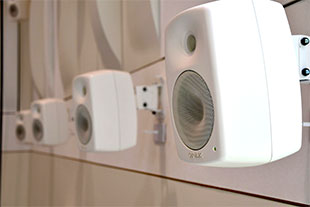 ‘We could measure an individual loudspeaker, see how its particular position in the room was affecting its response and then create an EQ profile specifically for that loudspeaker,’ Marasco reports. ‘That profile could then be stored in the loudspeaker. When you’re dealing with a system this large, having that degree of control is tremendously powerful.’
‘Smart IP Manager streamlined both individual and zoned control for EQ, sensitivity, and loudspeaker features without the need for an external DSP,’ said Upthegrove. ‘The real-time control makes calibration and commissioning straightforward and predictable.’
The system uses a Danish Audio Devices AX Center interface, with a Mac Studio serving as a primary production workstation. Additional connectivity includes Dante Virtual Soundcard, an RME Digiface Dante 256-channel 192kHz USB interface and a Behringer X32 mixer for bringing analogue sources and live instruments into the environment. Software including Reaper and Max is used for routing, composition, Ambisonic processing and custom spatial audio applications.
For Marasco, however, the technology is ultimately about what students can create with it. His Immersive Sound Design course, which is open to students across Michigan State University, explores immersive audio for music composition, gaming, storytelling, themed entertainment, museum experiences and other applications. Previous versions of the course required him to repeatedly assemble and dismantle a temporary 7.1.4 loudspeaker array. The new Eichler Hall system gives students access to an entirely different level of spatial experimentation.
‘We can now go beyond simply talking about spatial audio and let students actually create for an environment of this scale,’ he says. ‘They can place a sound at a specific coordinate, move it above or around the audience, combine Ambisonic recordings with individually positioned mono or stereo elements, or create an acoustic environment that couldn’t exist in the physical world. It gives them an extraordinary laboratory for experimentation.’
That opportunity extends well beyond music students. Immersive Sound Design has attracted students studying game design, engineering and communications, and the College of Music hopes the new facility will encourage further participation from disciplines including film and journalism.
The university also anticipates Eichler Hall becoming a destination for concerts, workshops, visiting artists and immersive audio events. Plans include fixed-media playback concerts, performances incorporating live spatialisation and potential festivals bringing together artists and researchers working in immersive sound.
Just as importantly, the system is being positioned as a multidisciplinary research platform. Michigan State is already exploring potential collaborations involving acoustic and sonic ecology, health and wellness, simulation, manufacturing and occupational safety training, among other fields.
The ability to reproduce highly convincing spatial environments has already made an impression during early demonstrations. Ambisonic field recordings, for example, can create the perception of sounds moving naturally through and above the room rather than simply jumping from loudspeaker to loudspeaker.
‘The reaction has been fantastic,’ Marasco notes. ‘We’ve played Ambisonic field recordings where you hear a bird above you and then hear it fly around the room. You’re not thinking, ‘the sound is coming from that speaker and then that speaker.’ It feels like the sound is actually there in the space with you. That accuracy of spatialisation has really impressed people. It’s very moving.’
The system can also recreate the acoustic characteristics of real-world and even entirely imaginary spaces using impulse-response (IR) modelling. Demonstrations have placed performers virtually within environments ranging from a Scottish mausoleum to train tunnels, as well as acoustical spaces that exist only as computer models.
‘Genelec has always been viewed by me and many of my colleagues as a premier tool for accurate sound and professional audio reproduction,’ Marasco offers. ‘I had worked in Genelec-equipped multichannel spaces before, and we already have other Genelec systems here at Michigan State. When Tanner told us that Smart IP made it possible to create this entire environment with Genelec, it almost sounded too good to be true. But it worked, and the result has been fantastic.’
Genelec also worked closely with the university throughout the procurement process to help ensure that the unusually large quantity of loudspeakers required for the installation could be secured and delivered on schedule.
For Marasco, Eichler Hall’s new capabilities ultimately represent something larger than an impressive loudspeaker count. They provide students, faculty, visiting artists and researchers with an environment in which ideas that previously existed primarily in theory can now be experienced, tested and shared. ‘One of the great things about being at a university like Michigan State is having the ability to explore and try things that might be impossible to do on your own,’ he concludes.
‘Our students share their work and learn from one another, whether they’re writing for band, choir, homemade electronic instruments or now this massive immersive system. We’re excited to give them a space where they can create things that simply weren’t possible here before, and to see what they come up with that we haven’t even imagined yet.’
More: www.genelec.com