

AEA Ribbon Mics has released Behind the Ribbon: The AEA Story, a documentary exploring the history of the ribbon microphone and the people whose knowledge and craftsmanship have helped preserve and advance the technology for today’s musicians and engineers.
Ribbon microphones became central to American broadcasting, film and music during the 1930s and 1940s, valued for their natural response and ability to capture voices and instruments. RCA designs such as the 44 and 77 became fixtures in radio stations, recording studios and film production stages, capturing performances and broadcasts from Bing Crosby, Orson Welles, Franklin D Roosevelt among many others.
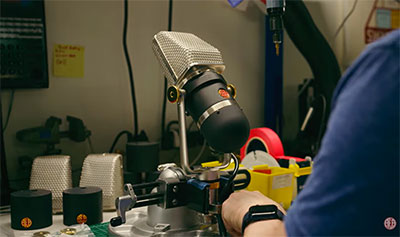 As condenser microphones gained popularity and RCA shifted its attention toward colour television, the company ultimately exited the microphone business in 1976. The microphones remained in use, but replacement parts became scarce and much of the specialized knowledge required to repair and manufacture them was in danger of disappearing.
Behind the Ribbon follows AEA founder Wes Dooley’s work repairing vintage ribbon microphones during the 1970s and 1980s and his relationship with former RCA engineer Jon Sank, who shared RCA’s techniques for installing and tensioning ribbons. After more than two decades of repair work and development, AEA introduced its recreation of the RCA 44 at AES in 1998, bringing the classic design back into production while laying the groundwork for a broader line of modern ribbon microphones.
Today, AEA manufactures its microphones by hand at its Pasadena workshop. The company works with specialised vendors throughout Southern California to machine, form and finish individual components before they are inspected and assembled at the workshop. Processes such as ribboning require years of experience and involve placing, tensioning and testing aluminium ribbon material measuring just 1.8 microns thick.
As electronics manufacturing increasingly moved overseas, AEA faced the challenge of retaining those skills, supplier relationships and quality-control processes locally. The company continues to reproduce classic ribbon designs while developing original microphones and electronics for recording, advancing the technology without separating it from the knowledge on which it was built.
‘These are the kind of products that you want to hand down from generation to generation,’ says AEA owner and CEO, Julie Tan, in the film. ‘These are the kind of products that I want my kids to have.’
The film is available now on YouTube.