

A new immersive recording studio at the Gaoping Future Music Technology Industrial Park is home to the first Alcons Audio M-series installation in Mainland China, bringing together businesses involved in musical instruments, lighting, audio equipment and stage design, with the aim of developing an integrated music technology ecosystem.
It is located within Gaoping City’s Mishan Industrial Park and includes a digital R&D centre, an exhibition and experience centre, an intelligent manufacturing centre, and supporting office and living facilities. The recording studio adds a professional production and critical-listening facility to the, which is designed to serve leading national arts ensembles. Its 5.2.4 studio called for accurate reproduction, ample dynamic range and a monitoring environment suited to demanding recording work.
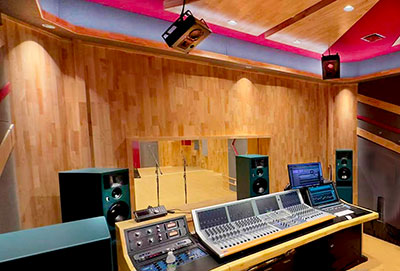 The project was designed by Bian Liunian of the Oriental Song and Dance Troupe With EAD supplying the Alcons system, which was installed and tuned by sound engineer Niu Wenjie of Beijing Da Niu Audio Company.
The production chain pairs a German Stagetec digital mixing system with Dutch Alcons Audio monitors. Together they provide a 5.1 surround production environment intended to meet the standards of leading international studios, with additional channels in the immersive monitoring layout.
An active-monitor solution was initially under consideration. After EAD introduced the M-series, the team compared systems through on-site listening sessions using a range of musical genres and assessed the overall system costs. The Alcons configuration won them over with its sound quality and the economics of a centrally amplified, multichannel design.
Five bi-amplified MR10 pro-ribbon reference monitors reproduce the main channels, with two MB10 low-frequency extension systems and four CRMSC-SRIW/120 in-wall loudspeakers completing the 5.2.4 layout. Two Director6 amplified loudspeaker controllers provide system processing and amplification, using Klotz cabling. The M-series combines Alcons’ pro-ribbon technology with the resolution and dynamic headroom needed for critical listening.
The passive loudspeakers and centrally located amplification also suited the studio’s acoustic construction. With no amplifier electronics inside each monitor, the design team had greater flexibility when integrating the loudspeakers into the sound-isolated room. For the client, the architecture offered a practical way to build a larger immersive system while keeping overall costs in view.
‘I thought the VR5 was already performing at a very high level,’ says project chief engineer, Li Liang,. ‘After listening to the MR5 and MR10, I realized it was not the limit of what Alcons could do. Perhaps there is no upper limit.’