

First held in 2013 as a party thrown by a group of friends at the Bione sports centre in Lecco, Nameless Festival has returned to its original sites after 13 years and three alternative venues, it as one of Italy’s defining electronic music events with the Red Bull Energy Zone becoming the first festival stage in Europe with an L-Acoustics DJ spatial sound system,
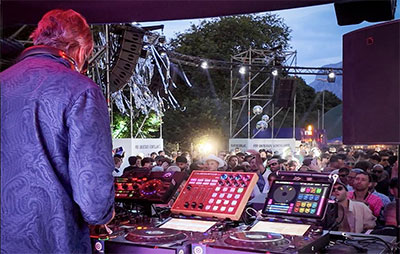 Featuring four stages – each using L-Acoustics sound systems – the 2026 event hosted more than 100 artists and 90,000 festivalgoers across three days, with Calvin Harris, John Summit and Fisher headlining.
The decision to unify the stages’ PA systems came from the top of the production team with Production Director Angelo Loizzi setting the brief: L-Acoustics on all five stages, down to the smallest. The festival supplies its own front of house and system engineers, so the specification came from the people who would operate it.
‘We wanted to have L-Acoustics on every single stage because our artists and technicians all prefer L-Acoustics,’ Loizzi says. ‘We consistently see L-Acoustics as the first choice on technical riders. Touring technicians are familiar with it and love it for the low end it delivers for electronic music.’
That brief fell to L-Acoustics Certified Provider Milano Show Rent, who supplied the systems and crewed all five stages. Technical and lighting designer Nico Berna of Black Box, also an L-Acoustics partner, handled the stage and coverage with Nameless’ Jacopo Naso. Both companies had already worked with the Nameless team at smaller festivals earlier in the year. ‘At Nameless 2026, our partnership with the team scaled up,’ says Amaury Froiio, Project Manager and owner of Milano Show Rent. ‘We were delighted to take on the full, AVL production entirely in-house.’
The Red Bull Energy Zone had been conceived as an in-the-round dancefloor rather than a conventional end-on stage, and Loizzi saw an opening in that geometry. ‘Our audience comes for house and club music, and that music is built to be felt from every direction,’ he says. ‘Once we decided the Red Bull Energy Zone would be in the round, a stereo system no longer made sense for it.’
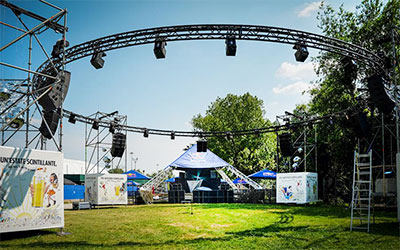
The floor and its ring truss came from the production team’s own design, and the audio layout followed it. Working to Berna’s stage design, Milano Show Rent and L-Acoustics sound engineer Rafael Pereira developed a system for the 16m diameter circular truss, with six towers carrying both audio and lighting rigs and wrapping the floor in a fully spatialised listening experience. ‘The floor and the ring were already the plan when we came in,’ says Amaury. ‘Our job, with Rafael, was to make that shape sound the way it looked. That is the space we put L-Acoustics DJ into.’
L-Acoustics DJ is a complete solution pairing the L-Acoustics ecosystem of loudspeakers, electronics and software with a control interface that can be used at the DJ booth via iPad or the L-Acoustics DJ Controller. At its centre is a low-latency, machine-learning-powered technology that separates stereo music into multiple discrete stems, live. Those stems route directly into the spatial mix engine, where beats, bass lines, melodies and vocals can be positioned and moved throughout the space. It integrates with both digital and analogue DJ set-ups with no change to existing gear or technique, and artists can either drive the spatial mix themselves or work with a dedicated spatial audio engineer.
‘L-Acoustics DJ has a very low barrier to entry,’ Amaury says. ‘Even DJs who are unfamiliar with the tech can be trained in almost no time. We were pleased that an overwhelming majority, around 80 per cent, embraced it wholeheartedly.’
 Naso saw the same reaction on the floor. ‘When I talked to people afterwards, to the audience and to the artists, everyone talked about the experience,’ he says.
Bione was familiar ground, but not at this scale, so the site had to be surveyed as if it were new. A run of buildings directly behind the main stage had to be kept out of the coverage pattern, which was one of the reasons the main hangs used K1 over K1-SB, with subs in cardioid configuration, which extended the line array to help focus sound on the audience, avoiding spill behind the stage. With no usable position for delay towers anywhere in the main field, the full depth of the audience area had to be covered from the stage itself. The Nameless Tent presented the opposite problem: it faced the main stage across the site, so spill had to be controlled in both directions, while the tent structure’s load capacity ruled out heavy flown hangs.
The audio crew worked inside a ten-day build shared with structure contractor Stageco, installing all five systems over two days and taking them out in a single night. Soundvision underpinned that schedule. The design flow began in vector drawings and SketchUp, which Berna’s team passed to System Engineer Luigi Vargiolo, who built the Soundvision files for three stages. These became the shared reference for the whole audio crew, and for visiting artists’ engineers.
‘We had eight people on the audio crew this year, and every one of them is a good Soundvision user,’ says Berna. ‘We share the file, we meet briefly before load-in, and everybody can see their own part of the project. It speeds up load-in and load-out, and it is where we start when we fine-tune for wind and weather on site.’
Each stage was designed around its own footprint, load limits and programme. The main, Ploom Stage, home to the three headliners, was built on 12 K1 and 2 K2 down per side below six K1-SB which extended the line to better control low frequency over the audience. Additional KS28 subwoofers – forty-eight in all, in cardioid configuration – were groundstacked across the stage front to add bass punch.
The Live stage carried hangs of four K1-SB with 12 K2 each side, and 16 groundstacked KS28 subs.
The Garnier Fructis Arena, the rap, urban and pop stage, boasted ten K2 per side, with 16 cardioid-configured, groundstacked KS28.
The Red Bull Energy Zone ran Kara II and A15 across the seven arrays in the LA DJ set up, on the 16m ring, with eight KS28 on the low end, while the Heineken Stage, an open platform where the public could book slots on the consoles, used a scaled-down Kara II and A15 rig.
Kara II and SB18 handled monitoring on every stage, and the whole site ran on LA12X amplified controllers. In total, more than 80 K2 and over 100 KS28 joined the 24 K1 across the five stages.
Nameless came off with a consistent sound across all stages for the first time in its history, and one stage no other Italian festival could offer. ‘L-Acoustics DJ gave us a stage nobody else in Italy has, and having every stage running on the same system for the first time meant our artists and crew never had to think twice about the sound,’ says Loizzi. ‘All of this helped to make Nameless 2026 one of our most successful festivals yet.’
More: www.milanoshowrent.it