

When producer Noah Strik arrived for a month in Nepal, he anticipated a straightforward recording project using a compact set-up comprising an Audient Evo 8 and a couple of mics. His initial plan to track an EP with local musicians was quickly derailed, however, by earthquakes, remote locations and cultural considerations that launched him into filmmaking.
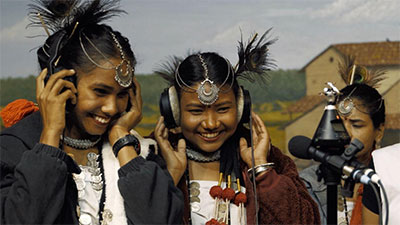 Set to debut at the Beholders Film Festival on 4 October, the 70-minute feature documentary, Project Nepal, follows an extraordinary three-year journey of personal transformation and self-discovery.
Faced with immediate isolation in a foreign country, he adapted his plan from a structured studio project into an unscripted exploration of human connection, and required teaching himself how to edit, score and produce a feature-length film entirely from scratch upon his return.
Central to his ability to adapt to constantly changing circumstances was his compact set-up. With unpredictable conditions forcing spontaneous recording sessions in local homes, villages and remote jungle locations, the interface’s rugged build, intuitive single-knob operation and Smartgain feature meant Strik could trust his gear without technical friction. The clarity of the unit’s preamps also allowed him to keep his deeply personal voiceover narration raw and completely unprocessed, whils capturing ambient field recordings that formed the backbone of the film’s full musical score.
‘The Evo 8 might have been my most underrated set-up choice looking back,’ Strik says. ‘So many times, we had to improvise and adapt, but the Evo 8 was the one thing that just worked. It made professional recording feel portable, and I never felt like I was compromising on quality simply because I wasn’t in a studio.
‘The interesting thing about making the film completely by myself is that the boundaries between filmmaker and musician basically disappeared,’ he continues. ‘I was filming, editing, composing, recording and doing the voiceover all simultaneously, so the sound of the film became another part of the storytelling.
‘The preamps were particularly important for the voiceover. The narration is very personal – I’m essentially letting the audience into my own head, so I wanted it to sound intimate and natural rather than overly processed. I kept adding and adding processing elements, but eventually removed all of the processing. I realised that the recordings were already clean and natural enough that processing was actually making the voice feel less authentic. So now, there’s no EQ, no compression, and the voiceovers are entirely raw.’
Reflecting on his journey from music producer to filmmaker, he adds: ‘I went from trying to just make songs to trying to find out if music could bring us together. The journey completely changed the way I view music. I hope people leave the cinema either feeling empowered to connect more with those around them or feeling recognised in their own personal struggles.’
More: http://evo.audio