

East Sussex’s Glyndebourne opera house has integrated TiMax SoundHub spatial processing into its audio infrastructure in a landmark upgrade. The venue is among the world’s most acoustically sensitive performance environments, regarding opera as a fundamentally acoustic performance.
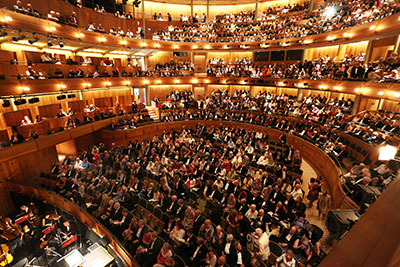 Head of Sound and Video Jonathan Moss led the installation, which marks the first stage of a long-term move to harness object-based spatialisation, with TiMax central to the venue’s design. Moss’ dialogue with Robin Whittaker of TiMax was conducted over a period of four years well ahead of any further reinforcement considerations. ‘With a number of upgrades coinciding, we had the rather unique opportunity to look at things holistically,’ Moss says. ‘We were able to assess where we wanted to end up. TiMax is one of the first steps, not the end of the journey.’
A traditional proscenium system comprises EM Acoustics’ Reference Series – R12s with R8 fills and S215 subs at balcony level, supported by a network of permanently installed Reference Series loudspeakers throughout the auditorium. With Dante providing the audio backbone for EM Acoustics DQ20s, driven via an SSL Live console, the TiMax integration amounted to little more than a rackmount connected the network by two cables. ‘TiMax gives us the toolkit that can actually accommodate our schedule,’ Moss comments.
During a busy summer season, dedicated sound sessions are rare and the time taken in preparing for spatial work was operationally costly. With a timetable that devotes mornings to fully supported technical rehearsals, an afternoon changeover for a public evening show, then an overnight reset for the next day, TiMax promises significant operational savings: ‘We can achieve what we need within the sessions we’ve got, rather than being limited by the time it takes to do things manually,’ Moss confirms.
The benefits were immediate – with spatial imaging applied only to the proscenium loudspeakers, TiMax tightened image definitions inward by roughly a metre on each side, pulling the perceived source firmly to the stage while mapping the stage area. Moss describes the shift as PA sound becoming hi-fi sound: ‘TiMax does a surprising amount, even when you’re not using it heavily at all.’
Following system commissioning by TiMax product Support Engineer Gerry Marrone, the Glyndebourne sound team set about using the SoundHub for A/B testing, initially preserving the original set-up as a cue in TiMax, because change can be scary’.
‘We quickly ditched that,’ Moss says. ‘It was very clear the new sound was just better. Currently TiMax is just in the background as a system processor, without adding specific spatial elements to our current shows. We’re taking advantage of it whether its physical improvements, the psychoacoustic improvements – without anyone really knowing it’s there.’
The transparency extends beyond operaproductions – for presentations and talks in the intentionally reverberant auditorium, TiMax enables the sound to flourish within the room’s acoustic influence at lower SPLs.
The audio infrastructure is future-proofed, with the SSL Live console’s flexibility via OSC and control panels allow any channel to be designated as a spatial object on demand. Full object-based spatialisation is built into the workflow, with spatial presets, tracked movement paths and surround distribution, simply awaiting the expanded infrastructure planned for the auditorium over coming years.
Having successfully made the sound system ‘disappear’ at Glyndebourne, Moss reflects that the reaction to the new system is exactly what he had hoped for: ‘The general response is nothing. The biggest compliment we can get is when someone doesn’t notice what we’ve done.’
More: https://timaxspatial.com