

Among the largest in Europe, the University of Birmingham’s Medical School is a leading centre for medical education, using A/V technology is a major part of its practical learning. After a recent review, some facilities were deemed in need of an upgrade, including the 450-seat Leonard Deacon Lecture Theatre – Renkus-Heinz beam-steering solution was the answer to more intelligible sound.
The theatre is divided into two acoustic areas: a semi-circular stage at the front of the room, and the tiered seating area that extends to the rear: ‘The acoustics at each end of the room presented several challenges,’ says Mark Bromfield, Director of System Solution Sales for CUK – the distribution company supporting the project from early conversations through to implementation. ‘The stage was highly reflective, largely due to its hard wooden flooring and projection screen, while the seating area incorporated more absorptive finishes, meaning both areas presented very different conditions within the same space.’
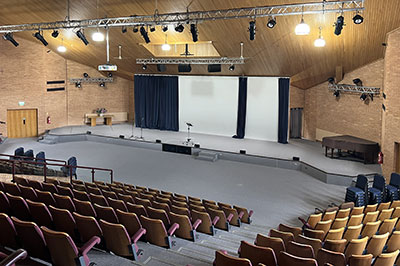 Combining wall-mounted and ceiling loudspeakers, the existing system operated without time alignment. ‘Listeners could hear sound coming from multiple directions with noticeable delays between loudspeakers,’ Bromfield explains. ‘This compromised intelligibility and contributed to listener fatigue, prompting the university to assess options for a new sound system. We were approached by the technical team, who had seen a Renkus-Heinz demo at an industry event, and wanted to explore whether its products could address the challenges in the lecture theatre.’
To determine the ideal sound solution for the Leonard Deacon Lecture Theatre, CUK conducted acoustic modelling, followed by a live demonstration of the Renkus-Heinz Iconyx system in the venue. ‘The university’s A/V team was incredibly impressed with the precise directionality and consistency provided by the Iconyx Series, which led to the specification of four of these beam-steering arrays,’ Bromfield reports.
GVAV, an A/V integrator with extensive experience in education-based deployments, was tasked with installing the new system. To manage the distinct acoustic conditions of the stage and the seating area, the theatre was treated as two separate zones.
‘At the front of the room, two IC16 digitally steerable column arrays are wall-mounted on the left and right of the projection screen,’ Bromfield says. Architecturally discreet, they blend in with the theatre’s white walls, while delivering sound directly to the seating section. Each array features eight individually steerable beams that can be shaped around the precise measurements of the room while minimising acoustic energy in unwanted areas.
For the other half of the room, two of compact IC8 steerable line arrays were installed behind panels on each side, providing controlled coverage to the rear of the theatre. ‘The system’s adjustable DSP delay allowed the IC8 arrays to be accurately time-aligned with the IC16s to prevent audible delays between the loudspeakers,’ Bromfield adds. ‘During information-packed lectures, it is critical for students to hear every word. By directing audio precisely where it’s needed, the Iconyx system now ensures every seat receives the same clear, intelligible audio.’
With the installation complete, the new system brough an immediate improvement in speech intelligibility and the overall listening experience. ‘The system provided controlled, focused coverage from a significantly smaller number of loudspeakers compared to the previous system,’ Bromfield says. ‘Delighted by the performance of the system and how it addressed previous challenges, the university’s A/V department began looking at other areas of campus that would benefit from a similar upgrade.’
‘The improved audio quality was a guaranteed win, but what really helped drive wider adoption was the economics,’ says James Ball, A/V Designer and Project Lead for the university. ‘By reducing labour and infrastructure requirements, we were able to invest in better technology while stretching available budgets further, allowing us to upgrade more teaching spaces across the campus.’
During its first visit, CUK assessed 11 teaching spaces in addition to the Leonard Deacon Lecture Theatre. Achieving the required coverage with fewer loudspeakers reduced the cabling and amplifier channels that a high-quality solution typically demands. This helped initiate a more cost-effective approach to a campus-wide audio upgrade.
‘We assessed each room individually, selecting loudspeakers based on dimensions, acoustics, and coverage requirements,’ Bromfield says. ‘With the breadth of the Renkus-Heinz portfolio, we could select the most appropriate solution for each.’
The University of Birmingham’s long-term plan is to upgrade 15 lecture theatres across its campus using a range of products from Renkus-Heinz’s Iconyx Gen5, UBX Series, and CX Series.
‘The Leonard Deacon Lecture Theatre demonstrates exactly what Renkus-Heinz beam-steering technology can achieve in acoustically challenging venues,’ Bromfield says. ‘It allowed the university to overcome issues of clarity and coverage that had affected the experience for students and faculty, creating an improved learning environment with significantly less infrastructure, and at a lower cost than competing solutions. With the broad range of solutions available for different room sizes and acoustic conditions, the same approach can now be extended across the campus.’