

The University of Lincoln has completed a campus-wide uptake of Sennheiser conference systems to improve its hybrid teaching, accessibility and ease of use.
Established in 1996, the University of Lincoln has established a reputation as one of the UK’s most dynamic modern universities, combining a city-centre campus and a focus on industry collaboration. As the it continues to evolve, the university’s A/V team has developing learning spaces that support a broad range of teaching styles and access requirements.
At the heart of this recent project was a simple but transformative question: What do the people actually using these rooms need? Rather than beginning with technical specifications, the university approached the project from the perspective of lecturers and students, focusing on workflow, usability and accessibility. ‘The idea was to design and enhance our rooms from a user perspective rather than a technological perspective,’ says AV Design Lead and Deputy AV Manager, Jason Ramsden. ‘How does the user journey in that room work? What does that workflow feel like? We have moved microphones into the infrastructure of the building, so lecturers don’t have to think about the set-up or the use case.’
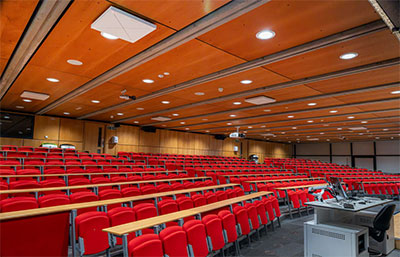 The installation includes 172 TeamConnect Ceiling 2 (TCC 2) mics shared across 80 seminar rooms, 12 lecture theatres and a range of boardrooms and professional services spaces, alongside TeamConnect Ceiling Medium (TCC M), SpeechLine Digital Wireless (SL DW) and MobileConnect solutions.
The initial design phase was completed in 2023, with the main rollout beginning in 2024. Installation was carried out primarily by the university’s long-standing A/V partner, Pure AV, with recent additions completed by Snellings Business Systems following a new tender process.
‘We’ve had really strong support from both our integration partners and the manufacturers,’ says University Digital Audio Visual Technology Manager, Caleb Connors. ‘Having a team that understands what you’re trying to achieve makes a huge difference when you’re rolling something out at this scale.’
The need for change was highlighted during the Covid-19 pandemic, when hybrid teaching became essential and the imbalance between in-room and remote learning experiences became very apparent. Handheld and lapel microphones captured the lecturer effectively, but student contributions, questions and discussion were often lost to remote participants. Portable microphones also introduced practical challenges, from being left uncharged or misplaced to being used incorrectly.
‘Lecturers are experts in their subject, not in A/V systems,’ Ramsden says. ‘All we want them to do is turn the system on and log in. Everything else should just work.’
Following extensive evaluation, the university selected Sennheiser’s TeamConnect Ceiling Solutions. The A/V team assessed a range of ceiling microphone technologies and found that Sennheiser’s adaptive beamforming delivered the most consistent results in real-world teaching environments. The decision was also supported by prior experience with SL DW systems.
‘We’d been using SpeechLine for a long time, so we already trusted the performance,’ Ramsden explains. ‘That familiarity gave us confidence when we started looking at ceiling-based solutions.’
In seminar rooms and standard teaching spaces, the move to TCC 2 and TCC M has allowed a fundamentally different approach – audio capture is no longer dependent on user interaction, allowing academics to walk into a room and teach in the way that best suits the session. Full-room coverage supports hybrid teaching, while more focused zones allow for traditional lecture delivery and collaborative discussion.
‘We’ve had to be flexible with how we deploy and use the technology,’ says Connors. ‘It’s not about forcing a solution into a space; it’s about shaping it so it works for how people actually teach and interact.’
The university has found TruVoicelift and Advanced Exclusion Zones especially valuable. Available with both TCC 2 and TCC M, TruVoicelift allows lecturers to move freely and speak naturally without requiring a handheld or body-worn microphone, while exclusion zones help mask unwanted noise and address challenging room acoustics.
‘We’re using TruVoicelift in our larger lecture rooms and it feels really natural in those spaces,’ Ramsden continues. ‘The exclusion zones are fantastic, especially when we look at the nature of our rooms acoustically. No rooms, we would say, are acoustically perfect. They’re all full of unique challenges, and being able to shape how the system behaves has been vital.’
This flexibility also supports changing room layouts and evolving teaching practices. If a room needs to be reconfigured, the AV team can adjust zones and exclusion zones without major infrastructure changes. ‘There’s flexibility in the technology,’ Ramsden says. ‘If we need to reconfigure a room, the beamforming makes it easy. The TCC 2 lends itself to the kind of dynamic shifting we’re currently seeing in higher education, allowing us to support rooms regardless of how they are used.’
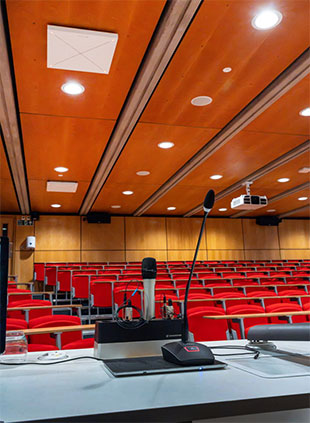 Sennheiser Control Cockpit provides centralised monitoring and management across the deployment, giving the A/V team visibility and control over devices at scale. ‘It’s essential at this scale,’ says Ramsden. ‘Being able to see what’s happening across all devices and respond quickly has made the system much more manageable.
SL DW continues to play an important role in the university’s 12 lecture theatres, which are used for teaching, events and presentations. In these larger and mixed-use spaces, handheld and bodypack microphones remain useful, particularly when academics need additional control.
‘Our SpeechLine systems are predominantly used in our lecture theatres,’ Ramsden notes. ‘There will be situations where the feel of a handheld mic or a bodypack is preferred. If academics are losing control of the room in a healthy debate or conversation, they can refocus attention by speaking into one of the SpeechLine microphones.’
Camera tracking adds another layer of automation. In smaller seminar rooms, TCC 2 microphones are paired with Huddly cameras, whose onboard AI manages framing automatically. In larger lecture theatres, EVA camera systems use microphone data to track speakers and questioners, creating a more natural and engaging experience for remote participants. Room control is handled via Extron.
‘Sometimes a really clever tech solution can become a barrier to what you want to deliver,’ Ramsden says. ‘Even with guides and training resources, it can feel uninviting, so we decided to automate as much as we could. When our staff and visitors enter the room, the A/V can take care of itself.’
The university has also deployed Sennheiser MobileConnect in four spaces as part of a broader focus on accessibility and inclusion. The solution allows students to connect using their own devices and headphones, creating a more personalised listening experience.
‘The beauty of MobileConnect is that it is not just an assistive listening platform,’ Ramsden says. ‘It opens up a whole world of support to students with additional learning needs. Some neurodivergent students can become overwhelmed in loud or crowded spaces, but with MobileConnect they can step out of the room and remain part of the session. That made the product really attractive, because we could add equity and value into our spaces for everybody.’
For the A/V team, the deployment has improved consistency across campus and reduced support interventions. ‘The installation has increased the consistency of microphone use across the campus,’ Ramsden explains. ‘There has also been a reduction in our support interventions for microphone-related callouts, because everything is now part of the infrastructure and takes care of its own workflow.’
‘It’s taken a lot of pressure off the team,’ Connors adds. ‘We’re not constantly reacting to issues; we can focus on improving the spaces instead.’
The success of a deployment at this scale also depends on strong relationships between the university, its integration partners, internal teams and manufacturers. ‘We are meeting very strict deadlines because if we don’t meet them, teaching is affected,’ says Connors. ‘As a team, we’ve been lucky with our integrators, both Pure AV and Snellings, because we are able to understand each other. It is imperative to have good relationships not just with our vendors, but with all the teams we work with internally.’
‘The nice thing we have with Sennheiser is that we’ve got people in the company that we trust,’ Ramsden closes. ‘We can have an honest conversation about the limitations of products, so if we come up with an idea, I’m confident that we’re not just going to be told it will work just to sell us another mic. Those personal relationships are really important to us.’
More: www.sennheiser.com