

CoStar National Lab explores how technological innovation can support grassroots venues at the heart of the UK’s live music industry. placing Stage Precision’s SP Grid at the centre of audience-interaction and live experience experiment.
Following extensive interviews with those working across the live sector, detailed data analysis, and a subsequent UK-wide R&D competition, four creative companies were given access to CoStar infrastructure and research expertise to develop a series of new technology-led live experiences.
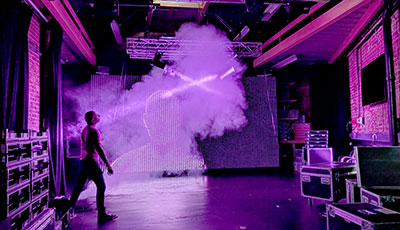
A live, stage-free performance developed by video production and experience specialists, Bluman Associates, MASS blured the line between audience and performer, It was held at The Bath House in Hackney Wick as part of the,CoStar Futures: Grassroots Venues, initiative.
‘MASS brings together live music, visuals, and interactive technology, inviting audience members to engage with the venue as they become part of the performance,’ says Branden Faulls, Creative Technologist at CoStar National Lab.
Rather than watching an artist from a fixed position, audiences are encouraged to actively explore the environment, triggering audio and visual effects that ensure no two performances are ever the same.
CoStar National Lab is the central hub of the CoStar Network, a £75.6m investment by the UKRI Infrastructure Fund, delivered by the Arts and Humanities Research Council (AHRC). Led by the StoryFutures team at Royal Holloway, University of London, the Lab combines leading-edge technology with industry and academic partners to help creative businesses develop, test and commercialise new ideas, strengthening the UK’s creative technology capability.
 During preproduction, of Bluman Associates founder Pod Bluman, outlined the potential uses of Stage Precision’s SP Grid platform. ‘I’ve been working with some variation of Stage Precision for the past five years,’ says Pod Bluman. ‘Whatever project I’m working on, I always think of it as a potential tool. It wasn’t a case of whether we should use Stage Precision, but how much of the project we could implement through the platform.’
The aim was to explore how audiences move and interact with immersive spaces and how the resulting information could be presented and used in a variety of contexts. ‘Whether it’s a performer who wants to learn how to respond to audience engagement, or venue owners planning an event based on these behaviours, we wanted to explore audience interaction,’ Faulls says. ‘SP Grid proved to be an excellent way to collect and contextualise this data.’
The full system incorporates d&b audiotechnik spatial audio and real-time generative graphics created in Notch and delivered to screens via Disguise media servers. Disguise controlled the visual and lighting elements in real time, while a separate audio system delivered the artists’ performances and sound effects triggered or augmented by user actions. Acting as the central middleware layer, SP Grid collected and processed data generated by these interactions before distributing it to a custom dashboard.
Strategically placed throughout the space were RoboSense Airy LiDAR devices to create a map that could be aligned with a virtual model and the A/V elements. Within SP Grid’s Grid Studio, Faulls was responsible for building a customisable real-time dashboard, which received and visualised tracking data from the LiDAR devices.
‘We were interested in the flow of movement and how audiences were interacting with different immersive elements,’ he says. ‘In Grid Studio, we used the LiDAR data for point tracking and spatial alignment, with the results surfaced through the real-time audience dashboard as a model of the space.’
On top of this, Faulls implemented a custom telemetry workflow that sampled the tracking data and wrote it to a database in real time, allowing it to be queried and examined later through the dashboard.
As audience members entered The Bath House, they found themselves in an environment shaped by their own movement and interaction. ‘The audience experienced something they’ve likely never experienced before,’ says Bluman. ‘They were offered a sense of agency and the ability to co-create their own experience. When they stand on a floor tile, the environment around them changes instantly, allowing them to feel the immediate impact of their actions.’
‘These systems and workflows were already required for the experience, so with SP Grid we were able to make greater use of the data and actions they were generating,’ Faulls says. ‘Previously, the different technologies had operated alongside one another with only loose connections. By centralising them through SP Grid, we transformed the system from a largely passive set-up into an active, responsive environment defined by audience engagement.’
Since the project, CoStar National Lab has continued to use SP Grid for its research around LiDAR. ‘In recent conversations, Pod and I have started looking at “SP-shaped problems”, considering from the outset all the different ways that SP Grid could provide a solution,’ says Faulls.
For Bluman, the platform’s value continues to be clear as projects increase in scale and technical complexity: ‘When it comes to centralising data collection, distribution, processing and logic, SP Grid is the only tool I would turn to.’