

Having found that a recent renovation prompted an audio upgrade to match, the 3,000-capacity Leangen Ishall indoor ice hockey arena in Trondheim called A/V integration specialist Avonlyd to ensure intelligible sound throughout.
Home to Nidaros, one of Norway’s Elite Hockey League teams, the venue hosts competition matches, training sessions and public skating events throughout the year, making it one of the region’s major destinations for winter sports.
 Following a highly competitive public procurement process, Avonlyd undertook the design and commissioning of an upgrade that would fulfil the requirements of the venue. Avonlyd has spent nearly two decades building a reputation as one of Norway’s specialist engineering-led integrators, combining system integration, distribution and tech support.
‘Due to the inherently reverberant nature of an ice hockey arena, there were several acoustic challenges that we needed to overcome,’ says Edgar Andraa Lien, Partner, founder and Sales Director at Avonlyd.
The performance requirements were set by consulting engineers COWI, whose tender specified two demanding – and potentially conflicting – targets: high sound pressure level and a high Speech Transmission Index.
‘Meeting both in a highly reverberant arena was never simply a question of extreme output capability,’ Lien says. ‘It depended on maintaining precise directivity and a consistent frequency response across all seating areas. We spent a great deal of time arriving at a solution that did exactly that.’
With large concrete walls, exposed steelwork and expansive reflective surfaces of glass and ice, Leangen Arena’s previous sound system struggled to overcome the long reverberation lines. ‘The key to excellent engineering begins with understanding the room,’ Lien continues. ‘If you understand the acoustics, you can design the system correctly, well in advance of even entering the venue.’
Avonlyd had been in contact with KV2 Audio from the early stages of this project, during which a core solution was developed by the two companies well in advance of the installation. Lien worked with Leo Tanzil, KV2’s Technical Support Director and Product Specialist for APAC, throughout the design process, refining the Ease models and optimising the loudspeaker design.
‘Leo and I share the same engineering mindset,’ Lien says. ‘We both enjoy working in Ease and SketchUp, discussing drawings and solving problems long before anyone arrives on site. Having accurate acoustic data alongside professionally prepared SketchUp models made the whole optimisation process efficient and genuinely enjoyable.’
‘Loudspeaker positioning, amplifier racks, cable routing, and mounting details were all digitally modelled to verify coverage, delay values, and predicted intelligibility,’ he continues. ‘KV2 Audio’s comprehensive SketchUp library proved invaluable as it allowed every loudspeaker to be precisely integrated into the digital venue, giving us detailed data for coverage and intelligibility.’
Fredrik Haugdal and Øyvind Antonsen of COWI placed significant emphasis on simulation data, documentation and design methodology, and a meeting gave Avonlyd the opportunity to present its Ease models, SketchUp drawings and the technical reasoning behind every major design decision.
‘Meeting the consultants face to face was extremely valuable,’ says Lien. ‘It allowed us to walk through the project together, explain our design philosophy and demonstrate how every engineering decision had been validated. Those discussions helped build confidence – not only in our approach, but in KV2 Audio as the right solution for the venue.’
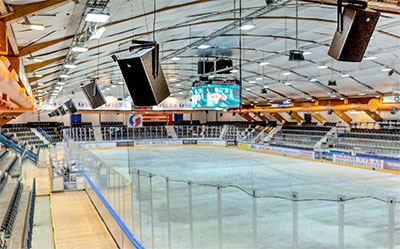
An eight-element subwoofer array from KV2’s VHD Series and ESD Series full-range loudspeakers were chosen for their power and clarity. ‘The original plan was to suspend the subwoofer cluster in the centre of the ice rink for low-frequency reinforcement, but a media cube was already suspended in this position to display scores and live match content to the audience,’ Lien says. The digital Ease model had already allowed them to determine the optimum loudspeaker placement, leading to the installation of a completely new steel suspension structure around the media cube from which eight VHD4.18 subwoofers were deployed in an oval geometry that reflected the layout of the arena.
Twenty-six ESD12 2-way, passive loudspeakers were flown around the perimeter of the ice rink, with four positioned along each short side and nine along each long side. ‘The arena’s geometry proved to be a natural advantage for the sound design,’ Lien explains. ‘Every loudspeaker position was relatively close to the audience seating area, allowing the system to deliver high output with excellent tonal consistency so that direct sound remained dominant over the highly reflective acoustics. The arena’s short throw distance allowed us to keep audiences inside the direct field of every loudspeaker, which meant we could fully exploit KV2’s controlled directivity to achieve excellent intelligibility without needing excessive SPLs.’
Since the installation, the arena has seen significant improvement during ice hockey matches and public skating events. ‘Working with KV2 helped ensure that logistics and commissioning progressed efficiently, and delivered a robust, future-ready system that can be expanded and optimised for years to come,’ Lien reports.
‘One of the most rewarding aspects of the project was working with people who share the same engineering mindset,’ he concludes. ‘KV2’s Leo Tanzil, Sascha Khelifa and Dominik Krampera were always available throughout the design and integration process, and this close collaboration ensured that every aspect of the system was carefully refined, from the earliest Ease model through to final optimisation.’
More: www.kv2audio.com