

Prompted by a combination of lifestyle changes and a desire for independence, Kurt Martinez made the bold move to step away from commercial facilities to build his own Dolby Atmos mixing room in his garden, with an Audient Oria at its heart.
Having previously been Head Dolby Atmos Mix Engineer at Dean Street Studios, Martinez has worked with a stellar line-up of artists including Central Cee, Kylie Minogue, Perrie and Soft Play. But long, unpredictable hours and a gruelling commute into London meant prioritising family time became essential after the birth of his daughter.
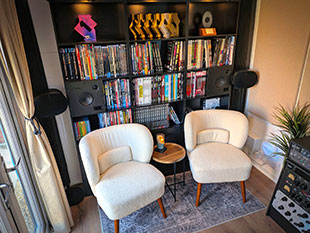
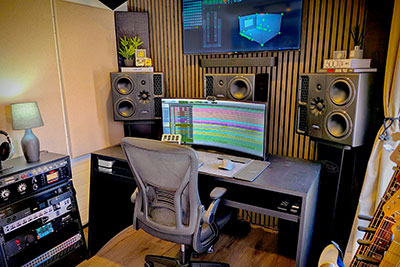 Martinez settled on a compact 2.5m x 3.5m footprint in his garden and took on the build himself, outsourcing only the electrics and internet. Situated in the quiet countryside, traditional heavy soundproofing was less of a concern than internal acoustic treatment, so he used a combination of naturally porous timber walls to absorb low frequencies, acoustic panels on the sides and ceiling, front-wall acoustic slat panelling and a large rear bookshelf for diffusion.
To make the space functional, he installed wood laminate flooring with thick acoustic underlay to reduce vibrations and allow him to roll smoothly from his listening position to gear racks. Armchairs and a rug in front of the shelves were added to provide a touch of extra acoustic absorption. Because this space is part of a short-term two-to-five-year plan rather than a forever home, the DIY route was the way to get back into freelance life without a massive corporate budget.
For monitoring, he invested in a high-end PMC system comprising PMC6-2 left and right monitors, a PMC6 centre, an 8 Sub LFE and Ci30 heights and surrounds. At the heart of monitoring control sits the Audient Oria, handling all room correction and routing out to his speaker array and headphones.
Working in Pro Tools alongside the external Dolby Atmos Renderer, Martinez feeds his audio to Ginger Audio’s Ground Control Sphere, which he controls via an Elgato Stream Deck+ on his desktop. This set-up allows him to readily switch between physical outputs, binaural re-renders, Apple Spatial re-renders and stereo references.
Having spent four years using an Ethernet network system in commercial studios, Martinez was eager for a more dependable, straightforward connectivity option at home. He notes that the network system often required a degree in network engineering just to troubleshoot issues minutes before a client playback. With Oria, the physical speaker outputs and AES connectivity provided a massive advantage.
 Unlike interfaces that require complex expansion cards, adapters or custom cabling, the Oria offered a direct, uncomplicated set-up – Martinez runs balanced quarter-inch jack outputs out from the rear panel to the XLR inputs on his main monitors, and jacks to bare wire to his amplifier for the heights and surrounds.
Once up and running, the Oria allows him to switch between distinct speaker profiles at the push of a physical button on his Stream Deck+ or directly from the front panel interface. These profiles include a flat profile running native speaker DSP, a fully calibrated Sonarworks profile, a Dolby curve profile and a dedicated stereo profile that changes how the left and right speakers behave when not interacting with the rest of the room.
Alongside the Oria, Martinez has an Audient iD48, dedicated to managing his analogue outboard gear. Using a DB25 cable, the iD48 connects the interface’s analogue sends and returns directly into a main patchbay where the hardware lives.
While his mastering chain rarely changes, anchoring the iD48 to the patchbay gives Martinez the flexibility to switch routing or audition different pieces of hardware on the fly. When working in stereo, he runs his outboard gear as hardware inserts just like standard plug-ins. In Atmos, he applies those same hardware inserts to the left and right channels as a stereo bus, choosing plug-in emulations if he needs that specific processing on objects pulled further into the room.
Moving to a dedicated personal workspace has transformed Martinez’s daily workflow and creative confidence. Before completing the room, he relied heavily on mixing on headphones and booking commercial rooms to double-check his work. Now, his workflow is entirely loudspeaker-focused once more.
‘The benefit of having a proper Atmos system here means I’m able to accurately gauge object placement in a 3D space, and know exactly how those movements will fold down for consumer systems,’ Martinez says. To ensure his mixes translate perfectly to everyday listeners, he checks his work against Apple AirPods Max and a Sonos Home Theatre system.
The results speak for themselves: on his last five full-length records, his mixes required absolutely no adjustment after checking them in larger commercial rooms, receiving immediate first-time approval from the artists.
For other engineers looking to follow in his footsteps and establish an immersive audio space at home, Martinez offers a final piece of seasoned advice: ‘Don’t rush it. Work out your budget, work out your time frame and map out exactly what you need, not necessarily what you want.’
See also:
Audient/Sonarworks Oria Mini
Audient Oria iPad Remote App/Dante card
More: https://audient.com/products/monitor-controllers/oria/overview