

Possessing one of the most distinctive voices in British alt rock, Richard Ashcroft continues to captivate live audiences. His support slot on Oasis’ Live ‘25 reunion tour established a new generation of fans while long-time followers embraced the man who is often credited with inspiring the band’s early work.
This summer, following a sold-out UK arena headline tour led by Tour Manager Lewis Allman and Production Manager Will Matthews, he will play against the backdrop of some of the UK’s most historic outdoor venues, including medieval castles – a fitting stage for the enduring King of Orchestral Indie.
Celebrating songs that helped define the 1990s and his still-evolving songwriting, the show mixes new material from the Lovin’ You studio album with anthems from his time with The Verve. Sound reinforcement comes from Britannia Row.
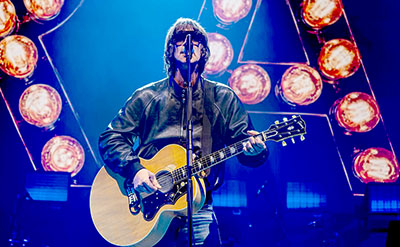 ‘This was my first tour using Brit Row,’ says longtime FOH Mixer, Eds John. ‘I met [Account Executive] Dave Compton when Richard was supporting Oasis last year, and it’s been a very successful partnership. I’ve been massively impressed by the care that goes into the prep of the whole system and by the team assembled to support us both on the road and at the warehouse.’
‘Richard’s voice has so much character and needs to be crystal clear, so I tend to sit his vocal right on top of the mix,’ he continues. ‘This doesn’t mean the band are mixed quietly, far from it, but that vocal needs to pop out. Richard’s a huge fan of vocal FX, especially delay, so they’re constantly bubbling under until he’s ready – then the delays take your head off.
‘He loves to be immersed in delays. I have a click track from playback world just to trigger delay times and then two macros to take the delay feedback from 40–100%. When the macro fires the 100% feedback, it turns the input to delay off to save unwanted spill.’
The ‘Lucky Man’ singer has used a Shure Beta 58a microphone for years: ‘It works well through FOH and, more importantly, Matt (Lewis, monitor engineer) can get enormous amounts of clean level on stage as we don’t use any IEMs. I’ve been using Earthworks mics for the drums – once you’ve tried them, you won’t want to use anything else.’
The string sections use a combination of DPA4099 and Schertler dynamic mics.
For the indoor arena run, Britannia Row supplied a d&b audiotechnik PA rig with DiGiCo mixing surfaces, a combination these engineers see as non-negotiable package. For control, John’s choice of the Quantum 338 and a Fourier Transform Engine in his rack keeps things simple. ‘These two items are all I’ve been touring for the last couple of years, along with a Pro Tools recording rig, which I bring with me,’ he says.
‘I like a minimal FOH set-up for many reasons, including ease of duplication, as I tour the world. Fourier was a game changer for me; I have everything I need in one box and with the DiGiCo integration I really don’t need anything else.’
On the meter bridge are two iPads; one running walk-in music and an RTA connected via a Universal Audio Volt interface: ‘It’s a brilliant piece of kit designed to work with IOS. The second is running the DiGiCo remote software,’ Johns notes.
‘Plug-in wise. I’m using Waves Renaissance Compressors on all vocals with Waves F6 RTA EQs, there’s two vocal subgroups; one for Richard and one for BVs which have a Waves C6 multi-band. There’s also a Waves SSL Buss Compressor on the master which sits around minus 3dB reduction.’
Johns also has Valhalla reverbs for vocals, strings and drums and Sonnox reverb for acoustic guitar, while everything else is on the console, including those all-important vocal delays and MSE on vocals and live strings.
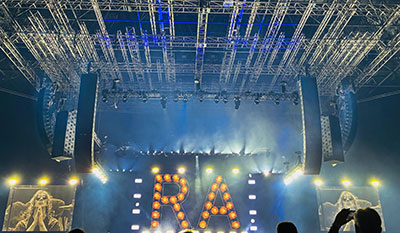 Another rider must-have is a d&b rig: ‘In my opinion, no-one is making better speakers, amplifiers and software. The DiGiCo, Fourier and d&b combo is what I use for all the artists I tour with.
For the past five years, Craig Burns has been system designer/engineer for all Johns’ tours. ‘The idea for this tour was to ensure that the audience got the best possible experience no matter where they were sat, with minimal spill onto stage,’ he says. ‘As long-standing d&b users, the choice was made quickly for the SL Series.
‘The only difficulties we faced were acoustics and low trim height in arenas. With the PA being positioned correctly and the desired trim heights secured, we were able to achieve great results in room, which didn’t initially sound great. The SL Series is a huge help with its rearward cancellation, and Array Processing ensures the audio gets to just where it needs to go. Having the right amount of speaker hangs ensured we also didn’t have to compromise on coverage or positioning.’
The duo specified the Direct Out’s Prodigy.MP processing out front: ‘It’s pretty much my go-to processor these days. The flexibility and features ensure I don’t have to worry about being restricted in workflow. We also use Milan infrastructure with d&b D90 amplifiers which worked perfectly.’
Burns is also handles Crew Chief: ‘Touring is tough when all the elements aren’t thought about, but every element here was. It’s the people who make a tour and the people on this tour were exceptional. Every time I work with Britannia Row, I feel at ease as I know everything has been taken care of before I even have to think about it.’
‘I’ve always enjoyed working with Britannia Row, and the new warehouse is fantastic,’ agrees monitor engineer Matt Lewis, who had 21 mixes for the arena shows courtesy of additional musicians. This includes a five-piece string section, keys player and two backing vocalists. They all use IEMs primarily, whereas Richard and his core touring band rely solely on the stage sound, wedges and side fills, and this is where the gig happens.
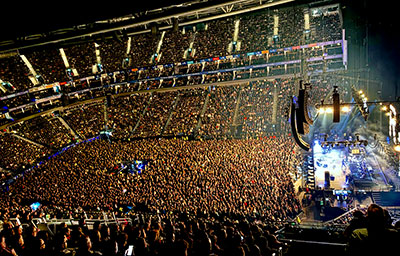 ‘Brit Row’s techs are at the top of their game, and that’s the most important part for me - knowing I have knowledgeable and friendly support on the gig in those moments. It can be hard to keep on top of everything with 11 musicians onstage and my eyes fixed on Richard but knowing they are right there with you, ready to jump into battle, helps immeasurably. A gig is only ever as good as the team behind it.’
Side fills are particularly important for Lewis: ‘They have always played a crucial role for me. They are positioned close to the performers and consist of a full compilation, close to a FOH mix. ‘I like to walk the stage a lot during soundcheck and often find myself spending more time in front of Richard’s mic position if he hasn’t sound checked on that day. I like to understand exactly what he will be hearing during the show and from the moment he walks onstage, it has to be right.’
‘Currently, he uses a Waves Superrack alongside the DiGiCo Quantum 338. ‘I enjoy how flexible the set-up is and how deep and full the preamps sound. Over the years I’ve used all formats of the console on this gig but have settled on the 338 mainly due the extra processing including Aux nodes and Mustard processing. I also really enjoy the three screen/bank layout – it just makes my life easier being able to set up my console with more information viewable at once.’
Lewis has a variety of plug-ins for a little extra dynamic control such as the C6, F6 and SSL Bus Compressor. Onstage is strictly d&b: ‘I have five M2 stage monitors that sit in front of Richard, whereas the rest of the band use M4s. Side fill consist of a single V-sub with fourx V8s on top.
‘Over the years, this set-up has become non-negotiable for me on this gig. Having a live string section through your side fills alone brings its own challenge but I do everything to ensure the band will have a great gig.’
More: www.britanniarow.co