

At the heart of the technical modernisation of Bayerischer Rundfunk’s (BR) radio outside broadcast vehicle Ü5 is a 48-fader Lawo mc²56 MkIII production console. The vehicle supports a wide range of production formats, including sports, concert productions and cultural events like classic open air concerts.
Audio processing is handled by Lawo’s Home mc² DSP App running on a standard CPU server. The system is complemented by Power Core gateways for onboard and stagebox I/O, an additional Power Core dedicated to communications tasks, Home Multiviewer and Home Stream Transcoder Apps, as well as a .edge interface providing SDI video connectivity and audio embedding/de-embedding.
 Audio and video signals are transported across the IP network using SMPTE ST 2110 and AES67 standards.
While the truck’s chassis and body – originally built in 2007 – were retained, the entire technical infrastructure inside the vehicle has been rebuilt from the ground up. ‘This was not a conventional retrofit project but rather a complete technical redesign within the existing vehicle,’ explains Bayerischer Rundfunk Media Engineer, Nicolas Anselm-Rasor.
The conceptual phase of the project began in 2022. Ü5’s production architecture is built around a SMPTE ST 2110-compliant IP infrastructure, carrying audio, video, monitoring, and control data over a shared network. The Home mc² DSP App provides audio mixing capabilities and is licensed for up to 384 processing channels and as many as 1,280 inputs and outputs. Additional components include a Home Multiviewer and multiple Home Stream Transcoder instances.
The multiviewer displays both SDI sources, connected via .edge, and NDI-based PTZ camera feeds. Sources can be distributed to additional displays across the network using IP connectivity.
‘Ü5 is Bayerischer Rundfunk’s first mobile production platform to operate entirely on SMPTE ST 2110 and to be based on a software-defined architecture,’ says Anselm-Rasor.
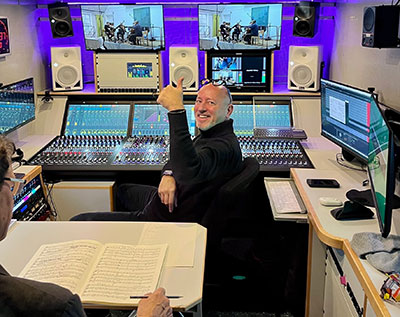
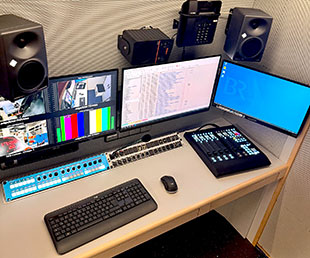 The audio control room is centred on a Lawo mc²56 MkIII production console, replacing the previous mc²66. The vehicle features three primary workstations – the main audio engineer’s position at the mc²56 MkIII, a second position for the balance engineer, and a dedicated technical and recording workstation.
A crystal controller is installed at the recording position, allowing control functions to be flexibly assigned from the main console. All workstations share access to the same central DSP engine.
The stagebox architecture is fully IP-based. Each stagebox provides up to 48 microphone inputs and 16 line outputs, along with Madi and Dante interfaces with integrated sample-rate conversion. The units serve as gateways between IP audio, local peripherals and the central DSP infrastructure. A fibre-optic connection carries audio signals, network connectivity, control data, and NDI-based camera feeds between locations.
For recording applications, the system provides up to 192 channels across multiple workstations. Independent recordings can be created at individual workstations, while markers can be inserted directly from the mixing console.
The first production assignment took place in January 2026 with the recording of a chamber music concert for BR Klassik. Since then, the Ü5 has been deployed in several additional production scenarios. In February, the vehicle handled transmission operations for a live opera broadcast from the Bavarian State Opera for BR Klassik. Audio mixing was performed in the venue’s permanent control room and handed off to Ü5 for transmission. From there, the vehicle managed the complete broadcast chain, including pre-show and intermission programming. The vehicle has also been used for jazz production, further demonstrating the flexibility of its software-defined, IP-based production environment.
More: www.lawo.com