

The House of Music is the result of the personal vision of Italian producer and former DJ Andrea Lo Solfo. Equipped exclusively with Genelec Smart Active Monitoring, it is a multi-purpose space with a Dolby Atmos capability.
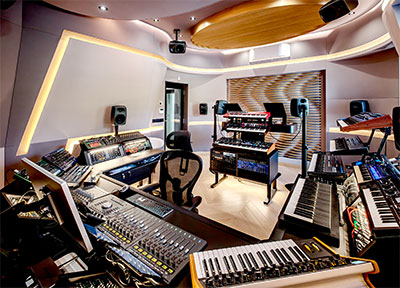 A major presence in the Italian dance and progressive scene through the 1990s and 2000s, Lo Solfo now works outside the music industry but remains passionate about music production. Setting his sights on building a music studio in Warsaw, he has drawn on his personal aesthetic and wife Gosia’s architectural sensibility.
‘Our goal was to create a genuinely multi-purpose creative space with a Dolby Atmos mixing room, a fully featured production studio, and a DJ performance area – all within a high-end architectural setting with a single acoustically optimised environment,’ he explains.
Crucially, the facility also has a broader educational mission: ‘We wanted to create a Dolby-certified facility capable of hosting producers, serving as a laboratory for immersive audio production, and acting as a base for educational activities and courses focused on Dolby Atmos Music and immersive workflows,’ he says. ‘With this, we can position the studio as a true laboratory for music creation rather than a purely postproduction environment.’
With Acusticarte from Rome handling the facility’s construction, the acoustic and interior design were handled by Studio Sound Service from Florence. ‘We actually began the design back in 2017, when Andrea and Gosia were still planning the construction of the new facility,’ says Studio Sound Service’s Donato Masci. ‘Since the building itself was intended to realise Andrea’s vision for the music studio, the construction and optimisation spanned several years, with the pandemic further extending the timeline.’
The growth of immersive technology also influenced the development of the project. ‘Initially, the room design didn’t account for Atmos at all,’ Masci says. ‘Then, as immersive audio became an industry standard, the project underwent a complete revision. The concept was adapted to meet Atmos requirements, and some of the more complex curved elements were simplified to ensure practical implementation.’
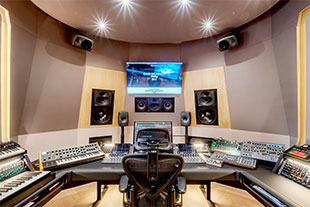 A second major development involved the Artnovion console and instrument system: ‘What began with the simple requirement of “just a small keyboard” evolved into a complex set-up,’ says Masci. ‘Percorsi Audio – Fausto Demetrio and Luca Ravagni – optimised the system so that Andrea can power on the studio, walk in, and immediately play any instrument, all fully patched and ready to use.’
The studio’s 7.1.4 immersive system features a pair of Genelec 1238As as main L/R monitors with a horizontal 1238AC in the centre, complemented by eight 8340As for surrounds and overheads. A 7380A subwoofer handles LF. The room also includes two pairs of compact 8341A three-way coaxial monitors – one pair for stereo close-field work at the front of the room, with the second pair integrated into the DJ set-up at the rear of the space.
‘Genelec was selected based on strong musical and technical considerations, fully aligned between the client and the design team,’ Masci says. ‘The monitor choices proved particularly effective when the project was adapted for Dolby Atmos Music. The horizontal 1238AC performed optimally as the centre channel, saving vertical space and allowing seamless integration of the screen above it.’
Lo Solfo has high praise for the quality of the monitoring system: ‘The stereo image is extremely accurate, the low end remains tight and controlled, and the overall translation is remarkably consistent even at different listening levels. At the same time, the system preserves a natural warmth that makes long sessions comfortable and inspiring. It allows me to hear every nuance of a mix with confidence, from subtle dynamics to spatial details, without ever sounding harsh or fatiguing.
‘Genelec has significantly improved both the efficiency of my workflow and the overall quality of my mixes,’ he adds. ‘The accuracy of the monitoring environment allows me to make critical decisions much faster, with far less second-guessing during production and final mix stages. This level of trust in the monitoring chain enables a more creative and focused workflow, while ultimately delivering mixes that are more precise, immersive and emotionally engaging.’