

Argentine composers and producers Andres Goldstein and Daniel Tarrab – founders of leading Latin American music production company Swing Music – have opened a new dual-studio in Buenos Aires with the help of WSDG on its acoustic and technical design.
Having previously collaborated with WSDG on the original Swing Music studio, Goldstein and Tarrab again partnered with the firm on Swing Music 2.0, led by Senior Partner and Co-CEO Sergio Molho, to create a new generation of production spaces tailored to the evolving demands of contemporary film, television and multimedia composition.
Designed as two distinct but interconnected creative environments, Swing Music 2.0 reflects the individual workflows and artistic personalities of its owners while maintaining a cohesive production identity. The studios support the full spectrum of modern soundtrack production, from composition and programming to recording, editing, mixing and remote collaboration.
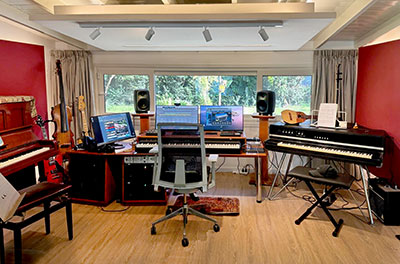 ‘Over the years, the way we work has evolved enormously,’ Goldstein says. ‘We needed spaces that could support very long creative sessions, allow us to move quickly between different stages of production, and still feel inspiring and comfortable. WSDG understood that, and translated it into rooms that genuinely support the creative process.’
The project was developed around the increasingly hybrid nature of modern music production. With this in mind, WSDG’s brief included acoustic design, technical integration, workflow planning, lighting design and technical interior design for both studio environments.
Rather than creating two identical rooms, WSDG worked with Goldstein and Tarrab to shape each studio to their individual working methods and technical preferences.
‘Each of us has a very personal relationship with sound, instruments and workflow,’ Tarrab explains. ‘What I appreciated most was that WSDG never approached the project with a ‘one-size-fits-all’ mentality. They listened carefully to how we actually create music and designed spaces around that reality.’
Goldstein’s studio, Swing Godoy Cruz, is centred on a hybrid scoring workflow and features a master Mac system alongside a dedicated Mac slave for sound libraries, a Smart TV for picture reference, Genelec 8331A monitoring, Focusrite Scarlett interface, Avalon compressor, Studiologic control surface, keyboard controller, beyerdynamic headphone distribution, and AKG 414 and Neumann microphones.
Meanwhile, Tarrab’s Swing Control Z Studio combines digital production tools with an extensive collection of instruments and analogue equipment. The studio features a Hackintosh master computer, PC slave, StudioLogic SL88-Grand, Studiologic SL Mixface, Avalon AD2022 preamplifier, SSL 2+ interface, Genelec 8040A monitoring, AKG 414 and Neumann U87 microphones, as well as an instrument collection that includes a 1905 Steinway & Sons Vertegrand piano, Yamaha CP70, Fender Jazz Bass and multiple Epiphone guitars.
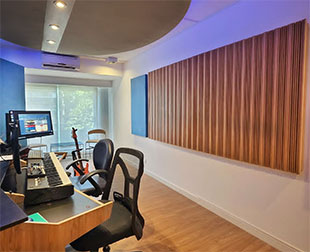 Throughout the project, WSDG focused on balancing acoustic precision with musicality and comfort, ensuring that both spaces could function as highly technical production environments without losing their sense of intimacy and creative character. ‘One of the most important aspects of this project was creating spaces that disappear when you’re working,’ Goldstein says. ‘Technically, everything performs exactly as we need it to, but emotionally the studios also feel warm, relaxed and musical. That balance is extremely difficult to achieve.’
‘Working with Sergio and the WSDG team felt incredibly collaborative from beginning to end,’ Tarrab adds. ‘There was a real understanding that these studios were not just technical rooms, but creative environments where ideas need to flow naturally. That level of sensitivity made a huge difference.’
Throughout their careers, Goldstein and Tarrab have contributed to a number of internationally recognized film and television productions, including Some Who Lived, directed by Luis Puenzo and produced by Steven Spielberg; Lucía Puenzo’s XXY, which screened at Cannes in 2007; the Emmy-winning Inheritance, directed by James Moll; Netflix’s Nadie Nos Vio Partir; Prime Video’s La Jauría; and Señorita 89 for StarzPlay.
‘Swing Music 2.0 represents exactly the kind of highly personalized creative environment we are passionate about designing at WSDG,’ says Molho. ‘Andres and Daniel each have their own unique artistic processes, and our goal was to create spaces that technically support those workflows while also preserving the emotional and creative energy that is so essential to music composition. The result is a pair of studios that feel deeply personal while functioning together as one cohesive production ecosystem.’
More: www.wsdg.com