

Lindell Audio has announced the LiN76 mkII, the next-generation of its 1176-style FET compressor, introducing upgrades driven by user feedback.
With an updated compression circuit, improved power architecture and expanded functionality, the mkII is engineered for higher performance, lower noise, and greater workflow efficiency than its predecessor. At its heart is an updated compression circuit optimised for high performance and low noise. A newly developed custom transformer unique to the LiN76 mkII delivers both clarity and harmonic richness, depending on how hard the unit is driven.
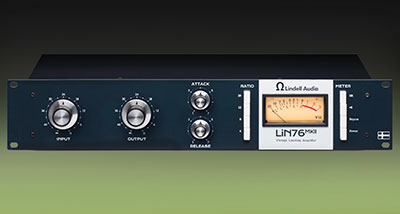 One of the most requested additions, stereo linking via RCA, allows pairing of two units for matched stereo compression as used for bus processing and mix applications. The mkII also replaces the external power supply with a new internal PSU and standard IEC connection, simplifying studio integration and reducing cable clutter.
Workflow enhancements include true bypass for instant A/B comparison, a meter calibration trim for fine-tuning vu response, and a revised control scheme that follows the traditional ’76 behaviour – clockwise for faster attack and release, anticlockwise for slower response.
Rather than modelling a single historical unit, the LiN76 mkII draws from several revisions of the classic Universal Audio 1176 FET compressor topology, combining their most desirable characteristics into a single, highly versatile tool.
These include an input stage: inspired by Rev. D and Rev. G circuits, delivering exceptionally clean pre-amplification into the compression stage; a compression stage that uses a FET topology reminiscent of early 1176 designs, selected for its tonal character; and an output stage based on Rev. A circuitry, capable of delivering harmonic grit and saturation when pushed.
This hybrid approach grants users a broad tonal palette to choose from. Engineers can dial in pristine, transparent compression by increasing input while keeping output conservative, or introduce colour and saturation by driving the output stage more aggressively.
LiN76 mkII maintains the immediacy and musicality that define classic hardware compressors, while incorporating modern expectations for reliability and usability. Whether shaping vocals, tightening bass, or energising drum buses, the unit offers a fast, intuitive workflow backed by robust analogue design.
KEY FEATURES:
- FET-based compressor inspired by multiple classic 76 revisions.
- Custom-designed transformer.
- Redesigned compression circuit with improved performance and noise.
- RCA stereo link for matched dual-mono operation.
- Internal power supply with standard IEC connection.
- True bypass for instant A/B comparison.
- Meter calibration control for precise VU adjustment
- 4:1, 8:1, 12:1, 20:1, and all-buttons-in ratio modes.
- Variable attack and release with ultra-fast response times.
- Balanced input and output.
- Vintage-style vu metering.
The LiN76 mkII will carry an MAP of US$399 and an EU SSP of €532.00 (inc. 19% VAT).