

A 2023 upgrade to its Connecticut remote production centre saw Ross Production Services (RPS) install three 60-fader Calrec Argo S consoles, one of which has recently been adopted for the company’s new Hypermax-1 truck. According to Director of Engineering Lance Bracale, the swap offers greater flexibility on the road without sacrificing remote capabilities.
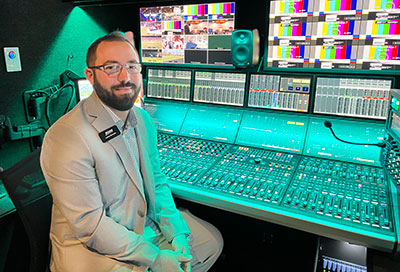 ‘The compact Argo S fits perfectly into the footprint of Hypermax-1 and the Argo M we have replaced it with is a 36-fader console to mirror the Brio consoles that we have across our fleet of smaller trucks,’ he says. ‘The Argo M gives us maximum flexibility; it continues to connect to our range of RP1-enabled REMI-only units, and we can also adopt our Ross Ultrix platform to mux and demux everything fully back to Connecticut if we don’t have an RP1 available. Because it is totally self-contained with built-in I/O, we can even send it offsite for full remote mixing.’
Designed and built during the pandemic, RPS remote facility in Connecticut supports a range of established remote production workflows for major broadcast networks and league start-ups. In addition to the Argo consoles in its remote facility and Hypermax-1 truck, RPS relies exclusively on Calrec for its entire distributed audio infrastructure, which includes Calrec Brio consoles in its Fin1, Fin3, Fin4, Fin7 and Fin8 Sprinter van units. The fleet also boasts two flypacked Brios, an Apollo in its RPS 9 truck, and a suite of RP1 remote production engines in its Distro 1/2/3 REMI-only mobile units.
‘Calrec is used in every one of our trucks and the Argo is becoming more and more of a standard for mixing in remotes and mobile units,’ says Bracale, who oversees all mobiles, engineers and workflows at RPS. ‘The flexibility of Calrec’s True Control 2.0, which will be added, and the seamless way we can connect an RP1 for a remote workflow are both really standout features. ‘But the biggest advantage to having Calrec across the board is that it keeps everything simple. It means almost any A1 can walk into an audio control room or truck and know how to use it.’
Bracale says that RPS’ adaptable Hypermax-1 unit already has bookings for a wide variety of events, from sports broadcasts and music festivals to government debates and rodeos. Meanwhile, the speed of installation of the Argo M onto Calrec’s existing IP ImPulse backbone meant that the console was on air within hours of commissioning.
‘The swap was super easy for the Argo M to be integrated into the IP network due to Calrec’s flexibility and powerful ImPulse core options,’ he explains. ‘Having an existing network and not having to recreate it from scratch was super simple to get up and running and took just two days to commission. Calrec’s Rob Lewis and Drew McEachin also helped us work through our unique workflows and supported us to commission everything in such a timely manner that the Argo M was used the day after commissioning for a Versant Basketball game – and it worked like a charm.’
With a shared drive to prioritise flexibility over more traditional architectures, Calrec Technical Sales Manager Lewis says that the company’s relationship with RPS is one that is designed to scale to meet future requirements.
‘Remote and distributed production models already make the most of a production company’s resources, but the opportunities it creates are more nuanced,’ he says. ‘The ability to do more with the same flexible equipment enables production companies like RPS to create more content with the same resources.
‘It gives broadcasters and production houses the freedom to experiment with content that they might not have had the resources to cover before. And in today’s fragmented media landscape, that kind of agility is priceless.’
More: https://calrec.com