

Stuttgart’s State University of Music and the Performing Arts (HMDK) is among Germany’s largest and most prestigious universities for the arts, as well as playing an important role as a concert promoter and cultural centre. With an increasing focus on immersive audio, HMDK recently upgraded its recording facilities with a 9.1.4 control room equipped with Genelec Smart Active Monitors.
‘We have four performance spaces’ says Arne Morgner, HMDK’s Deputy Technical Director. ‘Our large concert hall, a chamber music hall, a theatre and an orchestra rehearsal hall, which can also be used as a performance venue. We host 500-550 events per year – which actually makes us the largest event organiser in Stuttgart.’
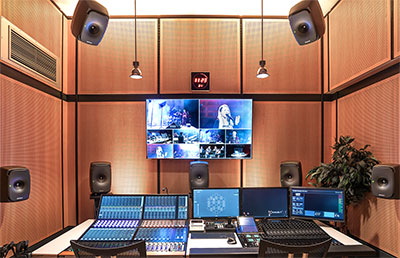 As Morgner points out, HMDK’s recording studio fulfils multiple important functions beyond recording classical music. ‘We’re also responsible for livestreaming and broadcasting, including collaborations with the public broadcaster SWR, and we function as the technical backbone for all event technology. It’s also the centre for all servers and networks related to audio, video and lighting in the building.’
While the studio itself has evolved organically over the years, Genelec has long provided an element of continuity.
‘Control Rooms A and B both started out as compact stereo spaces equipped with classic 1031A and 1032A models,’ Morgner explains. ‘After successive upgrades to 5.1 then 7.1 surround systems, we finally adopted 7.1.4 immersive in 2024. Then, with the recent development of our Klangmobil 9.1.4 immersive mobile recording truck, we upgraded the system in Control Room A to the same 9.1.4 format using Genelec’s The Ones monitors.’
Klangmobil allows children in the region to experience the music of Bach in an immersive format, with all the content for the truck being produced, edited and programmed at the studio.
‘In our broadcasting operations, we started very early with binaural livestreams to transmit 3D audio, and that’s how we encountered 3D audio microphone arrays,’ Morgner continues. ‘We also regularly supervise master’s theses in cooperation with the Stuttgart Media University, focusing on 3D audio, under Professors Oliver Curdt and Frank Melchior.’
While able to produce binaural 3D audio content, HMDK lacked a room with the necessary monitoring capabilities: ‘We wanted to be able to work with established formats like Dolby Atmos, but also to produce 3D audio independently of any specific standard. As a result, we decided on a 9.1.4 set-up,’ says Morgner.
With Morgner handling the planning and implementation alongside HMDK colleague Walter Schimon, Control Room A’s 9.1.4 system features 8351As in the LCR positions, with 8341As as surrounds and overheads, supported with a 7370A subwoofer for LFE. Control Room B is equipped with a stereo pair of 1032Bs, plus a 2.1 system comprising 8341As with a 7370A sub. Lastly, a pair of 8350A monitors powers the studio’s Recording Room.
The Klangmobil truck is powered by 4430A Smart IP loudspeaker models, which deliver studio-quality Genelec performance with the added power and flexibility of Dante/AES67 network connectivity.
‘For us, The Ones models were particularly interesting for Control Room A because we’re not just a traditional production studio – we also work extensively with students,’ Morgner adds. ‘Therefore, it was important for us to offer as many people as possible a balanced listening experience – we wanted a large sweet spot. We also appreciate the deep low-frequency extension of these models, since we work a lot with classical music and value a sense of true envelopment, especially in the low-frequency range. That’s why The Ones operate in full-range mode in our immersive setups – the subwoofer only handles the dedicated LFE channel, without bass management.’
The integration of The Ones with Genelec GLM loudspeaker manager software is also bringing significant benefits: ‘We use GLM constantly, because it allows us to switch from standard stereo 2.1 operation to 3D audio with one click, eliminating the need for external loudspeaker management,’ Morgner explains. ‘The calibration function is also very helpful. The room is acoustically well-designed, but in combination with GLM, we can achieve significantly better results.’
With the studio upgrade now complete, Morgner is pleased with the quality of the mixes now being produced: ‘Sonically, we all benefit from the wider sweet spot, and I clearly feel that our mixes now translate better to other playback systems. Much more often, my colleagues and I find that when we listen to our mixes on a different system elsewhere, the result is much closer to what we originally intended.’
More: www.genelec.com