

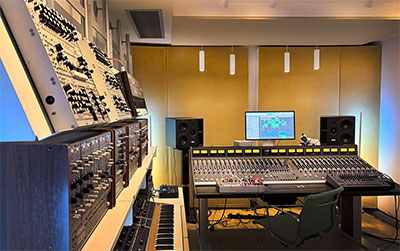
Formerly keyboard player with the band Sade, Andrew Hale has installed a Harrison 32Classic analogue mixing console in his Owlspace Studio in northwest London.
The 32-channel console, with 64 bi-directional channels of Dante and AD/DA conversion, is the focus of creative activity for the BAFTA and Grammy Award-winning composer, songwriter and producer, providing routing of any source in the studio and adjacent live space without leaving the monitor sweet spot.
 Hale won his BAFTA Award in 2011, along with co-composer and orchestrator Simon Hale (no relation), for the soundtrack of Rockstar Games’ LA Noire video game. These days, he says, ‘I do music for a wide range of things, including fashion shows and I still DJ quite a bit. But I’m always playing around. I just love all this old equipment. It’s like coming into the lab every day.’
Over the 20 years he has had Ownspace, Hale has switched his studio between a console-based and computer-based workflow a number of times. ‘Now we’re in a world where people are going back to hardware, and you want to hook things up together and have say six keyboards, two drum machines ,some guitar pedals and a Eurorack modular set-up all running at the same time,’ he says. ‘With the Harrison desk as a centrepiece, it’s almost like running a live 32-track session, putting everything through a fantastic sounding signal path and getting it into the DAW via the consoles integrated Dante audio interface. I’m able to write and record with very little friction because of the freedom it gives me.
The console’s frame design also allows him to keep the computer keyboard or a laptop computer easily accessible, again, without having to move away from the monitors. ‘I even put little keyboards on there when I’m writing,’ he says. ‘It’s all about how you work, day in, day out, so I can’t overemphasise how great all these things are. The console becomes integral to everything that you’re doing, ergonomically as well as technically and sonically.’
Hale was unfamiliar with Dante networking but discovered that it brings significant flexibility to his as well as making installation virtually plug-and-play. ‘We brought the desk in, plugged in the Ethernet cables, and ten minutes later we had music coming out,’ he recalls.
He has also recently integrated Harrison Audio’s D510 10-slot rack and D510dante interface, loading it with Harrison Comp dynamics modules. ‘So, there are ten compressors that I can assign anywhere across the console within a few clicks…’
Two 16-channel Dante interfaces allow Hale to select a different set of sources to send to the 32Classic. ‘The Dante interface and routing is effectively my patchbay,’ he explains. ‘When I want to change my way of working or use a different set of equipment, that’s a two-minute job, and then I’ve got 32 new things coming out of the faders. I didn’t want to go down the route of having everything plugged in and then changing my way of working. The flexibility of the Dante interface also enables me to have a live room with mics on the piano and then a little Dante box to integrate it back into the control room. All these things are just huge problem solvers.’
After considering available new console options, Hale was ultimately drawn to the 32Classic: ‘Nostalgia was a big part of it,’ he admits, as Sade’s debut album, 1984’s Diamond Life and second full-length, Promise, released in 1985, were both produced by Robin Millar at his Power Plant London facility, which had Harrison MR3 consoles in two of its studios.
Hale and the band were always drawn to the musical warmth of Harrison consoles: ‘I trusted that the sound of the 32Classic would be somewhat what I remembered or as had been described. The sonics are as important as the chords to me, and I get a kick out of the fact that the 808 drum machine sounds fantastic going through six channels of the desk. Other desks that are currently around could have done the job technically but maybe wouldn’t have had that difference in sonics – and they certainly wouldn’t have had the ergonomic feel.’