

Playing 41 sold-out stadium shows across 17 cities in the UK, Canada, the US, Mexico, South Korea, Japan, Australia, Argentina, Chile and Brazil, with three shows added along the way due to demand, the Oasis’ Live ’25 tour has included Britannia Row Productions deployment of DiGiCo monitor systems and an L-Acoustics K Series sound system.
While this marks Oasis’ first tour with the French loudspeaker manufacturer, L-Acoustics has been part of the Gallagher brothers’ story for well over a decade. When Noel Gallagher’s High Flying Birds launched their touring career in 2011, FOH engineer Dan Lewis specified K1 and K2 arrays with precision-tuned subwoofer arrangements to nail Noel’s signature controlled low-end. Meanwhile, Liam’s solo tours used a K Series for his explosive Definitely Maybe 30th anniversary tour in 2024, with K1 over K2 arrays and flown K1-SB subs.
Marking the return of Liam and Noel Gallagher to the stage together for the first time in 16 years, the current the tour’s system deployment is more grand in scale than either of the siblings’ separate ventures.
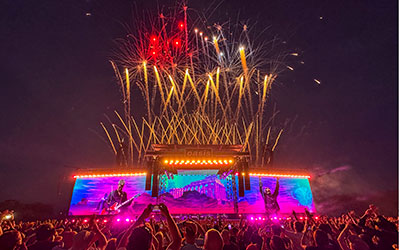 Tour crew chief and systems engineer, Ben Webb, has worked with Peter Gabriel, Thirty Seconds to Mars and the K-pop band ATEEZ in recent years, and is familiar with L-Acoustics, having recently taken Brit Row’s first L-ISA-equipped L Series arena touring system out with Andrea Bocelli. For Oasis, Webb is tasked with crafting the Soundvision design for each tour stop and rigging the system for FOH engineers Dan Lewis, who mixes Noel and the band, and Sam Parker, for Liam’s vocal and effects.
The rig features main arrays of four L-Acoustics K1-SB subs over 14 K1 over two K2 per side, with left and right hangs of 16 K1-SB subs adjacent to each main, while rear 270° hangs add a dozen more K2 per side. Out-fill hangs were identical to the main arrays for the European run, but the audio crew swapped out the four K1-SB with four K1 in North America due to the higher venue heights.
On the ground, KS28 subs were set in 16 stacks of three in a cardioid configuration, with six K3 for front fill. Twenty A15 were used as out fill, with a eight A15 as FOH shadow fill.
The tour’s delay system typically comprised four towers of 12 K1 over four K2, although that was elevated to six towers for the band’s hometown show at Heaton Park in Manchester to cover the field. And in venues where a ring delay system can be hung from the stadium roof, between eight and 11 hangs of eight K2 each have been flown, the full system being more than amply driven by 136 LA12X amplified controllers, paired with a P1 processor at FOH (primarily used to run an analogue backup and for using M1 to tune the system).
‘The original system design was done by Dan Lewis and Britannia Row Head of Engineering Josh Lloyd before the tour even went on sale,’ says Webb, who estimates that he gets in 35,000-plus steps a day walking each venue as he’s tuning the system, then again for soundcheck, and finally during the actual gig. ‘I’m tweaking Josh’s original designs to match venue characteristics and any production changes. That said, I have to say that the new version of Soundvision is better than ever. Show consistency with Autofilter is spot on and it’s a vital tool in my workflow. I strive to get that consistent, even frequency response throughout the entire venue, and Autofilter helps me do just that.’
All Around Monitor World
Steve Weall mixes monitors for Noel and half of the band while his colleague, Bertie Hunter, mixes monitors for Liam and the rest of the band – the split duties are not the result of animosity. ‘It’s not unusual at the very pinnacle level of stadium touring,’ says Weall, who also does monitors for Noel’s solo project, Noel Gallagher’s High Flying Birds. ‘When you’ve got the wherewithal to do it, it’s quite nice to have someone who’s just there for you.
The tour’s pair of DiGiCo Quantum852 consoles – and the Quantum338 and Quantum326 desks used by some of the support acts on the tour – were supplied by UK-based Urban Audio Productions, whose technical director, Dan Lewis, is also one of Oasis’ FOH engineers. Urban also supplied a Fourier Audio transform.engine that is being used by Weall.
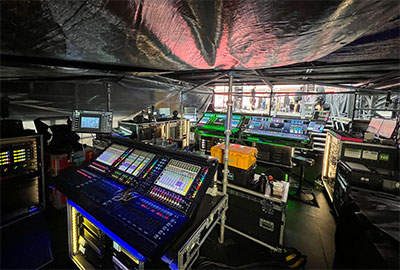
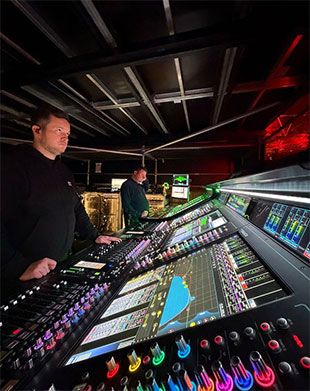 ‘We have a separate console each, and they are side-by-side next to each other, very close, very sociable,’ Weall says. ‘And despite obviously having a significant budget, the floor space is not infinite, so we also have a shared SD-Rack set-up: two main SD-Racks that take all the inputs and the majority of the outputs that we share between two consoles, and we additionally share a master Shure RF rig for the in-ear monitors. I also have another local SD-Rack, and Bertie has a local SD-MiNi Rack, and then we have another SD11 mixer running some shouts, talkbacks, matrixing and other elements, all on a large Optocore network.’
He puts the channel count at approximately 140 inputs and 100 outputs between the two desks, including outboard processing. The monitor operations are quite independent of each other, Hunter emphasises, and are intended to give each Gallagher his own monitor universe.
‘We both have to kind of work together. We both have to decide on the gain structure of every channel. It’s been a lot easier because we’ve been working quite closely together physically, as opposed to being in our own little worlds, which we could have been if we had separate SD-Racks. We can also take input from elsewhere. For instance, I take some effects stems and things like delays, slap delays on Liam’s voice, and sort of one-off catching words from Sam Parker, who is mixing Liam’s vocal and effects out front, just to kind of keep it all locked in. The DiGiCo infrastructure gives us the options and we chose what works best for this situation.’
Weall points out that the Quantum852 consoles were newly purchased by Urban Audio for the tour. The presence of a third LED screen and a redundant engine made all the difference, he says. ‘In case of an emergency – one that has yet to happen.’
The flexibility of the Quantum852 comes into play in a big way with Oasis. Hunter says that, unlike Noel, who uses IEMs every night, Liam prefers floor wedges but will also use IEMs on occasion.
‘So I kind of split the desk up; I have Liam on one end and I have the band in-ears on the other, with a central bank with my graphic EQs and outputs,’ he explains. ‘There really isn’t another desk that could be laid out that easily and where I can pretty much grab anything, anywhere I need to be, whether it’s an in-ear mix or Liam’s wedge, and get it into the right balance and tone. And the amount of faders is definitely useful. If I was to have to start flipping through layers, that’s not where you want to be on a show of this size. And with the 852, I don’t even have to think about it.’
When it comes to processing, Hunter says he uses the Spice Rack’s Chilli 6 six-band dynamic multiband compressor/expander module often, especially on vocals. ‘It’s really handy,’ he says. ‘I used to have to have that as a plugin, so now it’s nice to have it on the desk. I’m also running a couple of Midas XL42 preamps for Liam’s vocal, to give it that sound of ‘old’ Oasis that he likes, so his vocal will go straight into a Midas preamp. Then I’ve got some Distressors in my rack and I’ve got a couple of Kush Audio EQs and a couple of Bricasti M7 reverbs.’
Weall estimates he’s working with 24 stereo channels of effects returns, ‘So it does start to fill up the console quite easily. But the thing is that the central screen can be fully usable as a home screen, with inputs, outputs and overview, which is very handy.’
Much of his processing is outboard, including Neve 5045 primary source enhancers on the vocal chain, Summit DCL-200 compressor/limiters, a Bricasti M7 reverb, and Neve master bus processors. These he’s able to manage easily through the console’s aux sends and inserts, applying them directly to the IEM outputs. ‘We have the flexibility to send anything we want pretty much anywhere,’ he says. ‘For a big, complex show like this, you need flexibility and management, and the Quantum852 desks have tons of that.’
 While not being a heavy plug-in user when mixing monitors, Weall adds that ‘there are a few metering and measurement tools I find extremely useful to have at my disposal to help me deliver the best and most consistent IEM mixes’.
‘The demo and support I received from the team at Fourier Audio’s HQ in London to get familiar with the set-up and integration to my DiGiCo console was invaluable, having never previously used the Fourier transform.engine. I’ve really enjoyed having the extra tools available and am looking forward to bringing the Fourier engine further into my workflow on future projects.’
Urban has been a DiGiCo stockist for some time, having a rental fleet of Quantum Range consoles at its disposal, so the company was more than familiar with the DiGiCo line-up prior to the tour. ‘We have the philosophy of giving people what they want to do the gig, so naturally have invested heavily in DiGiCo over the years as they are a very popular product for our clients,’ says Urban Audio MD Warren Fisher.
‘In the early planning phases of the Oasis tour, it became apparent that both Bertie and Steve were seasoned DiGiCo users, so it made sense for them to stay in the familiar DiGiCo ecosystem,’ Fisher says. ‘For a show of this scale, though, the spec naturally gravitated towards consoles with redundancy built in, for which the Quantum852 fit the bill perfectly with its dual-engine set-up and plenty of available I/O. This, alongside the ability to put both consoles and associated racks on an Optocore loop and share all the routing alongside some very neat custom packaging from Urban Audio, meant we managed to streamline a complex infrastructure project into an easily tour-able and freight-able package. DiGiCo’s consoles have been performing brilliantly on this tour, and we at Urban Audio look forward to using them on more projects soon.’