

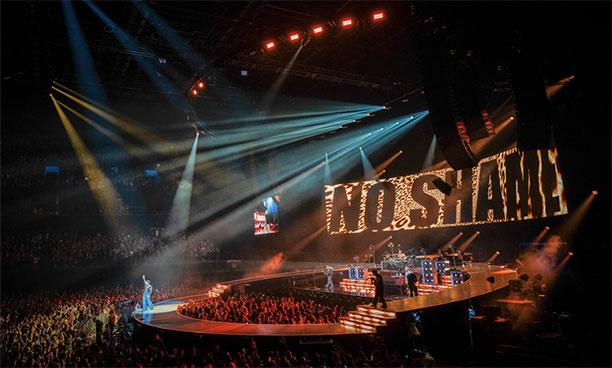
Australian pop rock band 5 Seconds of Summer are currently travelling the world with their Everyone’s a Star! World Tour, making the sound team an early adopter both of L-Acoustics Source Intelligence – after participating in its development – and Shure’s Axient Digital in-ear monitors.
Encompassing 98 shows in total, Everyone’s a Star! opened at the SSE Arena Belfast in March 2026 and runs into December, crossing UK and European arenas, North American arenas and amphitheatres, then South America, Australia, New Zealand and Asia. Every date runs on an L-Acoustics K Series system from UK Certified Provider Adlib, designed by Adlib audio systems engineer Billy Bryson and mixed by Sebastien Teti at FOH.
Teti came to the gig through the band’s drummer: ‘I received a call to mix Ashton Irwin’s solo project two years ago for a show in Los Angeles,’ he says. ‘Since Ashton shares management with 5SOS, they asked me to take over FOH mixing duties for the band, right after the first day of rehearsals.’
With audience capacities from 8,000 to 20,000, Teti’s PA preference is unequivocal. ‘I find L-Acoustics to be the most musical-sounding speaker platform available,’ he says. ‘From a mixing perspective, I don’t feel like I’m fighting aggressive system DSP or artificial processing. There is a distinct sonic signature, but it remains natural and transparent, giving me full control over my mix.’
Production management asked for his preference on the system. What he stressed was not a box count but a person. ‘I emphasised that having a dedicated Systems Engineer who is deeply invested and detail-oriented was critical,’ he continues. ‘Our System Engineer, Billy Bryson, has been all of that and more.’ Bryson has toured with the band since 2020.
The stage for the tour is a ring rather than a rectangle, 75ft across. The band plays their upstage half against a curved video wall, with the downstage half being a curved thrust that carries them out into the room, ending at a second drum kit on an automated lift. The ground inside the ring is a VIP pit, so part of the audience stands within the circle.
 The unconventional stage geometry determined the system design – sound had to reach the VIP pit and the thrust curving around it without the two spilling into each other, and without a centre cluster that have blocked sightlines to the video wall. Four band members move along the thrust, in front of an acoustic drum kit at full volume behind.
Bryson chose to treat the VIP pit as a room in its own right: ‘Billy solved this during the design phase by engineering coverage to give that section the high-energy feel of an intimate club,’ Teti says. ‘It sounds fantastic. I almost wish I could mix the show from down there.’
The same design phase made the tour an early adopter of L-Acoustics Source Intelligence, running it before the technology was publicly launched in May 2026. Source Intelligence applies a machine learning source separation algorithm to a vocal channel in real time, stripping crowd noise, instrument bleed and PA spill and reducing everything that is not the voice by up to 40dB. It runs four instances at once, exactly the number of lead vocals this show has.
‘Being one of the early adopters testing L-Acoustics Source Intelligence was also critical, as it helped manage the bleed from four lead vocalists moving along the thrust, alongside an extremely loud acoustic drum kit on the mainstage,’ Teti says. ‘Between L-Acoustics and Adlib, facilitating that tool has been a genuine game-changer compared to workflows I’ve used in the past.’
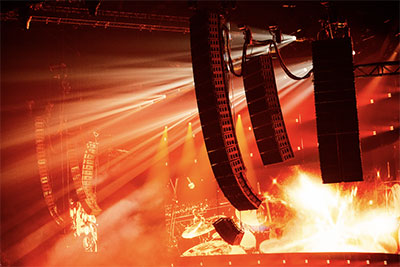
Bryson designed the system to hold its shape between the two venue types. The main hangs comprise up to 14 K1 and four K2 elements per side, the K2 Panflex fins set to minimise spill onto the thrust. Up to eight K1-SB per side fly directly behind them, with both the box count and the electronic steering of the low-frequency pattern reset venue by venue, so the sub coverage is shaped to each room. Side hangs of up to 16 K2 per side carry coverage to the 180° line.
A hang of four Kara II boxes per side serves as fill, flown inboard of the main hangs to cover the VIP pit in stereo, the Panflex fins again turned to keep energy off the thrust and the main stage. Eighteen KS28, on Adlib’s custom touring dollies, are deployed end-firing at the outer edges of the circle, four of them in the centre for the VIP pit. Two A15 travel on the same dollies as out fill, alongside two X12 for utility. Ten X8 front fill the VIP pit from the downstage lighting shelf, and a further eight X8 on custom brackets line the outer perimeter of the thrust for close-field imaging during the B-stage songs.
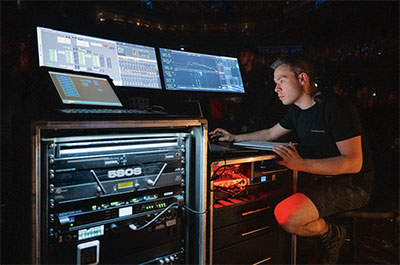 For the small number of larger venues that need them, delays comprise four hangs of six K2 with a flown LARak II. Teti works over two X8 and an SB18 on an LA4X. Thirty-two LA12X drive the system, mostly in Adlib’s triple-wide racks each side of the stage, with a further LARak II under the stage for the VIP and thrust fill, alongside five P1 processors and the L-ISA Processor II that Source Intelligence runs on.
‘A K Series system was the clear choice for Seb and I, providing the precise control needed to work with the show’s design,’ Bryson says. ‘The comprehensive tools in Soundvision allow the system to be scaled to fit venues of different sizes and tuned in detail for each room. This translates into excellent tonal consistency day-to-day, and has allowed us to deliver the same sonic signature as we’ve transitioned between arena and amphitheatre shows in the US.’
Two festival dates took the show off the touring system entirely. At Lollapalooza in Chicago, 5 Seconds of Summer played the main stage on the festival’s own L-Acoustics rig, specified by the festival rather than by Adlib, as it is for every act there.
‘Beyond managing the thrust, we also navigated two major festival dates: one on a K2 deployment and another on a massive K1/K2/K-Sub rig on the main stage at Lollapalooza,’ Teti says. ‘The transition was seamless, and the mix translated effortlessly. Moving from indoor arenas to outdoor amphitheatres brings its own set of variables, but Billy and I maintain constant communication. He works relentlessly to deliver daily system consistency, leaving the venue’s natural acoustic environment as the only real variable I have to account for.’
As one of the earliest adopters of Axient Digital PSM monitors, monitor engineer Mike Platt has worked closely its manufacturer throughout the tour’s run, and a recent firmware update – introducing a new single-carrier narrowband operating mode – has, in his words, changed the way digital transmission performs.
The system now handles 16 stereo mixes for a band and crew who move constantly between stages, bunkers and back/under-stage positions, many with challenging sightlines and RF conditions. Alongside Axient Digital PSM, 12 channels of Shure Axient Digital AD2 microphones cover the band’s multiple vocal positions, with Wireless Workbench providing RF visibility from front of house.
‘We’ve been through a journey with Shure on this tour, ultimately ending up with a really high-performing setup that everyone is really happy with,’ says Platt.
That journey led the team to adopt the single-carrier narrowband firmware ahead of its official release, driven by an urgent need to solve moving-metal digital interference around the drum kit of Ashton Irwin, 5SOS’s drummer.
‘Ashton has a large and diverse drum kit that he plays at a very high velocity throughout the show,’ Platt explains. ‘We had our transmission mode in Multi-channel Wideband, and we found that in the environment we presented with on this show, it wasn’t performing to the standard that we needed.
‘Once we moved over to single carrier narrowband, it completely changed the game for us,’ he continues. Unlike the OFDM (Orthogonal Frequency Division Multiplexing) transmission used in wideband mode, single-carrier narrowband draws on the single-carrier technology already used in Shure Axient Digital microphones. ‘The single carrier frequency firmly plants its transmission and is much more robust against the hostile RF environment that you’ll find around a drum kit and in a busy arena show.’
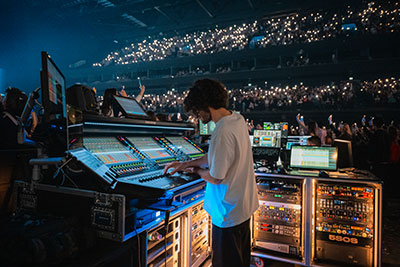 Platt also observed that venue construction, spectrum coordination, and audience presence all influenced performance under the previous mode. These variables were difficult to predict but had a clear impact on signal quality. Using the Timeline function within Wireless Workbench, the team were able to log and compare RF receive levels, quality and dropouts before and after the switch.
Running 16 mixes required two combiners feeding two short helical antennas. For the drummer, the team ran a BNC cable directly from the transmitter up to the drum riser, feeding a paddle antenna. ‘We found that it removed some of the quality dropouts we were having in some arenas,’ says Platt, who notes the trade-off is a busier coordination process. ‘OFDM mode was a little more forgiving on width, but what we have gained by using the new mode is fantastic.’
For monitoring and control, Wireless Workbench has been essential to Platt’s workflow. ‘Especially during this show, where I had no clear line of sight for any of the band members, I need as much monitoring and timeline data as I can get to fix issues promptly and even before they become an issue,’ he says.
For Platt, the standout benefit of Axient Digital PSM is audio quality. ‘The transmission is now a huge leap closer to sounding like a wired connection. This gives you more scope to make more detailed, wider and dynamic mixes for the artist,’ he says. ‘The days of having to compromise your mix for it to “work” with the companding and inferior FM transmission modes are over. It’s been the missing link in wireless monitoring we’ve been waiting for.’
The band and crew have noticed the difference, too. ‘Overall, it’s been the best they’ve heard,’ Platt says. ‘And the noticeable reduction in noise floor is great. It sounds like it should.’
Platt also relies on Shure ShowLink for remote coordination. ‘I do use ShowLink, and it’s great. Time saved on coordination and syncing is so good. Thirty packs of syncing a day would take an age. Also, for firmware updates, it was great to just leave it all on the network.’
‘Every interaction with the L-Acoustics team has gone above and beyond,’ Teti adds. ‘Feedback from the band, management and fans has been nothing but positive. Even in the most challenging acoustic environments we’ve encountered, the system has proven reliable, consistent and exceptionally articulate.’
See also: L-Acoustics Source Intelligence
More: www.adlib.co.uk