L-Acoustics has announced Source Intelligence, a proprietary voice-separation technology that promises clearer, more intelligible vocals and unprecedented gain before feedback for live performances.
Running as an exclusive licensed application on the L-ISA Processor II and integrated in the L-Acoustics system workflow, Source Intelligence gives FOH engineers mixing on an L-Acoustics PA a tool to clean up vocals from noisy stages and allow performers to move freely across any stage configuration, including in front of the PA, without risking feedback or sacrificing vocal clarity.
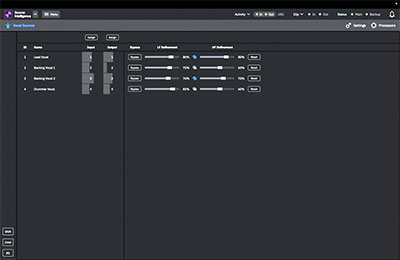 Source Intelligence uses machine learning to continuously identify the voice in a microphone signal and remove everything else. PA bleed, crowd noise, stage instruments and room reverb are stripped away in real time, leaving a vocal that preserves the natural tone, character and intelligibility of the source, a quality difference that has consistently been audible to engineers and listeners in blind tests.
“For decades, engineers have been solving the PA bleed and feedback problem with compromises like notch filters that colour the sound, expanders that can be unpredictable, or staging layouts that pull performers away from the audience,” says Director of Product Management for Software, Ryan John. “Source Intelligence removes that trade-off entirely. The machine is continuously listening and continuously working, so the engineer can focus on the mix instead of fighting feedback, and the performer can own the whole stage.”
quality among competitors, removing up to 40dB of non-voice signal – a difference that is immediately and consistently audible to professional engineers and casual listeners. The technology also significantly reduces feedback risk by eliminating the PA bleed and ambient noise that cause it, rather than reacting after it starts.
The technology is designed for any application where a voice is amplified including touring, house of worship, corporate events and theatrical productions. It works with handheld, headset, lapel and distant-pickup microphones, and processes up to four channels simultaneously. Each instance can handle one vocal at a time or can be placed in the path of a group of channels so that a single instance may, for example, serve all handheld microphones in a corporate workflow.
More: www.l-acoustics.com