

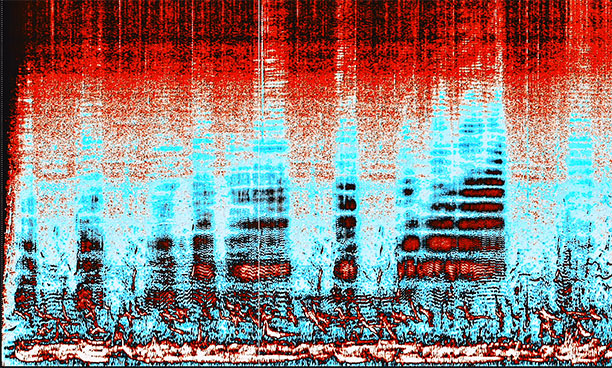
Armed with Sennheiser HD 300 PROtect headphones, Sennheiser MKH 8020 mics and a bespoke 3D hydrophone array, nature sound recordist Thomas Rex Beverly recently visited Hawaii’s Big Island and French Polynesia in pursuit of high-definition, spatialised recordings of whales – the likes of which researchers had previously been unable to make.
Beverly’s field expeditions previously followed three themes – glaciation, weather and ancient trees, but now has a fourth with whales. He felt he could do more to capture their otherworldly song and the essence of their habitat to deliver a more accurate depiction of the vast spatial nature of the underwater world.
‘I started recording whales in Hawaii during February 2025 – this was my first whale project, and I did a huge amount of learning,’ he recalls. ‘I got some great recordings, but for my French Polynesia trip in October 2025, I was able to really improve on that, refining my techniques and immersive hydrophone arrays.’
Prior recordings of whale song saw scientists conducting recordings of up to six months duration. These are factually accurate and suited to scientific study, but are not of high enough resolution to be suitable for spatialisation processing or high-definition listening.
As a field recordist, Beverly strives for perfection. His sound libraries are used by sound designers for film, TV, video games, and museums, with clients including Oscar, Emmy, and Golden Globe-winning sound designers and sound editors. Capturing the unique and almost alien environments of the sea requires robust and reliable equipment.
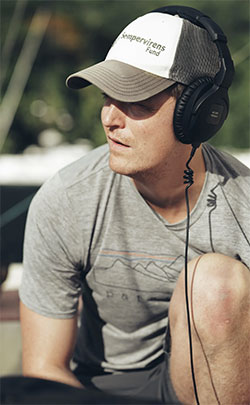
For his latest adventure, he called on the accuracy and safety of his Sennheiser HD 300 PROtect headphones, alongside a complex and completely bespoke 3D-recording hydrophone rig. The headphones feature Sennheiser’s ActiveGard technology, which protects the wearer’s hearing from sudden sound bursts without interrupting the audio signal – a safety feature that differs from traditional acoustic shock clipping circuitry. The headphones proved critical for long overnight sessions spent immersed in some of the ocean’s loudest and most dynamic soundscapes.
‘I’m sitting in the dark, rocking gently on a catamaran off the coast of an island that looks like Jurassic Park,’ Beverly says. ‘I’m in French Polynesia and the humpbacks have all gone quiet. They’re hiding to protect their calves from a pod of Orcas that have been hunting. It’s been eerily quiet for almost an hour. I start to hear a sound like distant machine guns firing constantly. Then I hear a whistle and I realise something magical is about to happen, so I start scanning the horizon.
‘I see the first spinner jump – they really spin as their whole body flies out of the water. The dolphin pod was curious about why we are floating out in the open ocean with hydrophones and decided to check us out. The giant cube of eight hydrophones captures them swimming in three dimensions. Some of their sounds are in the audible range, but I know there’s a wild world of ultrasonics happening at the moment. I could feel my headphones screaming to reproduce them and got this weird ear fatigue all of a sudden... but the headphones protected my hearing and let me enjoy the moment. It was a beautiful wildlife encounter that I’ll remember when I’m 80.’
Beverly discovered that the Arctic population of humpback whales spend their summers in Alaska, but when winter begins, they migrate to Hawaii. Their food sources are in Alaska, so the whole journey is spent fasting. They congregate to mate, rear their calves and, importantly for Beverly, sing.
‘The Humpback soundscapes in French Polynesia are wildly different from the ones I recorded. In Hawaii, it’s a chorus of 20-50 whales singing at the same time. And in French Polynesia, it’s usually a solo humpback echoing to infinity.
‘I’m pretty sure the male humpbacks pick locations that are optimised for acoustic sound quality, like singing in an underwater canyon so their echoes sound better. At least that’s what I was imagining when lying on the deck of a sailboat in the dark in the middle of the Pacific Ocean.’
The reef system around Hawaii’s Big Island is dominated by the shape of the island volcano, causing the reef to form a narrow band. This means that the reef wildlife, like snapping shrimp are not as loud. It was this characteristic that had drawn Beverly to the area. He wanted to try out an idea he had been playing with, a 3D-hydrophonic array.
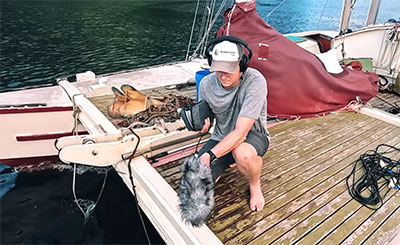
 ‘The idea was to build a square in the water, 3m by 3m, with four hydrophones on the top layer and a further four suspended beneath, creating a cube,’ he explains. ‘The trick was to lower the whole thing into the water, about 30m below the boat. This original iteration was difficult to manoeuvre; the PVC frame was not ideal because the cables got tangled. Out at sea, when waves are smashing you, it became exhausting trying to put it all together. Plus, once it’s in the water, the PVC pipe actually creaks. We learnt a lot from those first attempts, and we eventually got it all to work.’
For French Polynesia, Beverly developed an array system that used the shape and size of the boat, eliminating the need for an additional frame. This yielded excellent results and, by varying the height of the surface microphones, he was able to create a very dynamic mix, exploiting both near-surface sounds and the deep-ocean calls of the whales.
‘Not all environments benefit from a 3D recording, but the whales really do,’ he says. ‘They are spread around and often glide up and down, anywhere from 100-500m in depth, so capturing that dynamic was important. We got some cool, very dense recordings in Hawaii. It’s something that very few people have done, so figuring it out was always going to be tricky, but we learnt a lot of lessons.’
The designer of the hydrophones Beverly uses is Jules Ryckebusch, a retired US Navy veteran with 20 years’ experience as a sub-mariner. While serving, he developed expertise in the Navy’s use of hydrophones. After retiring, he became interested in the sounds he could hear and it made him want hydrophones of his own, leading him into custom design. He now shares those designs, as well as his audio expertise, showing how these remarkable hydrophones can be made for a reasonable outlay. Beverly first used the Gladys hydrophone in 2019, and has had them as an essential part of his toolkit ever since.
‘The speed of sound is different under water, it is roughly 4.5 times faster than in air, depending on the depth and temperature,’ Beverly explains. ‘This affects the size of the array. On land, I would aim for about 40cm, minimum, for an omni array, but the minimum distance to achieve a stereo image under water is going to be about 2m.’
For his work in French Polynesia, Beverly expanded the array to 7m as the whales are from a range of species, so their song occupies a wide frequency range. The stars were the humpbacks, with their distinctive calls, but there were also fin whales, which make much deeper, more bass sounding calls and songs. In the upper ranges, high frequency clicks from dolphins and orca were also audible, with the presence of orca pods having a surprising effect on his recordings.
‘Orcas hunt humpback whales,’ Beverly says. ‘A transient pod would move through the area we were recording in, chasing after the calves. When they were around, the humpback whales stopped singing and started hiding. It was interesting because the fin whales did not stop singing. That could be because they were farther away, but it could also be that they were just not bothered by the orcas.’
Beverly often recorded at night, when noise pollution from other vessels was limited. He found a local guide who agreed to take him out, in return for listening to the recordings, sounds that a lifetime on the sea had not given him the opportunity to hear before. His base was the island Mo’orea about ten miles west of Tahiti.
Lessons from Hawaii
With his experience from Hawaii, Beverly engineered a modified array system, with a central recording position. A stereo cable ran from here to each corner of the boat, with two hydrophones attached to each cable, the first at 25m, with the second 77m below. The result was a 7m cube, submerged 25m under water to reduce surface noise. It incurred less handling noise and was much faster to deploy than the Hawaii frame.
‘The whole set-up was much easier with me sitting in the middle of the boat,’ Beverly confirms. ‘I’d got the HD 300 PROtect’s SPL limiting enabled, so I was much happier about listening for long periods of time with the volume cranked up. There was a moment when I was listening to the sounds of the coral reef, half asleep, when a male humpback started singing loudly to the left of the sailboat. This came suddenly out of a quiet, subtle soundscape. I had the volume cranked way up, so I might have damaged my hearing without the limiters on the HD 300 PROtect.
Another dramatic sound came from snapping shrimp that use a high-pressure burst of water to stun prey and communicate. Despite their tiny size, their sounds are as loud as a dolphin’s, and dominate the reef soundscape.
Overnight, Beverly also heard sharks and rays stalking their prey. As he moved into deeper water, these sounds faded into the background, bringing the mournful, echoing calls of the humpback to the fore.
 Nicknaming the producers of these calls ‘the subwoofer whales’, the calls of the humpback can go as low as 20Hz. At these frequencies Beverly was feeling more than hearing the sounds.
‘I had no idea how far away the whales were, because the sounds travel so far,’ he says. ‘They could be fin whales, humpbacks or even blue whales, whose sounds are like a low-frequency pulse around 20-80Hz, with singing in every layer, added to by the background noise of the reef with shrimp clicks and animals that live in the coral. In the middle ground areas, you get these cool reflections from the underwater canyons. I really wouldn’t have been able to enjoy all these sounds as fully without the limiter on my headphones. During the night, I would be lying on the deck of the boat at night, maybe sipping rum, and if I didn’t have that added protection.
Beverly also experimented with layering in above-water sounds. In his experience, there was a juxtaposition between the calm, still night air and the cacophony of sound just below the waves. The stillness was occasionally broken by the emergence of humpback whales, slapping their flukes and playing as they came up for air.
For these moments, Beverly turned to his Sennheiser MKH 8000 Series microphones, specifically the MKH 8020, the same omnidirectional RF condensers that have accompanied him on every expedition, from the ice of Patagonia to the canopy of California’s redwoods. Their exceptionally low self-noise, flat frequency response, and ability to handle extreme conditions make them as well-suited to the salt air of the Pacific at midnight as they are to a howling Andean gale.
‘Under water, you have the snapping shrimp, which make an almost electric popping sort of sound,’ he says. ‘When it starts raining on the surface of the water, you have this underwater rain sound that’s mixed with the electrical crackling, and it starts sounding like a sci-fi rain. If I mix that with the sounds captured by the 8020s and switch between the two, it gives a shift that I find really interesting. Moving from the heard world above water, to the unheard world below.’
The stereo MKH 8018 served as a spot mic, adding effects like the wind in the sails or any moving sound sources.
Beverly has spent years chasing the sounds of the natural world, from Patagonian mountain ranges to glaciers of Greenland to the ancient redwood canopies of California. But this trip was more than capturing audio, it was an experiment in understanding an alien soundscape that few get to hear. His recording sessions were done from a large sailboat and he wasn’t allow to get in the water while recording. However, French Polynesia is one of the few places in the world where you can snorkel with humpback whales –you just have to charter a boat that is permitted to offer guided whale swims.
So, after recording these majestic creatures from a safe distance, Beverly packed away his hydrophones and came face to face with the humpbacks during a guided swimming session. During this experience, he made eye contact with a humpback calf and it left a lasting impression. He discovered more about nature during his time in French Polynesia than he could have imagined.
‘I think one of the main reasons I like whales so much is that you don’t have a reference for them,’ he says. ‘If I go from Texas to Tanzania, I hear birdsong – it may sound very different, but they still sound like birds! You have a reference because there are birds where you live. Underwater sounds are very foreign to me. It’s just another planet down there. The whales make all sorts of crazy sounds and I’m excited to share more of them.’
As he reflects, he is already contemplating what comes next. His MKH 8000 Series microphones, battered by glacial winds and ocean spray across years of expeditions, remain indispensable.
See also:
Field Recording in Patagonia
Capturing Greenland’s glaciers ‘calving’
Recording the ‘Ice Whisper’ (Juergen Staack Siberia recordings)