
Heritage Audio has announced the Mix Buddy, for home studios, live performance and synthesiser recording.
Mix Buddy has a generouus count of 19 inputs that use JFET technology based on the Toshiba 2SK JFET series. The Hi Gain Inputs: (left side, marked ⚡) Eight channels (four stereo pairs) of Toshiba 2SK JFET 12dB gain buffers, voiced to ‘breathe life into organic instruments and lower-level sources’. The Unity Inputs: (right side) Six channels (three stereo pairs) of Toshiba 2SK JFET unity gain buffers, voiced for higher level sources such as TR-808 and TR-909 frum machines, 1990s samplers, active basses and modern synths. The Mic Preamp channel offers up to 70dB of gain, while balanced line Inputs: (last channel on the right side) comprise stereo pair of balanced line level inputs for USB audio interfaces, computers or any line level source requiring a clean, professional, fully balanced connection.
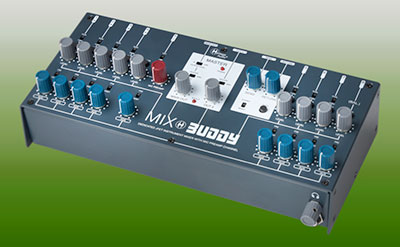 The FX Return is a stereo pair of low-noise balanced FX return, sharing the same topology as the line inputs and doubling as an extra set of stereo inputs when needed. Inserting only the left channel will automatically pan the signal to the centre.
Every instrument level channel on the Mix Buddy (both Hi Gain and Unity) has a toggle between Stereo and Mono+Thru. In Mono+Thru mode the instrument stays in Mix Buddy mix while simultaneously being sent out to any external destination: amplifier, outboard processor or front of house desk. The Thru output is transparent, preserving the instrument’s natural impedance so whatever it receives it sees the source as it would without the Mix Buddy in the chain.
The Mix Buddy features two independent master outputs, both of them balanced.
Master Main Out runs through Heritage Audio’s own 73 single-ended class-A output stage DI circuit, the same as used in DI boxes in studios and on stages worldwide. A pair of custom-wound 73 DI transformers sit at the heart of this output, with a switchable line level or mic level output to can send the Mix Buddy directly to a console, an interface or straight to front of house. Main Out 2 offers transformerless alternative.
The headphone output uses independent headphone amplifier with dedicated volume control on the front panel of the Mix Buddy, giving a third independent listening path.
The Mix Buddy’s stereo (or mono) aux send functions as a fully featured effects loop for inserting hardware effects processors directly into a mix. Each channel has its own aux send knob to dertermne in how much of that channel feeds the effects chain, with pre/post fader routing selectable per channel and a global FX on/off switch for instant wet/dry comparison. Because the aux is designed to work with instrument level hardware, a microphone signal can be sent directly to guitar effects pedals.
More: www.heritageaudio.com