

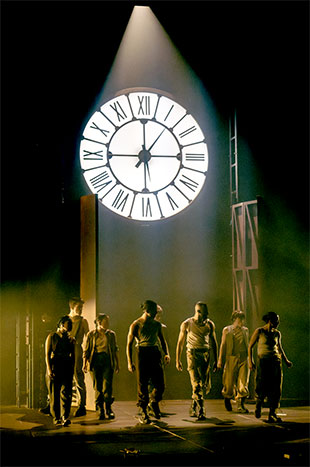
A new large-scale production from choreographer, composer and director Romain Rachline Borgeaud and his RB Dance Company plunges 34 dancer-vocalists into a post-apocalyptic world in a musical with a kinetic multi-level set of trapdoors and moving platforms, and a score that spans industrial percussion to symphonic orchestration to blues-rock.
 Staged in English, the production is designed specifically for Zénith-format venues seating 4,000 to 6,000k and premiered at the Dôme de Paris in April 2026, selling out ten dates. It returns for a full Paris season in 2027 with a national Zénith tour set for the following autumn.
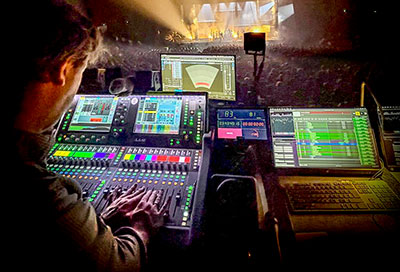
The set of The Rise has no room for speaker towers on either side of the stage but with a score requiring more than 30 live voices stacked over pre-recorded beds, demands a sound system that can separate every layer without pushing its SPL to uncomfortable levels in a sealed arena. RB Productions brought in lead FOH engineer Arnaud Bayssat and system engineer Pierre-Louis Charles, assisted by Jaï Louvet who did the original system design, who together proposed an L-ISA Immersive Hyperreal Sound solution. Bayssat has worked with L-Acoustics for nearly two decades.
‘For musical theatre formats that require high definition at contained acoustic levels, I have always been drawn instinctively to L-Acoustics,’ he says. ‘For The Rise, L-ISA became an obvious choice because it offered a different approach to speaker placement, a better fit with the stage design, and above all the unmasking capability I needed to handle such a dense mix.’
Bayssat began the design process in a studio environment, developing the L-ISA pre-encoding workflow on a smaller rig of X8 and KS21 loudspeakers. When the system moved to the full L2-based rig at the Dôme de Paris, everything translated – the pre-mixed sessions behaved in the large room exactly as they had in the studio.
Charles used Soundvision to model L-ISA coverage across the Dôme – a circular arena with no straight sightlines – confirming that 88 per cent of the seating would receive consistent level and tonal balance across all five hangs, with 98.8% of the audience within useful coverage. ‘At first I was a bit skeptical that the coverage we simulated in the studio would translate to the venue, but it actually performed even better than I had imagined, he admits.
Soundvision also calculated the system’s total weight and rigging load, an essential consideration given the volume of flown scenery and machinery.
The L-ISA Scene system at the Dôme de Paris is built around five hangs, each comprising one L2 and one L2D, with six KS28 subwoofers in cardioid configuration flown centrally. Fifteen 5XT loudspeakers provide spatial fill; two pole-mounted X15 HiQ serve as out fill, with two further L2D available as flown out fill for wider venues. These are deployed in 70° configuration via Panflex and the supercardioid preset to preserve L-ISA perception and minimise interaction with the Scene system.
At FOH, a L-ISA Processor II handles all real-time object-based audio rendering, alongside a P1 Processor for system tuning and LA Network Manager on a dedicated Mac Mini. The amplification network of 14 LA7.16, five LA12X and four LA4X amplified controllers runs on a fully redundant Milan-AVB network via 14 LS10 switches. All amplifiers are flown alongside the Scene system to minimise cable runs.
L-Acoustics Application Project Engineer Jean-Charles Schmid was present from first design conversations to the final show, providing regular technical reviews and optimisations at each stage. ‘Jean-Charles was an absolutely perfect support throughout, from design to pre-encoding to the big room,’ Bayssat says. ‘We are really enriched by those exchanges.’
The production ran without stage monitoring, a decision taken to protect the live vocal recordings and eliminate stage spill, made possible by the tight directivity of the L2, which left stage and backstage areas virtually silent. Far from creating problems, the quiet stage was welcomed by the technical crew managing concentration-critical tasks in the wings, as well as the audience. ‘It is rare for people to talk about the sound at a show,’ Bayssat observes. ‘We were surprised to have people mentioning it – to say it was good.’
The system logged no failures across its entire residency, and for Bayssat the defining moment came earlier: the first rehearsal in which all 32 singers performed together on the full L-ISA rig. ‘It worked far better than I could have imagined,’ he says. ‘It was fabulous.’
The team is already working on truss adaptations to make the touring rig faster to load in. For Bayssat, the message to any engineer considering L-ISA is direct: ‘Don’t be afraid of it. Invest in the training, absorb the fundamentals. And then it becomes a genuine game-changer.’
More: www.l-acoustics.com