

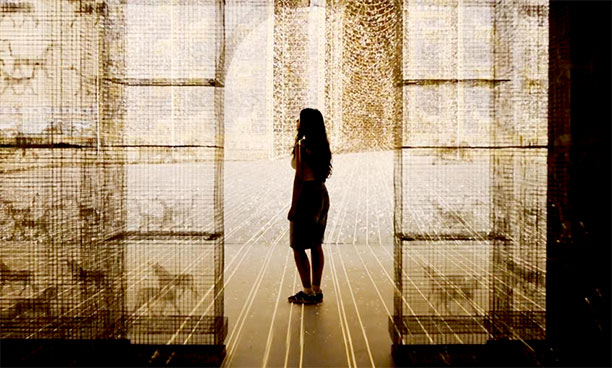
Offering an hour-long walk through 12,000 years of human history, Timewalk opened in July at Immerse LDN, the UK’s largest dedicated immersive entertainment district, on the ExCeL London waterfront. Its five worlds is each a projection-mapped room of its own with a L-ISA Immersive Hyperreal sound integral to the visitor experience.
The exhibition opens on the ritual gathering grounds of Göbeklitepe, then moves through the Hanging Gardens of Babylon, the temples of ancient Egypt, the observatories of the Maya and the Moai of Rapa Nui. It occupies more than 1,600sq-m and marks the UK debut of DEM Museums, the Turkish producer behind the Hagia Sophia History and Experience Museum and the Ephesus Experience Museum.
Having introduced DEM to L-Acoustics L-ISA, Asimetrik – an L-Acoustics Certified Provider located in Türkiye – recommend the appointment of an independent consultant covering both the sound system and the content sound design, so that decisions would rest on technical merit rather than on a supplier’s preference. Asimetrik then encouraged DEM to meet other manufacturers, and several object-based and immersive systems were evaluated. DEM came back to L-ISA.
The brief described an outcome rather than a system – DEM wanted visitors to be unaware of the equipment; sound had to belong to the image: a bird overhead, water beneath the floor, a voice moving across the space. And it had to be true for everyone standing in the room, not for one seat in it.
‘Timewalk wanted an environment so cohesive that visitors wouldn’t be aware there were loudspeakers in the room,’ says Asimetrik Project Engineering Manager, Buğra Kezan. ‘The sound had to be an integral part of the experience, and it had to work wherever people were standing and whichever room they were walking through.’
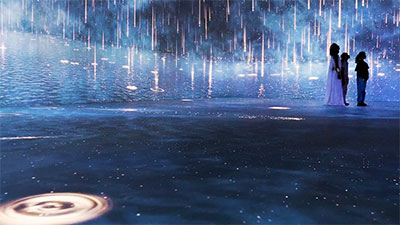 DEM’s definition of success was that the audio would carry the same emotional weight as the visuals, and that the system would run unattended, to the same standard, every day of the exhibition’s run.
There is no sweet spot to protect in a room where the audience stands and moves as a group, so the spatial image had to hold across the whole floor rather than collapse toward a single position. Each room runs a bank of projectors continuously, and their cooling fans lay down a broadband noise floor that never drops, so the dynamic range had to be worked out around it: quiet passages still clear above the bed, loud passages never loud enough to break the intimacy of the storytelling. And the five rooms run independent programme material simultaneously, all day, with no bleed permitted as one group walks into the chapter another has just left.
Then there was the architecture. Timewalk’s projection surfaces sit close to the walls, leaving nowhere to mount a cabinet in front of them, so every enclosure had to be recessed into a purpose-built housing. Those housings had to do three things that pull against one another: not colour the response or restrict the directivity of the loudspeaker inside; not compromise the isolation between rooms running independent material on separate cycles; and not encroach on the fire escape corridors immediately behind the walls, which fixed the available depth and made it non-negotiable.
Power was the second hard limit. The building’s electrical infrastructure had defined capacity, and the audio had to fit inside it alongside a very large projection load.
‘That is where L-Acoustics separated itself from the alternatives they evaluated,’ says Kezan. ‘The cabinet dimensions relative to the SPL we needed let the recessed housings stay within the depth the escape corridors allowed. And the combination of loudspeaker sensitivity and amplifier efficiency delivered the same acoustic result at a materially lower power draw. It was a technical advantage, not a preference.’
Göbeklitepe, the installation’s first chapter, runs a 9.1 layout of three X8i, six 5XT and two SB15m. Babylon, Ancient Egypt and the Maya each step up to a full L-ISA 360° configuration with a layer of loudspeakers set into the floor, so a sound can arrive from below a visitor as well as around them: five X8i, six X6i and 11 5XT paralleled across three separate lines, plus two SB18i apiece.
Rapa Nui, the final chapter, is the most demanding of the five and the only room carrying both a below-ear-level layer and an overhead one, letting L-ISA place a sound genuinely above or beneath a visitor rather than only around them. It runs five X8i, two A10i Wide, 29 X6i and three KS21i. Three further 5XT cover the corridors between chapters.
In all Timewalk employs 114 loudspeakers and 11 subwoofers across five zones, driven by 15 amplified controllers including LA7.16i, LA4X and LA2Xi, all running on Milan-AVB. The final mix is built in the L-ISA Processor, printed, and handed to the media servers, which send the files over the network straight to the amplified controllers.
L-Acoustics Application Engineer Sergey Becker worked with the Asimetrik team through the final L-ISA calibration, and Sales Manager Pavel Aheunin supported the project from its earliest stages through completion.
The immersive audio experience is landing as intended. DEM’s content team took to the sonic result immediately, and the exhibition’s own audio engineer picked up the day-to-day L-ISA workflow quickly, which counts for a room that has to open to the same standard every morning.
‘We specified this for the room, not for the content that happens to be in it,’ says Kezan. ‘Immerse LDN rotates its experiences, and a new production can be authored against the loudspeaker layout and the object rendering that are already there, in most cases with nothing more than a recalibration and a new show file. The infrastructure is the permanent asset. The content sits on top of it.’
More: www.asimetrik.com.tr