

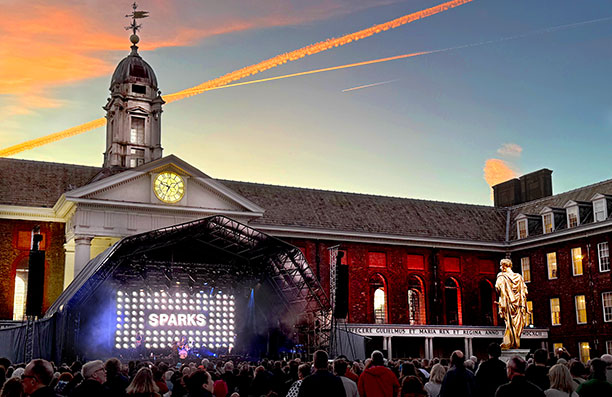
The recent Live at Chelsea concert series took place over five nights in June within the courtyard of London’s historic Royal Hospital Chelsea, attracting audiences of more than 4,000 each evening. Providing the sound reinforcement was UK rental company 22live, who employed a comprehensive Martin Audio system comprising WPC main arrays, Torus and WPS fills.
Founded by King Charles II and designed by Sir Christopher Wren, Royal Hospital Chelsea has been home to the Chelsea Pensioners since 1692. With the historic buildings and clock tower a striking backdrop, the events were staged in the Figure Court, a C17 courtyard. Among those appearing were Sparks, Holly Johnson, The Proclaimers and The Beach Boys.
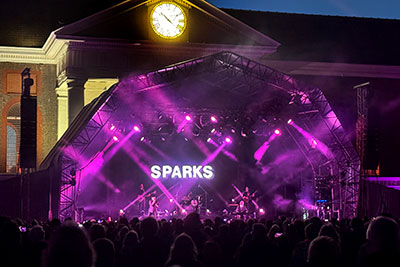 ‘It’s unusual because it’s an outdoor event, but the audience is entirely seated,’ says 22live Hire Director, Paul Timmins. ‘There was tiered seating around the sides and at the rear, so it felt much more like a purpose-built theatre environment.’
With an audience area measuring approximately 75m square, 22live selected Martin Audio’s WPC Wavefront Precision line arrays as the main system, deploying left and right hangs of 12 cabinets per side.
To provide coverage across the relatively wide listening area, four WPS line array elements were groundstacked on grids as out fill, while six Torus T1230 constant-curvature array elements provided front fill. Low-frequency reinforcement meanwhile came from eight SXH218 dual 18-inch subwoofers, configured in a compact castellated cardioid array, with five cabinets facing forwards and three facing backwards. The system was powered by iKon series amplifiers.
‘The audience area is bordered by large stone structures, so we wanted to minimise reflections from those surfaces,’ Timmins says. ‘We also wanted to avoid directing unnecessary energy into the surrounding buildings wherever possible. Beyond that, the challenge was simply to achieve consistent coverage across the audience area as efficiently as possible.’
‘It was an interesting event because each of the five nights featured a different headline artist, with a wide range of musical styles,’ Timmins says. ‘Most of the artists brought their own engineers, and the feedback was consistently positive. Everyone I spoke to had good things to say about the system.’