Violet Audio/Violet Audio US has expanded its Mix 128 Digital Mixer platform with the addition of full SMPTE ST 2110-30 Audio-over-IP support and key AMWA NMOS standards in line with modern broadcast network audio workflows. The new release represents a significant milestone for the dMix 128.
While SMPTE ST 2110 and NMOS have become foundational technologies within modern television facilities, broadcast centres, eSports venues, remote production environments and large-scale A/V systems, access to these workflows has traditionally required investment in premium broadcast infrastructure. With this update, Violet Audio is making those same capabilities available within a compact, affordable digital mixing platform designed for live production, broadcast, streaming, installed sound and hybrid production environments.
 dMix 128 software now includes support for SMPTE ST 2110-30 for professional uncompressed PCM audio over IP; NMOS IS-04 for device and stream discovery; NMOS IS-05 for connection management; and NMOS IS-08 for audio channel mapping.
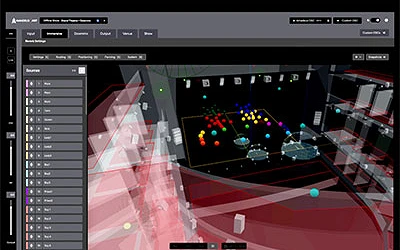
To support these new capabilities, Violet Audio has developed a dedicated Streams management interface that allows users to receive, transmit, clock, discover, connect and manage network audio streams directly from the mixer’s browser-based control environment.
The implementation has also been tested using the AMWA NMOS Testing Tool, which recognises the dMix 128 feature set and validates the mixer’s NMOS functionality to that level of qualification.
As broadcasters, production companies and systems integrators continue transitioning from traditional point-to-point audio architectures to flexible IP-based infrastructures, the addition of SMPTE ST 2110-30 and NMOS enables the dMix 128 to integrate seamlessly into contemporary production ecosystems while dramatically reducing system complexity and deployment costs.
‘This is a very exciting step for dMix 128 and the industry at large,’ says Violet Audio founder, Danny Olesh. ‘SMPTE 2110-30 and NMOS are normally associated with high-end broadcast infrastructure, yet we are bringing this level of IP connectivity into a live mixing product at a price point that makes it accessible to far more engineers, integrators and venues.’
‘The announcement is particularly significant because it introduces functionality rarely found in products within the dMix 128’s market segment,’ the company asserts. ‘The combination of standards-based discovery, connection management and channel mapping allows users to rapidly deploy and manage IP audio networks without relying on proprietary workflows or extensive external configuration.’
For broadcast engineers, the update provides direct interoperability with modern SMPTE 2110 infrastructures used throughout television production, sports broadcasting, news operations and remote production facilities. For systems integrators and A/V professionals, NMOS support simplifies system commissioning and ongoing management while ensuring compatibility with a growing ecosystem of standards-based networked devices.
With the addition of SMPTE ST 2110-30 and NMOS, the dMix 128 offers a comprehensive feature set that includes 32 Mic/Line In, 24 Line Out, Made IO, 128 mixing channels, dual redundant PSU, ultra-low 0.3ms latency, 300-plus channels of redundant AES67 networking, 64x64 CoreAudio/ASIO drivers, FPGA-based signal processing, advanced matrixing, integrated effects and browser-based control.
The update provides immediate benefits across multiple applications. For broadcast and media production, this means direct integration into SMPTE 2110 facilities and modern IP-based production environments, while for live production isimplifies connectivity to stageboxes, recording systems, production switchers, audio networks and mobile broadcast units.
For streaming and content creation, there is standards-based audio transport for increasingly sophisticated live streaming and remote production workflows, and for installed A/V systems, easier discovery, configuration and management of network audio devices using NMOS standards. Hybrid production facilities are offered a single platform capable of supporting live sound reinforcement, broadcast production, recording and A/V integration simultaneously.
The new Streams interface presents receive and transmit streams, clocking information, stream status, channel counts, sample rates, PTP synchronisation status and routing information within a practical engineering-focused workflow designed for fast deployment and operation.
‘This is not just a checkbox feature,’ Olesh adds. ‘The goal is to make professional IP audio easier to use. Engineers should be able to discover devices, connect streams and map audio without needing a complicated external setup. That is exactly where NMOS makes a huge difference.’
More: www.violetaudio.com