Chandler and Abbey Road Studios have announced the REDD Mixing System, a fully modular, hand-built analogue mixing console ‘that unites every era of EMI’s legendary recording technology into a single, expandable platform’.
Marking the first EMI recording console introduced in more than five decades, the REDD Mixing System enables engineers to design a personalised desk by freely combining REDD, TG and RS channels and busses in virtually any configuration. The system is equally suited to compact personal studios and demanding world-class control rooms, offering flexibility without compromising performance.
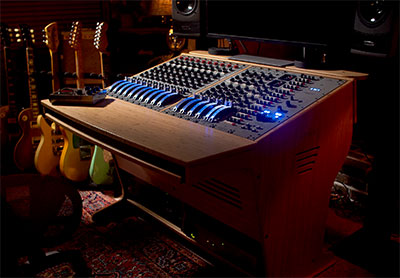 Six years in development, the REDD Mixing System is the result of an intensive collaboration between Chandler Limited founder Wade Goeke, Abbey Road Studios’ Head of Audio Products Mirek Stiles, and the wider Abbey Road engineering team. Designed to reflect both classic EMI construction techniques and modern studio workflows, every modular channel cassette is fully hard-wired, transformer-balanced and hand-assembled in the spirit of the original EMI Hayes manufacturing facility.
Reinforcing Chandler Limited’s long-standing commitment to uncompromising build quality, switches are hand-populated and wired eyelet-style, PCBs are hand-soldered and hand-loaded, and no surface-mount components, ribbon cables, or PCB-mounted switches are used anywhere in the system.
‘Development of the new desk was a labour of love,’ Goeke says. ‘I wanted to include all the different sounding gear we make with Abbey Road in a modular approach that is more suited for modern recording set-ups.’
The system’s versatility includes solid state and tube signal paths, simplified reamplifying and pedal insertion and flexible control room options. The visual identity of the REDD Mixing System’s heritage is completed by illuminated LED backlit faders that match the vintage EMI look while housing newly designed modern mechanisms.
The REDD Mixing System’s modular architecture allows cassettes to be mounted into a console frame occupying 12U of standard rack space. Near-limitless expansion is possible by populating additional bays. Systems can be easily assembled, reconfigured and disassembled as needs evolve, with valve/tube and solid-state cassettes freely placed across the desk. Input cassette options include a class-A TG2-style microphone preamplifier paired with a four-band Curve Bender EQ, and an all-tube REDD mic pre/EQ featuring switchable Pop and Classic EQ curves. In development is a Mk.I TG cassette based on the original germanium transistor TG desks, circa 1969, with release planned for Q4 2026.
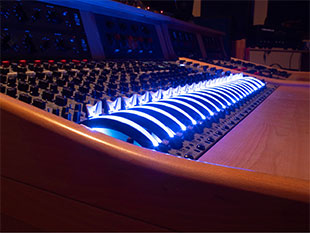 Buss options are class-A TG2-style buss cassettes or tube buss cassettes based on a newly developed RS61-type circuit. Each cassette includes a stereo wet/dry mix control with a switchable insert point, NAB/IEC stereo buss EQ, preamp-style coarse and fine gain controls for setting buss drive levels or fine-tuning buss gain structure. Low-level inserts on each console send allow reamping from any console input cassette without the need for external reamp boxes, also making it easy to integrate guitar pedals or other low-level devices directly into the signal path.
For higher channel count configurations, 12-Channel Expander cassettes provide additional flexibility, each housing twelve class-A TG2-style circuits and transformers. Multiple expanders can be combined to create large ‘mix-in-the-mix’ systems or to accommodate additional instrument and effects returns, with four busses and four sends available on each channel. The stereo Master Buss cassette, also designed for larger configurations, features class-A TG2-style circuitry, wet/dry mix capability, and a switchable insert point.
The comprehensive Control Room cassette supports three sets of loudspeakers and provides selectable monitoring of busses, sends, master buss, auxes and external inputs. Additional features include talkback routing to busses, sends, all outputs or headphone systems; discrete op-amp headphone amplification with ultra-clean performance and musical tone; discrete op-amp speaker outputs; and essential monitoring controls such as mute, mono, dim and polarity.
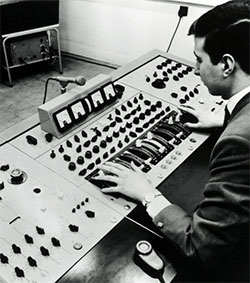 ‘I was introduced to the TG and REDD desks at Abbey Road Studios when I was 18 years old,’ says Abbey Road’s Stiles. ‘I’d never seen or heard anything like them. I was blown away watching how producers like Mike Hedges, Jon Brion or Peter Cobbin would use them to colour the sound of their recordings and mixes in such a musical way. It’s been a great pleasure to witness Wade revive these beautiful engineering classics for artists, producers and engineers of today, all of course with a modern innovative twist.’
As proof of performance, a REDD Mixing System was placed into active production use by nine-time Grammy Award–winning producer Dave Cobb, who used the console on albums for Jason Isbell and Brandi Carlile.
‘I truly believe the music production community now have access to a tool that will re-define what the mixing console is and how it’s used creatively,’ Stiles surmises. ‘This has truly been the design-of-a-lifetime and one I hope adds to the legacy of EMI, Abbey Road and Chandler Limited,’ Goeke adds.
The REDD Mixing System will initially be available in the US exclusively through Chandler Limited as a special-order system with expected deliveries beginning in Q3 2026.