 The mission: a Danish pro audio manufacturer would like to gain greater recognition for its achievements but produces nothing under its own name and anonymity is central to its business model. The proposed solution is to invite an international group of journalists to Copenhagen under an exacting NDA and make the challenge theirs. Let’s call the company Pascal Audio....
With a 20th anniversary providing an opportune springboard, invitations went out, flights were booked and a group of us set out on a unique venture.
In contrast to Copenhagen’s grey skies and heavy rain, the welcome awaiting us from the Pascal team was particularly warm. Over the coming days, much of what we heard, saw and discussed was to remain confidential – a frustrating constraint, especially given how impressive it all was.
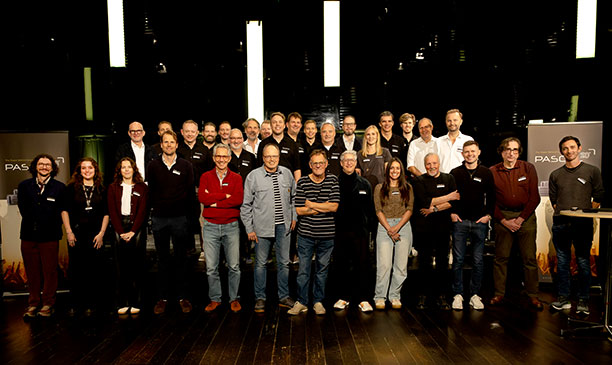 The ‘problem’ was called out early on by the French journalist in the group. ‘We want every amplifier manufacturer on the planet to know who we are and that we can help you,’ explained Chief Commercial Officer Bjørn Rennemo-Henriksen in response. Now we were all comfortably on the same page…
Pascal produces the amplification used in the products and services of very many high-profile companies in large-scale, mission-critical applications – as well as less exacting placements – to exceptional standards of design and performance, that includes an industry-leading returns figure of 0.08% across a global shipment of more than 350,000 (700,000 channels of amplification) delivered in the 2025/26 financial year.
These are names we all know well, and learning that Pascal’s technology plays such an important role gives a slightly different perspective to the shape of an industry we all thought we better understood.
‘You can’t buy a Pascal amplifier,’ quipped CEO Gustav Høskuldsson in his opening address.
In return for their custom, Pascal gives these can’t-be-named companies amplification and support systems that are extremely customisable with no obstacle to the scale of those systems or supply requirements.
Looking around, there is a very small number of dedicated power amplifier manufacturers serving professional audio, but a wealth of companies whose sound reinforcement systems include ‘amplifier/controller’ packages. The Pascal story would suggest looking under the hood of many of these would lead us to a single, exceptionally capable, source – a chameleon, able to meet a disparate range of requirements and relieve customers of making the R&D and financial investment necessary to develop top-line solutions while remaining completely under the radar.
Let’s get this straight. These folk don’t simply make very fine amplifiers and offer them to an internal industry market; they work with clients to deliver exactly what each requires. For many, this includes badging hardware and customising software to reflect their own identity – or even that of their clients. Pascal will make stuff look as much ‘yours’ as you wish.
Founded in Copenhagen in 2006, Pascal was established to develop high-performance amplification for professional audio manufacturers, evolving its initial class-D amplifier modules into an ecosystem that now includes Analog Devices SigmaDSP and Sharc platforms for processing and management of presets, and networking using Dante Ultimo and the Dante Embedded Platform as well as AES67. AES70 also underpins open APIs for third-party control and browser-based configuration of Pascal kit. Embedded firmware enables configuration, control and monitoring, while the evolving MoBeat software suite being developed alongside the new PX Series of amplifiers offers proprietary configuration, control and monitoring for live sound applications.
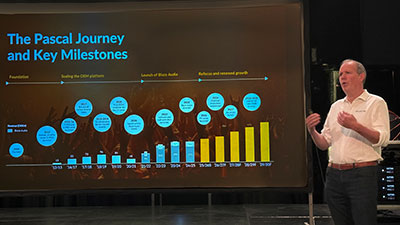 Pascal has also previously dipped into the audiophile market. If you recognise that the company has adopted its name from an SI unit of pressure, it’s small surprise that this venture was as sister company Blaze Audio, again borrowing from French mathematician, physicist, inventor and philosopher, Blaise Pascal.
Set up in 2020, this venture came to a close in 2025 with the sale of Blaze to architectural audio specialist Sonance, but with Pascal remaining an OEM partner.
Lingering in consumer audio, I found a review that set Pascal’s L-Pro2 module against modules from the very high end of the hi-fi world, declaring that it ‘ran absolute circles’ around two similar-sounding hi-fi heavyweights in certain respects.
Trading listening tests for measurements, in addition to his role at Pascal, co-founder and current CTO, Jesper Lind Hansen is also a member of the Cedia working group that is developing the RP1 Loudspeaker Performance Facts standard that, to quote Cedia ‘forces manufacturers to disclose performance metrics in a uniform, objective format and sequence so that system designers and integrators can accurately compare gear’.
Returning to the professional world, the PX Series amplifier platform has now launched after four years in development. Comprising two four-channel models and MoBeat management, this is a scalable platform for installation applications and, significantly, flags Pascal’s entry into live sound reinforcement and touring. The amps feature native Dante connectivity and open APIs for ready integration into A/V and control ecosystems.
As the lead in shaping the MoBeat front end, Caroline Larsen gave us a singularly impressive demonstration of the capabilities of MoBeat and the speed with which set-ups can be configured and changed. The MoBeat package includes amplifier monitoring and can be customised to adopt the visual requirements of customers.
The further intent of the company is reflected by its provision for future growth. This includes a US$5m investment already made in the development of the PX Series of amplifiers, while a new facility in Mexico will join those already running in Thailand and China, and is expected to take on more than half of the company’s production and assembly.
 ‘The perfect blend of speed and agility is a highly-prized currency today,’ Pascal COO Thorlak Vestergaard explained. ‘With configure-to-order in Mexico, we take a leap forward in serving customers. We want them to focus on generating business and realising their growth potential, knowing that Pascal has their back when it comes to supply and products.’
With EMC compliance testing already in-house, further moves will enable the company to serve a wider range of brands and business models through the use of Original Design Manufacture (ODM – handling research, design, prototyping and building products), and Joint Design Manufacture (JDM) as a collaborator in a client’s product development and production.
Pascal presently also expects to add upwards of 30 engineers to its R&D team and expand the software team. And down the line there is a 2030 strategy that will build on growth in live sound, alongside the commercial and residential sectors.
Another departure from usual press outings came when the Pascal people sat with their guests to share thoughts and explore our collective perspectives and insights into future industry expectations. This proved revealing in both directions, and demonstrated that the press do not share a common vision of what is to come and what opportunities await.
With that, it was time to leave and consider the challenge we had been set…
In conclusion, anyone out there unaware of this endearing Danish company and looking for a partner (or, indeed, to improve on an existing relationship) able to deliver custom OEM amplifier and software platforms to the very highest standard, they might be smart to drop Pascal a line.
See also:
Sonance acquires Blaze Audio
More: www.pascal-audio.com