 Alongside images on a screen, or art in a space, audio plays a significant role in gallery environments, as atmosphere, background music and, frequently, as the soundscape for the installation itself. Integrator ArtAV is an expert at operating in these unique spaces, where technology must be both sophisticated and reliable for extended periods – and often invisible.
Installations are temporary by definition and often complex, and these audio systems are typically operated by curators, exhibition staff or artists themselves. Dedicated technical teams are expensive and rarely found these days; systems must therefore deliver high-quality output while remaining simple to operate. ‘With fewer technical staff available, front of house teams are required to take on a broader range of responsibilities, often outside their comfort zone.’ says ArtAV Project Manager, Simon Weightman.
 To meet these demands, ArtAV has standardised on networked amplification from LEA Professional and loudspeakers from Fohhn, both supplied in the UK by Audiologic. Across several international exhibitions in recent years, including installations at the Venice Biennale, Tate Modern, the Baltic Centre for Contemporary Arts, Yorkshire Sculpture Park, and galleries in Scandinavia and New York, this combination has enabled the company to balance operational simplicity with robust technical infrastructure.
According to Weightman, usability can be every bit as important as amplification power and audo performance. LEA amplifiers, he notes, offer an ‘absolutely fantastic’ web GUI that simplifies day-to-day operations by front-of-house staff.
‘It allows our user base of non-technical people to control the volume of the amplifiers,’ he explains. ‘You can easily log on to the GUI via any web browser on a phone and adjust the volume of every single amp channel with a slider.’
The company recently fed back a specific request to LEA, courtesy of ArtAV’s close relationship with Audiologic (the US manufacturer’s UK distributor) requesting a stripped-back version of the interface with only a single volume slider and a mute button, removing all back-end complexity for end-users. ‘If we can simplify the user interface further, there will be even fewer problems,’ Weightman says.
At the same time, the systems ArtAV deploys behind the scenes are far from simple. Many installations involve multiple audio channels distributed across several rooms or outdoor areas, with equipment hidden in walls, plant spaces or temporary racks. Weightman’s design team can set up, measure and fine-tune the audio using LEA Professional’s extensive set of DSP parameters, and the company’s Sharkware configuration suite.
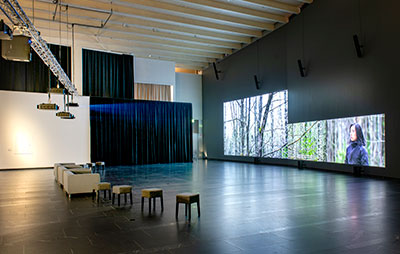
For example, LEA’s Connect Series, a range of smart amplifiers with flexible power management and IoT-enabled control capabilities, proved crucial for a large exhibition in Venice – Listening All Night to the Rain, an exhibition by John Akomfrah RA for the British Pavilion at the Venice Biennale. The scale of the system was significantly larger than normal.
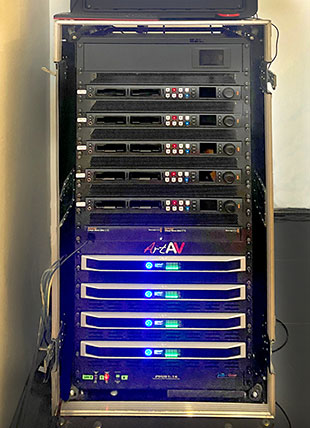
‘There were more than 100 channels of audio in that installation,’ Weightman recalls. ‘It required a dozen LEA amplifiers in a rack, all networked together.’
LEA’s metering and control enabled fast fault-finding and responsive level tweaks during the exhibition, but it wasn’t just a case of ‘set and forget’. ‘We remained plugged into that Venice network from the UK,’ Weightman says. ‘We could monitor and manage the system remotely during operation as well as the installation.’
Such visibility can be invaluable during temporary exhibitions, where systems can be installed quickly and then left to run for months without on-site technical supervision. The physical density of the amplifiers is also important in gallery environments. Many installations require all electronics to be entirely hidden from public view. ‘[the amps] have got eight channels of 160W in 1U,’ observes Weightman. ‘Being able to have that smaller form factor is a massive bonus to us.’
For one installation at Tate Modern, this density made it possible to hide the entire system inside architectural cavities. Here, ArtAV deployed the new CS Half Rack models, packing networked power into an even smaller form factor. ‘Because it is such a compact amplifier, we were able to get everything into a really small box, and we could hide the systems inside the hollow walls of the building,’ he recalls. The result was an audio system that was completely invisible to visitors.
 While amplification and control remain hidden, the loudspeakers themselves must integrate carefully with the visual language of each exhibition. ‘We want discrete speakers that aren’t going to take away from the aesthetic of the artwork,’ he says.
Fohhn loudspeakers have proved effective in striking that balance, providing the sonic quality required for sound art and multimedia installations while maintaining a visually restrained presence. These, Weightman notes, ‘get a lot of traction because of their aesthetic as well as their audio quality’.
Artists and curators also often respond immediately to the sonic character of the systems. ‘Every time we fire up a Fohhn speaker, you get “that nod”; they really like it,’ he adds. ‘It’s often hard to find something that looks good and sounds good too.’
ArtAV’s demanding workflow is made more challenging by the fact that many exhibitions travel between venues, each with very different acoustics and layouts. Forthcoming projects include a new exhibition at Yorkshire Sculpture Park and a touring leg of John Akomfrah’s exhibition visiting Liverpool and Dundee, alongside work in Sweden and Finland.
Rather than starting from scratch every time, the team builds up libraries of starting configurations for familiar spaces. ‘We have presets for sets of venues,’ says Weightman. ‘For example, we know that if you need to put 12 speakers on the columns at the Baltic in Gateshead [Baltic Centre for Contemporary Art], we’ve got that audio file saved. We can pull that in as a starting point for the next work that features that layout.’
These presets provide a reliable baseline for new installations, helping the team move quickly during tight installation schedules. Each soundscape is then tuned to suit the specific characteristics of the artwork, with ArtAV’s engineers adjusting EQ, level and spatial balance.
For example, a previous installation may have required heavy low-frequency reinforcement, while the next could be built around dialogue or vocal elements that demand greater clarity in the midrange. ‘The preset just gives us a flat starting point,’ Weightman says. ‘We then manipulate the sound within the constraints of the artwork to make it sound as good as it possibly can, to match the creative intent of each piece.’
The combination of LEA amplification and Fohhn loudspeakers supports a workflow that increasingly relies on networked infrastructure. ‘The A/V industry is seeing a big push for A/V over IP,’ Weightman observes. ‘Anything that helps reduce installation times but still does the job is a huge help.’
That efficiency is particularly valuable when working on international installations, where equipment must be transported, installed and commissioned within tight schedules before an exhibition opens to the public. For example, ArtAV’s close relationship with its distributor underpinned the Venice Biennale installation, where Audiologic quickly sourced Fohhn speakers for the British Pavilion, managing serial numbers, paperwork and EU import logistics within a tight deadline.
Just as the technology is there to support the artwork rather than compete with it, ArtAV’s role also remains deliberately unobtrusive. Ultimately, the success of an audio installation in a gallery space is measured by how little visitors think about the technology at all. ‘We’re not there to paint the picture,’ says Weightman. ‘We’re just there to make sure it looks and sounds as good as possible.’
‘The public doesn’t need or want to know how the A/V is working,’ he adds. ‘They just want to appreciate the art.’