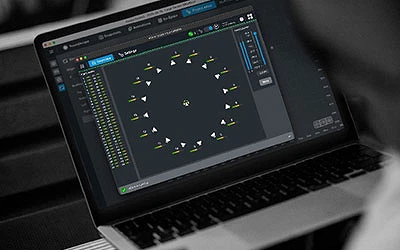
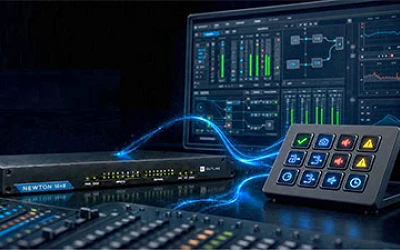
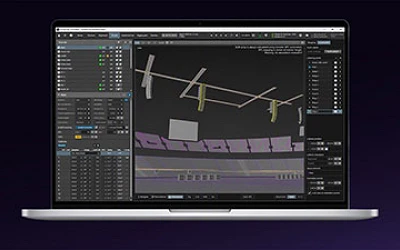
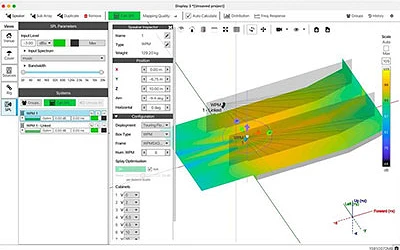
Spatial Audio specialist TiMax has launched TiMax panLab v1.4, bringing new ADM-WAV playback capabilities and workflow enhancements, and introducing a new pricing structure.
TiMax panLab v1.4 enables users to play back and render audio files that contain Audio Definition Model (ADM) metadata, allowing immersive mixes created in studio environments to be imported directly into a TiMax spatial playback workflow. The software supports playback of WAV, AIF, AIFF and CAF audio files through any connected soundcard, while rendering ADM object position metadata directly to TiMax panLab Sources for output to mixing consoles, system processors or TiMax rendering platforms.
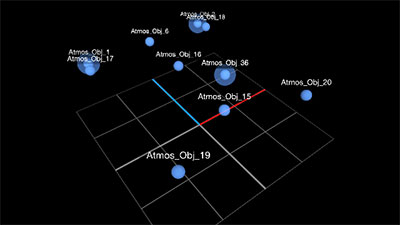 ‘The ability to read and re-render ADM WAV files unlocks a professional pipeline from studio to stage,’ says TiMax Product and Software Manager, Dan Higgott. ‘This integration allows sound designers to mix in Dolby Atmos in the studio and directly translate their creative intent to any live event loudspeaker system. This is game changing in the immersive production space, and I am excited to see how our customers take advantage of this new possibility.’
The capabilities available in v1.4 significantly simplify the traditional workflow for immersive content delivery. Previously, spatial productions often required producers and sound designers to export audio in multiple stems, after which system operators would recreate object positioning and movement within the playback system.
With ADM-WAV support in TiMax panLab, the full creative intent, including audio objects, position automation and track metadata, can be preserved in a single file and rendered directly within the TiMax environment. This enables smoother collaboration between content creators and playback engineers, allowing immersive audio production pipelines to mirror the efficiency and clarity often seen in video workflows.
‘This feature builds upon an exciting year of integration developments in the TiMax ecosystem, with Solid State Logic, Atlas Show Control, Grapes 3D and Spat AI all launching one click integration with TiMax2 Software. Our support for the ADM-OSC standard has added support for products from Yamaha, Sound Particles, QLab and many more.’
TiMax panLab v1.4. also introduces several usability improvements designed to streamline set-up and operation. Users can now connect or disconnect from mixing consoles and system processors via OSC, while the software automatically reopens the last project file when launched. The ability to create multiple Sources simultaneously and add them directly to the 3D panner significantly speeds up file set-up, while batch editing within the Source Manager allows parameters to be adjusted across multiple Sources at once.
Visualisation of spatial Zones has also been improved, offering clearer and more accurate indication of overlaps within the panner interface, and OSC handling has been optimised for smoother positional updates during snapshots, sequences and animated playback.
Alongside the software update, TiMax has also introduced lower pricing across the TiMax panLab range, making the platform more accessible to a broader community of spatial audio practitioners. ‘This revised pricing reflects the ongoing commitment of TiMax to creative professionals, enabling the exploration and deployment of spatial audio workflows across live performance, immersive installations, themed environments and experiential events.’