Independent Eurorack module and audio plug-in developer Modbap has announced Wax Theory, a record emulation effect for music producers and beatmakers.
Wax Theory places the needle at the centre of the creative process. A Side control emulates moving the stylus across the record from the lead-in at the outer edge toward the run-out near the label. As groove speed falls, tracing distortion, surface noise, wow and bandwidth change, inviting musicians and producers to find the character of a record by ear.
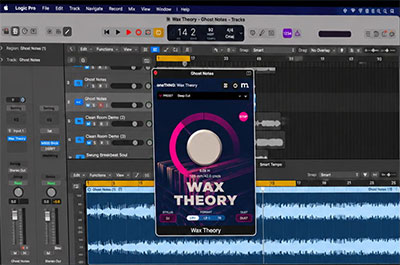 ‘A record has a whole life across one side, and where you drop the needle, what type of needle, vinyl noise, what format of vinyl – LP, 45, 78 – it all influences what you hear,’ says Corry Banks, founder of Modbap.
‘With Wax Theory, we wanted to make that relationship something you could play. You can find a clean outer groove, move into a worn part of the side, change the stylus or bring the platter to a stop. The character comes from how those parts work together, and one control lets you explore it without losing the idea you started with.’
The Side control sweeps from the lead-in (fully anticlockwise) to the run-out (fully clockwise). Across an LP side, groove speed drops from roughly 51cm/s to 21cm/s. Turn inward and tracing distortion climbs, wobble deepens and the top end closes down, while surface noise increases when Dust is enabled. Live readouts show time into the side, groove radius and the linear velocity under the stylus.
The Format control switches between three playback models: a 12-inch, 33⅓rpm LP, a 7-inch, 45rpm single and a 10-inch, 78rpm shellac record. Each behaves differently. The 78 has narrower bandwidth, a busier surface and a speed error that is unique to each instance.
Stylus sets the pickup that reads the groove. Hi-fi is the cleanest, with the widest bandwidth. DJ uses a larger conical profile, which adds tracing distortion and a presence lift and rolls off the top end. Worn adds the rasp of a flattened tip, audible even in quiet passages, with tighter low end. Dust adds a surface bed, clustered ticks, a scratch pop once per revolution and bearing rumble, all read by the cartridge alongside the music.
The Stop control simulates braking the platter according to the selected record format. When activated, pitch drops, wobble slows and the top end collapses until playback stops. Switch Stop off and the platter spins back up, bringing incoming audio back to pitch. Stop is latching and automatable, and smoothed knob changes and crossfaded switching keep performance moves clean across the panel.
Every instance gets its own repeatable pressing, including its dust pattern, warp phase and 78 speed error, and it is saved with the session. The interface scales from 75 to 200 per cent. There are 25 factory presets across five categories, plus Locker, Favs and Drops for organising sounds.