Yamaha has announced V2.0 firmware and related software updates for its DM7 series of digital mixing consoles, supporting the new DM5 and DM5 consoles, along with the RUio1608SB-D, RUio0804-D and RUio16FLX-D utility I/O units, and the existing Yamaha DME5, DME3 and Nexo DME10 signal processors.
The DM7 series and new DM5 series share the same operating philosophy and workflow, maintaining a familiar user experience between the two platforms. Firmware V2.0 strengthens this by allowing both platforms to share compatible console files, supporting straightforward use of systems of different sizes while preserving show data and operating workflows.
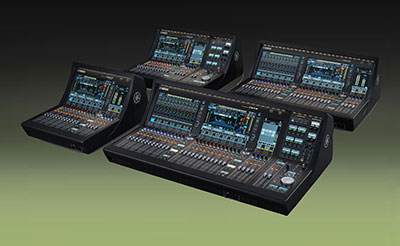 The software ecosystem has also been unified between the two console series. DM7 StageMix has been updated as DM StageMix, extending support to both DM7 and DM5 series consoles within the same application. A new DM Editor application has also been introduced, providing a common editing environment across the two families, enabling smoother transitions between systems.
DM7 firmware V2.0 introduces multiple workflow enhancements, designed to improve day-to-day operation and simplify console configuration. A Dynamic Mode has been added to the user-defined rotary controls, allowing these to automatically adapt to the currently selected processing section when the selected channel view is displayed. Selecting EQ instantly assigns EQ parameters to the controls, while selecting Dynamics automatically assigns dynamics parameters, providing faster access to frequently adjusted settings.
A Selected Channel View Mode option has also been added – when Channel is selected, commonly used Selected Channel parameters are directly accessible via the screen parameter control area and screen encoders, providing faster access to frequently adjusted settings. Users can also select Module, which replicates the channel encoder behaviour of firmware versions prior to V2.0. Both Channel and Module options are available in the preferences, allowing users to choose the workflow that best suits their operating style.
The preferences have also been updated to include a new Home Key Behavior option, allowing users to choose whether pressing the Home key displays the Selected Channel View, the Overview screen or toggling between each view.
The FX Rack has been enhanced with a refreshed GUI that offers a more intuitive, visually engaging environment. This streamlines parameter access and control, helping engineers to work more efficiently while encouraging greater creativity during mixing. For system configuration and show preparation, a Channel Move function has also been added, allowing channels to be reorganised more efficiently when building console data.
The CH JOB menu now includes a new With Sends option; engineers can choose to copy send parameters associated with the destination buses, helping to preserve routing and mix relationships during console set-up.
Operation in Sends on Fader mode has also been refined. When Pan/Bal is selected in encoder mode, entering Sends on Fader mode now automatically assigns the screen encoders to control the pan/balance of the currently selected send bus, enabling faster and more intuitive monitor and mix adjustments without interrupting the user’s workflow.
Patching has also been enhanced with the addition of a Take From Channel option, allowing users to change input patch assignments while maintaining existing head amp settings. This makes system modifications quicker and safer, especially in complex Dante environments.
Tto provide clearer identification of Dante devices and connections, patch buttons within the patch menu now display the Dante port ID and port label, making it easier to identify and select networked audio sources and destinations.
The new DM7 firmware also adds support for a wider range of third-party, Dante-enabled devices, allowing users to more easily integrate Yamaha and other audio devices into a system by providing greater visibility, enhanced monitoring convenience and control across the entire audio network from the mixer. The Dante supported device list now includes Stagetec Nexus (XDIP/Nexus Compact), DirectOut Dante.IO / Dante.IO DNA, Audio-Technica ATW-DR3240DAN and Shure SLXD4+/SLXD4D+ wireless microphone receivers.
Firmware V2.0 also introduces Comp Assist, a new addition to Yamaha’s growing family of assistive mixing tools, which suggests appropriate compressor settings based on the signal level, helping engineers to control and balance dynamics while establishing an effective starting point for their mixes. In addition, Fader Assist has been refined to optimize overall mix levels, minimizing level changes when Assist is applied.
‘The DM7 Firmware V2.0 makes the DM7 series even more powerful through support for our new DM5 series digital mixers and the addition of numerous workflow enhancements,’ says Yamaha Professional Solutions Division Senior General Manager, Motome Tanaka. ‘The DM7 series is already trusted by a wide range of audio professionals around the world, and now offers even greater flexibility for connecting with other devices and creating smoother, more comfortable workflows. We believe these enhancements will help our customers to deliver the exceptional sound experiences their audiences expect, making the DM7 series an even stronger partner for every production.’
More: www.yamaha.com