Cohesion has launched its proprietary simulation software, Canvas. As part of the growing Cohesion ecosystem, Canvas offers users a wide array of features beneficial to Cohesion system design.
‘With Canvas, we wanted to create a way for system engineers and all users of Cohesion systems to continually refine their craft of designing and working with Cohesion systems. This was something they did not have until today,’ says Lead Product Manager Rob Kosman. ‘Canvas provides an environment that is familiar and contains the same workflows and toolsets that they have in the real world to design, simulate, and optimise Cohesion systems.’
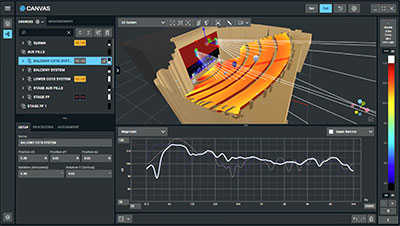 Canvas was designed and rigorously field-tested through Cohesion’s access to engineers from dozens of the world’s top-grossing global tours and leading permanent installations. Feedback provided from these industry veterans, as well as years of correlation between Canvas-simulated data and on-site field data, directly helped make Canvas powerful yet accessible.
Users can provide ‘a compelling level of realism’ through importing CAD elements that represent building architecture or event production. ‘Canvas has become more than a simulation platform, it’s also a common language for articulating the nuance and details of Cohesion systems between professional audio engineers and their production, integration, and creative design teams,’ explains Lead Application Engineer, Touring, Dave Shatto. ‘Canvas integrates easily with the industry’s common design platforms, so it is an ideal reference.’
‘Modeling in Canvas is a conversation starter,’ Kosman adds. ‘It enables collaboration.’
An engineer may develop, test and refine a design before setting foot inside a venue, adding confidence in deployment: ‘Because the acoustical engine and toolsets are so closely correlated to the real world, we’re able to detail the calibration workflow for a particular design in a particular room down to mic location and analytic interpretation,’ Shatto says.
In addition to coverage mapping, essential toolsets include time arrival, phase response, SPL over distance, and magnitude response, among others, for optimised design, effective pre-calibration, and detailed simulations of Cohesion systems.
Canvas has a user interface familiar to those who have designed and calibrated professional audio systems, and also encourages customisation, allowing use of either predetermined views or an interface tailored and saved to preference.
Much of the power behind Canvas is its Mechanical Acoustic Calculation Engine, or MACE, which provides expedient rendering of coverage maps and analysis. Complex, precise calculations with MACE occur near instantaneously without sacrificing performance. ‘The real power of Canvas is this acoustical engine,’ Shatto says. ‘We spent a lot of development time creating an engine that behaves identically to how we experience and analyze acoustical performance in-venue.’
Canvas is now available to download free of charge for PC and Mac users.
More: cohesionaudio.com